

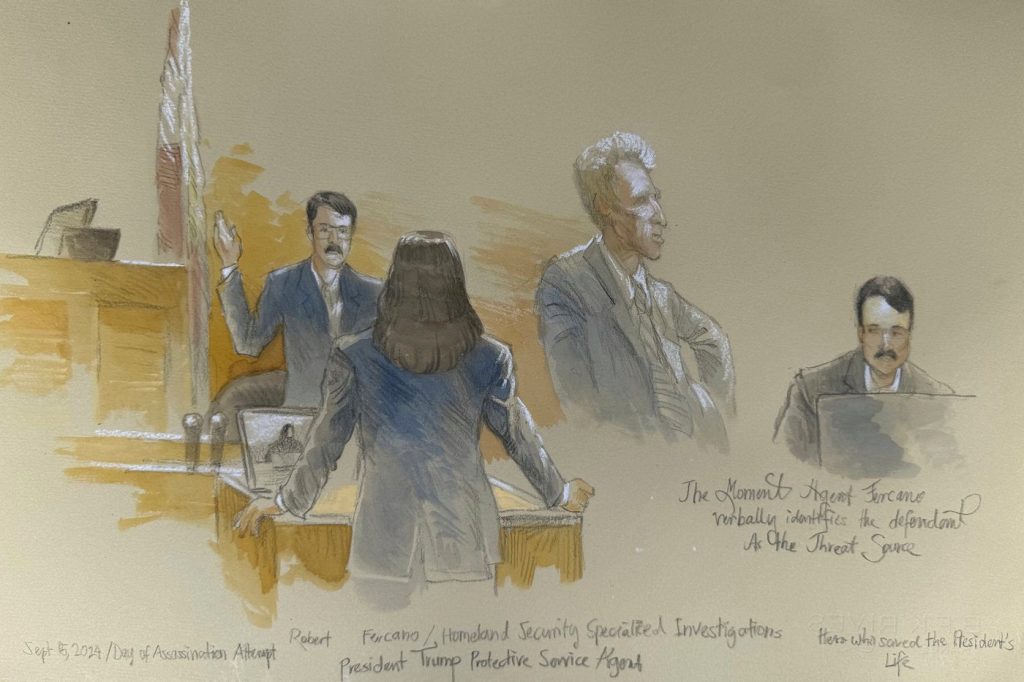
FORT PIERCE, Fla. (AP) – In a chilling case of alleged attempted assassination, Ryan Routh has been identified as the individual who tried to kill former President Donald Trump at his golf course in Florida. According to phone records, Routh sent heartfelt messages to his three adult children and his fiancée, professing his love shortly before a U.S. Secret Service agent recognized him. This recognition occurred just before Routh allegedly aimed a rifle at Trump while the former president was on the course on September 15, 2024.
Following his arrest, Routh called his fiancée from the Palm Beach County jail, only to discover that she was already aware of his situation. On the call, she stated, "Everybody knows, it's been hours," indicating the rapid dissemination of news about the assassination attempt. Routh is currently representing himself in federal court, facing multiple charges including attempting to assassinate a major presidential candidate, assaulting a federal officer, and various firearm violations.
During the trial, which has seen seasoned prosecutors from the U.S. Attorney's Office for the Southern District of Florida, Routh has indicated he will call only three witnesses to present his defense. The prosecution rested its case on Friday after a week of questioning 38 witnesses, emphasizing their determination to secure a life sentence for Routh. Prosecutors maintain that Routh had been plotting the assassination for weeks prior to the incident, creating a tense atmosphere in the courtroom.
U.S. District Court Judge Aileen Cannon allowed Routh to waive his right to legal representation after two hearings in July, where he argued that his court-appointed public defenders did not believe in him and were fearful of his character. This self-representation right is supported by a U.S. Supreme Court ruling, provided defendants can demonstrate their competency. Routh's former attorneys have taken on the role of standby counsel during the trial.
As the trial progresses, Judge Cannon has scheduled closing arguments for both sides, allocating one hour and 45 minutes each. Initially, the trial was expected to run for over three weeks; however, Routh's concise cross-examinations have accelerated the proceedings. A Secret Service agent testified last week about the moments leading up to the alleged attack, describing how he spotted Routh aiming his rifle before Trump was visible on the course. This prompted the agent to fire upon Routh, leading him to drop his weapon and flee the scene without discharging any shots.
Law enforcement was able to locate Routh with assistance from a witness who reported seeing someone running away as gunfire echoed in the area. This witness was subsequently transported via police helicopter to a nearby interstate, where Routh was apprehended and positively identified as the fleeing individual. Notably, this attempted assassination follows a similar incident where Trump survived a shooting while campaigning in Pennsylvania, just nine weeks earlier, underscoring the ongoing threats to his safety.
Routh's history paints a troubling picture. Originally from North Carolina, he had worked as a construction worker and had spent some time in Hawaii. Described as a self-styled mercenary leader, he reportedly shared violent ambitions and attempted to recruit soldiers to engage in global conflicts, particularly in the early stages of the war in Ukraine. His criminal history dates back to 2002 when he was arrested for evading a traffic stop armed with an automatic machine gun and what authorities labeled a "weapon of mass destruction." Additionally, in 2010, police discovered more than 100 stolen items in a warehouse he owned, yet he received lenient sentences in both felony cases.
Beyond federal charges, Routh has pleaded not guilty to state charges of terrorism and attempted murder, further complicating his extensive legal troubles. As the trial unfolds in Fort Pierce, the focus remains on the gravity of his actions and their implications for national security.








