

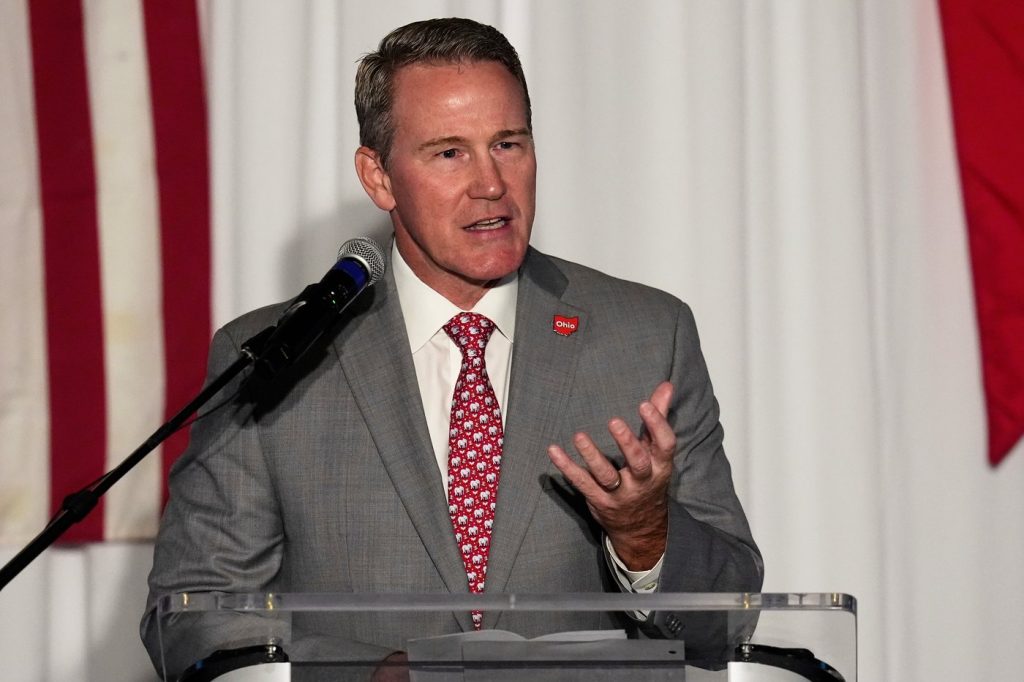
COLUMBUS, Ohio — The political landscape in Ohio is heating up as Sen. Jon Husted watched Vivek Ramaswamy energize a packed crowd, making his case for the governorship. Husted, who originally intended to run for governor, experienced a dramatic shift in his political trajectory when Gov. Mike DeWine appointed him to the U.S. Senate seat vacated by Vice President JD Vance in January. This unexpected turn propelled Husted from a low-profile role to a significant Senate position.
As Husted prepares to defend his Senate seat, the stakes are high with national ramifications. The Democratic Party has rallied behind Sherrod Brown, a well-known figure in Ohio politics, immediately transforming the race into a competitive one. Brown is seen as a key candidate, potentially enabling the Democrats to take ground in the Senate, albeit under challenging conditions due to the 2026 electoral map.
Husted is banking on his personal narrative, extensive political experience, and alignment with former President Donald Trump to maintain the GOP's successes in Ohio. However, he faces a formidable challenge as Trump's absence from the ballot could lower Republican voter enthusiasm. “We have a Republican Party that is winning in Ohio,” Husted declared, but added there are “no guarantees.”
Husted’s life story begins just outside of Detroit where he spent time in foster care before being adopted. He grew up in rural Ohio, excelling as an All-American football player at the University of Dayton. His political career kicked off when he was elected to the Ohio House of Representatives in his early thirties, leading to roles such as House Speaker, state senator, and secretary of state. In addition to serving as DeWine's running mate in 2018, Husted had planned to seek the governorship but had to pivot following the Senate appointment.
DeWine's choice of Husted over Ramaswamy—whom Trump had suggested for the Senate seat—underscores Husted's standing within the Ohio GOP. Despite having only served in the Senate for a short time, Husted has participated in a closely divided chamber exhibiting significant contention. He has worked to promote legislation seen as beneficial for working-class families, despite criticism from Democrats regarding its impact on health care funding.
Husted’s public demeanor contrasts sharply with Ramaswamy’s more bombastic style, as seen during their joint endorsement event. While Ramaswamy left swiftly amid questions from reporters, Husted engaged with supporters, reflecting their different campaign approaches. Many Republicans anticipate a landslide victory for Ramaswamy, while Husted braces for a more challenging path against Brown, who has deep roots in Ohio politics.
Brown, having served 32 years in Congress—including 18 years in the Senate—lost his seat last year to Republican Bernie Moreno by a narrow margin. The victory was notable as Moreno benefited from Trump's strong showing in the state. With Trump off the ballot in 2026, Democrats see a potential opportunity for Brown to reclaim his Senate seat, especially considering historical midterm dynamics that tend to favor the non-ruling party.
Notably, Democrats plan to leverage Husted’s unresolved ties to a major corruption scandal in Ohio as a campaign issue, despite Husted not facing any accusations of wrongdoing. The upcoming election cycle is projected to be highly costly, with previous races in Ohio reaching upwards of $500 million, reflecting the significant financial stakes involved.
In terms of fundraising, Husted reported raising over $3 million with $2.6 million in cash on hand, while Brown raised $3.6 million within the first day of his campaign launch. With the Republican Party currently dominating Ohio's political landscape—holding both Senate seats, the governor’s office, and both chambers of the state legislature—the upcoming election could serve as a pivotal test of the Democratic Party's ability to reconnect with essential voting blocs in the state.
As they rallied before a supportive crowd, it was clear that Ohio Republicans understood the thin margins that could dictate the election's outcome. Even if Husted wins, he will still need to contend for a full six-year term in 2028, a challenge he embraces with confidence, stating, “I’ve done a lot tougher things in my life than that.”








