

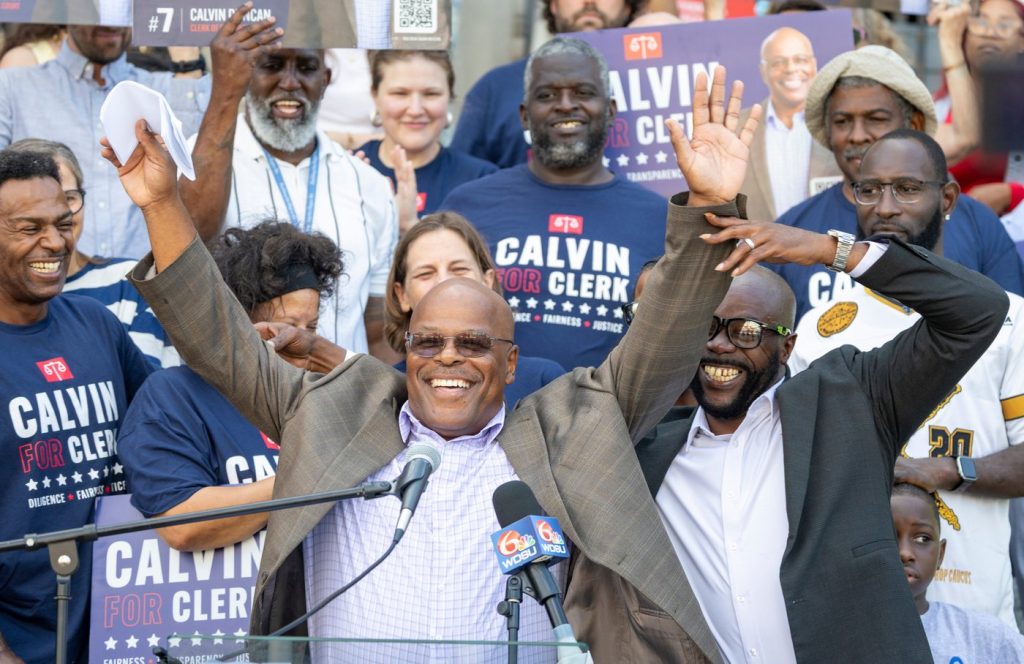
NEW ORLEANS (AP) – A heated down-ballot race for the position of clerk of criminal court in New Orleans has taken a personal turn as candidate Calvin Duncan faces scrutiny over his past. After serving three decades in prison, Duncan's murder conviction was vacated in 2021, but Louisiana's attorney general and the incumbent clerk have cast doubt on his claims of exoneration.
Duncan, 62, is running for the position of chief criminal recordkeeper in New Orleans, a role he sees as deeply personal given his struggles to access legal documents during his imprisonment. "I don’t never want to have what happened to me happen to nobody else," Duncan stated, emphasizing his commitment to preventing similar injustices. His case is recognized in the National Registry of Exonerations, alongside notable figures like Yousef Salaam, a member of the "Central Park Five" and current New York City councilmember.
The race has been marked by controversy, particularly around the interpretation of the term "exoneration." Both Louisiana Attorney General Liz Murrill and incumbent clerk Darren Lombard have publicly denied Duncan's innocence, citing a 2011 plea deal for manslaughter and armed robbery that Duncan claims he accepted merely to achieve his release from prison. Lombard has denounced Duncan as a murderer in various campaign settings, including televised debates and media appearances.
Duncan, who is running as a Democrat, argues that his opponents are misleading voters to undermine his candidacy. His supporters believe that the aggressive campaign tactics reflect the political climate in New Orleans, which is brimming with candidates vying for the position of mayor, currently held by LaToya Cantrell, who recently pleaded not guilty to corruption charges.
Jessica Paredes, the executive director of the exoneration registry, supports Duncan's position, stating that there should be no ambiguity regarding his case's place among the over 3,700 documented exonerations since 1989. According to Paredes, "We err conservatively to maintain the integrity of the database," asserting that Duncan's case clearly meets their criteria for inclusion.
Duncan's legal journey led him to uncover new evidence of his innocence related to a 1981 fatal shooting, which included testimony indicating that police officers had lied during his initial trial. A judge ultimately vacated his conviction based on "factual innocence," resulting in the dismissal of all charges against him. While there is no universal legal definition of exoneration, the registry defines it as the official clearance of a convicted individual when new evidence of innocence is presented.
While campaigning for office, Duncan's past has remained a focal point of controversy. Prior to his bid for clerk, he garnered attention for his legal acumen, which he developed during his time in prison. With only an eighth-grade education, he self-taught himself law, assisting fellow inmates in preparing court documents. His legal efforts have even led to significant changes in national law, including a landmark U.S. Supreme Court decision in 2020 that abolished non-unanimous jury convictions in Louisiana and Oregon.
The New Orleans criminal court system's challenges are still prevalent, as documented cases often encounter bureaucratic obstacles. Thousands of criminal files were lost during Hurricane Katrina, and a recent incident saw records mistakenly thrown away by the clerk's office, necessitating salvage efforts from a landfill. Lombard has promised a shift to a digital filing system within the year, but he questions Duncan's qualifications for the clerk position. In contrast, Duncan argues that his personal experiences give him a unique understanding of the office’s importance.
As Election Day approaches, with voters set to head to the polls on Saturday, the fierce rhetoric surrounding Duncan's candidacy illustrates the complexities of his past and the high stakes of the race.








