

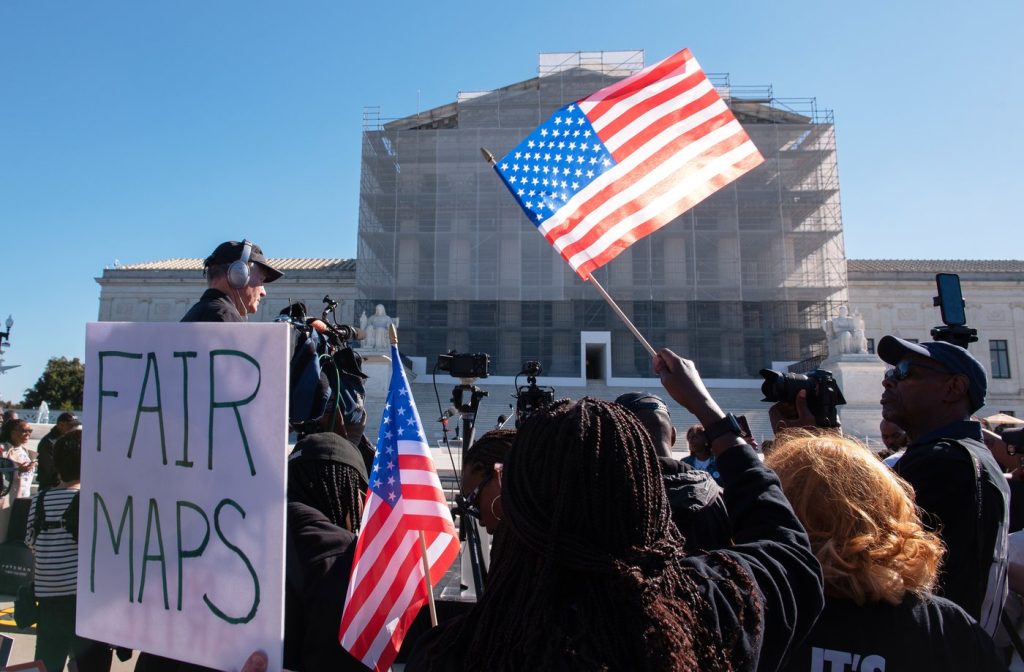
WASHINGTON — For decades, American politics has seen increasing diversity, with racial minority communities gradually gaining political representation after enduring long-standing legal disenfranchisement and violent discrimination. However, recent skepticism from some Supreme Court justices regarding a key provision of the Voting Rights Act of 1965 has raised concerns among Black lawmakers, civic leaders, and organizers. They fear the representation gains achieved over years of civil rights efforts could be reversed.
Justices heard oral arguments on Louisiana v. Callais, focusing on the constitutionality of Section 2 of the Voting Rights Act, which prohibits discrimination in voting systems. Representative Cleo Fields, whose Louisiana district is pivotal to the case, expressed hope that the consequences of any potential ruling would cause justices to reconsider weakening the law. Fields remarked, “If they do away with Section 2, they know the ripple effect that’s going to have all over this nation. It’s not just Congress.”
The Voting Rights Act has had significant effects on communities of color, banning discriminatory voting practices by state and local governments. Since its enactment, numerous minority lawmakers have gained representation, enabling them to effectively advocate for the interests of their constituents. State legislatures in the Deep South, which were once dominated by white supremacy, now include a substantial number of Black, Asian, and Latino lawmakers. The act was even amended to extend protections to language minorities, creating more inclusive political representation.
Lawmakers elected through Voting Rights Act-enabled districts have often emerged as vital voices within state legislatures and Congress, particularly within the Congressional Black Caucus. This organization has long served as a hub for Black political power in the U.S. Moreover, minority communities in areas previously subject to Voting Rights Act scrutiny have successfully elected a range of officials, from mayors to county commissioners, to lead many major cities.
Protestors, including Khadidah Stone, a plaintiff in a recent case involving Black Louisianans, gathered outside the Supreme Court, pointing out connections between current legal challenges and President Donald Trump’s calls to redraw congressional maps. Stone stated, “We’re back because it’s very evident what the current administration is trying to do when it comes to dismantling what we currently know as democracy.”
Concerns about reversing progress are echoed by other lawmakers. Representative Yvette Clarke, chair of the Congressional Black Caucus, described GOP-led redistricting in states like Texas as “blatant targeting” of Black lawmakers. She emphasized that the current case “could have an impact for generations to come.” Representative Troy Carter warned that a sweeping decision could lead to a “very weakened democracy,” asserting, “A representative form of government means it should look like its people.”
The Voting Rights Act is widely regarded as a landmark achievement of the Civil Rights movement, prohibiting discriminatory practices such as poll taxes and literacy tests, while also affirming citizens' constitutional voting rights. Some provisions of the act have been challenged or restricted in previous Supreme Court cases, leading advocates to caution that discriminatory practices have surged since the 2013 ruling in Shelby v. Holder. If Section 2 faces similar restrictions, it could significantly undermine Black representation.
During the oral arguments, justices from the conservative majority questioned the long-term implications of requiring governments to adopt race-conscious remedies for proven discrimination cases. Justice Brett Kavanaugh queried about the necessary time limits for such applications. However, the court's liberal justices argued that Section 2 serves as a necessary tool for addressing up and coming issues of discrimination without needing an imposed time limit, reflecting its role in safeguarding voting rights.
Representative Terri Sewell, an Alabama Democrat and a voice from a historically significant district, observed the proceedings and sensed a return of old battles. She noted the struggle for voting rights continues to be relevant as the legacy of the civil rights movement is currently under examination. However, she emphasized resilience, asserting, “Progress is elusive. The pendulum swings, and it doesn’t swing on its own.” Sewell reiterated the importance of maintaining a strong democracy for future generations.








