

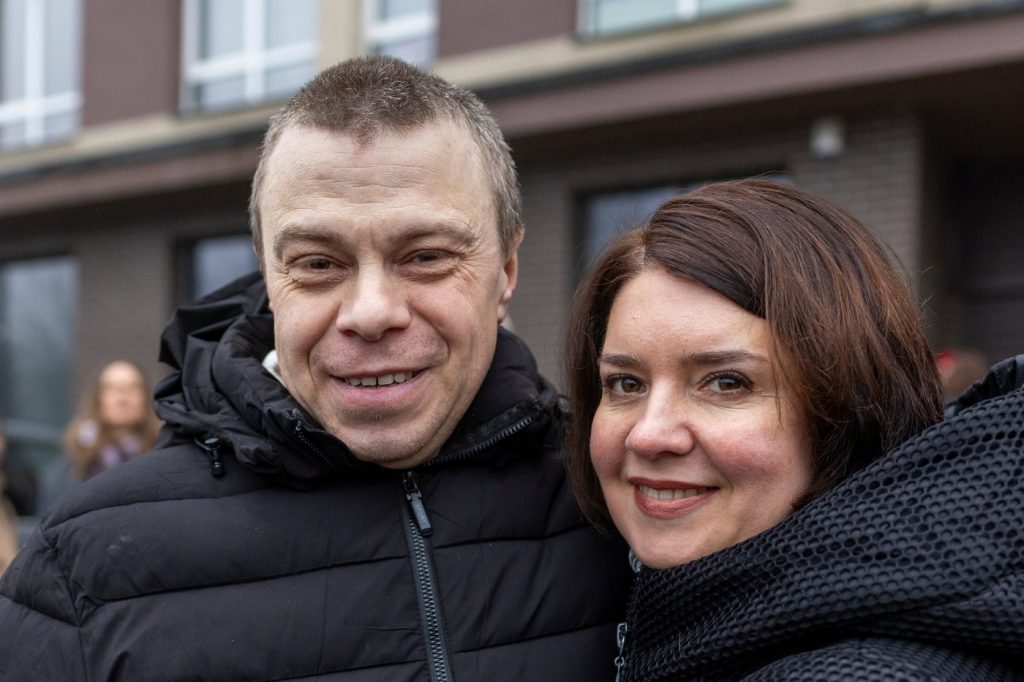
TALLINN, Estonia (AP) — Uladzimir Labkovich, a human rights advocate, was unexpectedly released from a Belarus prison after spending four and a half years behind bars. His only official identification upon release was a piece of paper displaying his name and mugshot. Labkovich expressed his discontent, stating, “After four and a half years of abuse in prison, I was thrown out of my own country without a passport or valid documents.” His release is part of a larger political maneuver involving the exchange of 123 prisoners for the U.S. reducing some sanctions against the Belarusian government of President Alexander Lukashenko.
On December 13, 2025, Labkovich was among many prisoners freed and taken to Ukraine, while others, including Nobel Peace Prize laureate Ales Bialiatski, were sent to Lithuania. President Lukashenko has ruled Belarus with an iron fist for over three decades, and despite recent releases, many have been subjected to inhumane treatment and forced deportation without proper documentation after being pardoned.
Labkovich, now 47, is one of many released prisoners who were not fully informed about their deportation status, forcing them to navigate life abroad under challenging circumstances. “I dream of hugging my three children and wife in Vilnius, but instead I have to deal with absurd bureaucratic procedures,” he lamented. Sviatlana Tsikhanouskaya, a prominent opposition leader, criticized the Belarusian government for what she calls a violation of international norms and human rights.
Many of the released prisoners, including Labkovich and fellow opposition figures Vitkar Babaryka and Maria Kolesnikova, were stripped of their identity documents. Human rights advocates reported that they suffered emotional and bureaucratic challenges as they attempted to rebuild their lives. Germany has extended support to Babaryka and Kolesnikova, but the overall situation remains dire for those released.
The issue extends beyond just the current released individuals. Belarus continues to repress opposition activists and critics, regardless of their location. Many Belarusians living abroad cannot renew their passports or obtain new ones, impacting their ability to live without barriers. The political landscape remains volatile, with recent arrests reinforcing a pattern where released prisoners can quickly find themselves back in a cycle of arrest and deportation.
In the past months, Belarus has witnessed both a rise in prisoner releases and an increase in re-arrests. Amnesty International has pointed out the continuing repression, stating that while releases provide a breather for some, they are often part of a broader strategy that treats prisoners merely as political pawns. Even with new pardons, the underlying policies have yet to shift, with Belarus ranked among nations with the highest number of political prisoners per capita.
Labkovich's horrific experience in prison included prolonged solitary confinement and physical mistreatment, revealing the brutal conditions that many prisoners faced during their incarceration. “I lost count of the nights on the concrete floor in the icy cell,” he recalled, painting a grim picture of life behind bars. Human rights officials have described the recent releases not as acts of clemency but rather forced exiles, stressing the inhumane actions taken by Belarusian authorities.
Overall, the situation in Belarus continues to evolve, with many political prisoners still behind bars, and the government maintaining a heavy-handed approach to dissent. The international community remains focused on the plight of the Belarusian people as activists and opposition leaders work tirelessly to advocate for fundamental human rights and freedoms within a repressive regime.








