

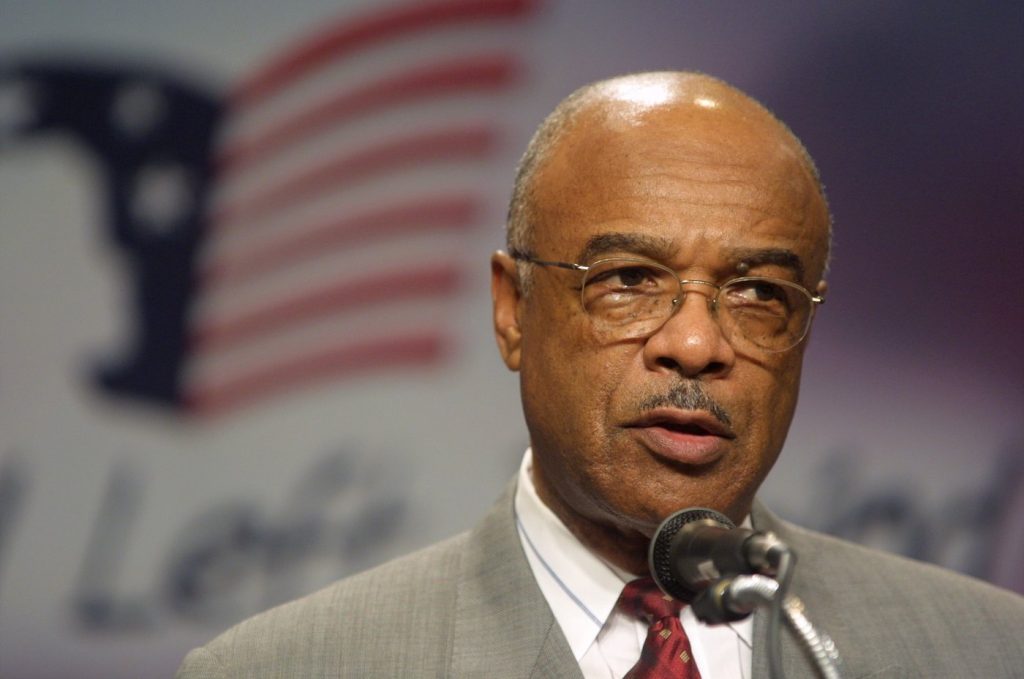
Rod Paige, a notable educator, coach, and administrator, passed away at the age of 92 on Tuesday. As the first African American to serve as U.S. Secretary of Education, Paige was instrumental in the rollout of the No Child Left Behind (NCLB) law, a significant education reform initiative in the United States. The announcement of his death was made by former President George W. Bush, who appointed Paige to the role in 2001.
Under Paige's leadership, the Department of Education implemented the NCLB policy, which became Bush's signature education law in 2002. This legislation was modeled after Paige's previous efforts as a superintendent in Houston, Texas. NCLB established universal testing standards for schools and imposed sanctions on those failing to meet specified benchmarks. Reflecting on Paige's legacy, Bush remarked, “Rod was a leader and a friend,” highlighting his commitment to challenging what he termed “the soft bigotry of low expectations.”
Born Roderick R. Paige in Monticello, Mississippi, a small town with a population of around 1,400, he was the oldest of five children in a family of educators. After serving two years in the U.S. Navy, Paige transitioned into coaching, eventually becoming the head football coach at Jackson State University, a historically black university. Notably, his team integrated Mississippi Veterans Memorial Stadium during a 1967 football game, a landmark event in the state's history.
In the mid-1970s, Paige moved to Houston to serve as head coach of Texas Southern University. However, he soon turned his focus toward education. Paige became a teacher, then an administrator, and ultimately the dean of the college of education from 1984 to 1994. His dedication to educational excellence gained widespread recognition, leading to his appointment as superintendent of the Houston Independent School District. There, he garnered attention for implementing educational reforms that emphasized stricter accountability measures regarding student outcomes, which became pivotal in Bush's 2000 presidential campaign.
As the Secretary of Education from 2001 to 2005, Paige placed a strong emphasis on the importance of high expectations for children's development. In a 2001 interview with the Washington Post, he expressed that the easiest approach would be to assign children menial tasks, but what was needed instead was to set high expectations and support them in achieving those goals.
While many educators praised NCLB for standardizing expectations for students regardless of race or income, critics argued that it led to an overwhelming reliance on testing and “teaching to the test.” By 2015, bipartisan lawmakers began to roll back many provisions of NCLB, leading to significant changes in federal involvement in education, particularly with respect to standardized testing and school sanctions.
Following his tenure as education secretary, Paige returned to Jackson State University in 2016, where he served as interim president at the age of 83. Even in his 90s, Paige remained an active voice in education reform, expressing concerns and optimism for the future of the U.S. education system. In a Houston Chronicle opinion piece in 2024, he urged the community to draw lessons from Houston’s educational history, advocating for innovative approaches to shake up stagnant systems.
Rod Paige’s legacy as an educator and policy maker reflects his commitment to improving education for all children, underscoring the transformative potential of high expectations and accountability in schools.








