

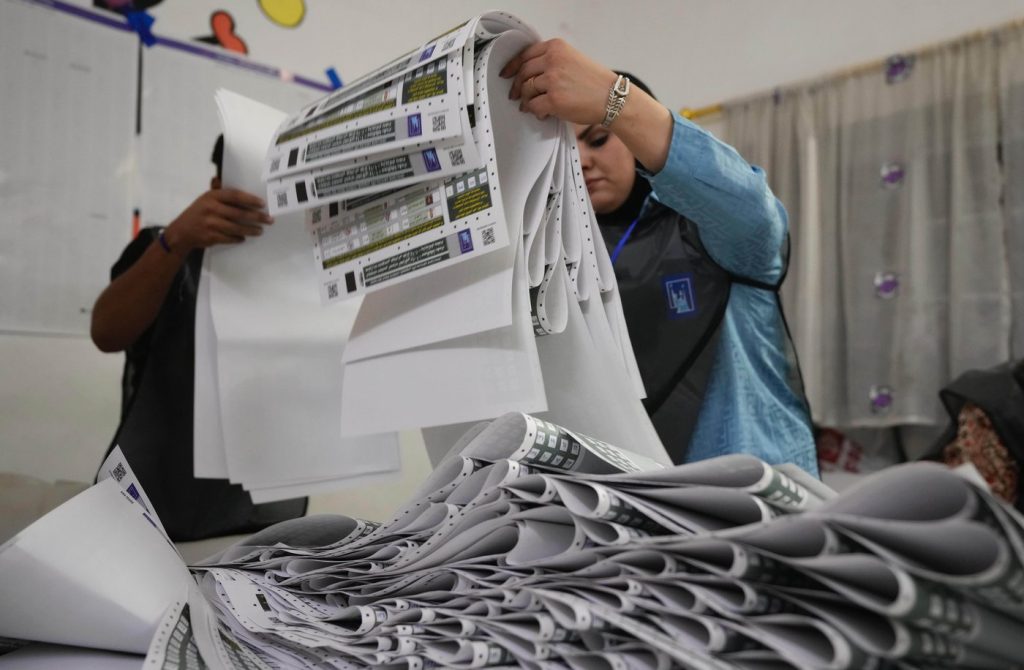
BAGHDAD (AP) – The Supreme Federal Court of Iraq ratified the results of last month’s parliamentary elections on Sunday, confirming that the party of caretaker Prime Minister Mohammed Shia al-Sudani secured the highest number of seats, although it fell short of the majority required for him to secure a second term. This decision affirmed the integrity of the electoral process, stating that it adhered to all constitutional and legal parameters without any significant irregularities.
The Independent High Electoral Commission presented the finalized legislative election results to the Supreme Federal Court on Monday for official endorsement, having addressed 853 complaints that were lodged concerning the voting results. Al-Sudani’s Reconstruction and Development Coalition obtained 46 out of 329 seats in the parliament, a significant number but not sufficient to independently control the government, as previous elections have shown that the largest bloc often struggles to appoint its preferred candidate.
The electoral landscape is marked by competition, as the coalition led by former Prime Minister Nouri al-Maliki garnered 29 seats, followed closely by the Sadiqoun Bloc, spearheaded by Qais al-Khazali of the Asaib Ahl al-Haq militia, which won 28 seats. The Kurdistan Democratic Party, headed by Masoud Barzani, one of the two primary Kurdish entities in Iraq, secured 27 seats, matching the Taqaddum (Progress) party, previously led by the ousted former Parliament Speaker Mohammed al-Halbousi. This tight race sets the stage for a contest over the significant speaker role within the parliament.
Traditionally, the political leadership structure in Iraq mandates that the Prime Minister be Shiite, the President a Kurd, and the Parliament Speaker a Sunni, ensuring a blend of representation among the country’s primary sects. In total, Shiite alliances and lists claimed 187 seats, while Sunni factions achieved 77 seats, and Kurdish groups accounted for 56 seats, alongside 9 seats reserved for minority representatives.
Al-Sudani first assumed office in 2022 with the backing of the Coordination Framework, a coalition composed primarily of Iran-affiliated Shiite parties. However, his prospects for reelection remain uncertain as it is unclear whether this coalition will rally behind him for a second term amidst shifting political dynamics. With no single bloc capable of governing independently, political leaders have initiated negotiations aimed at forming a stable ruling coalition to navigate the complexities of Iraq’s political landscape.
Martany reported from Irbil, Iraq.
Qassim Abdul-zahra And Stella Martany, The Associated Press








