

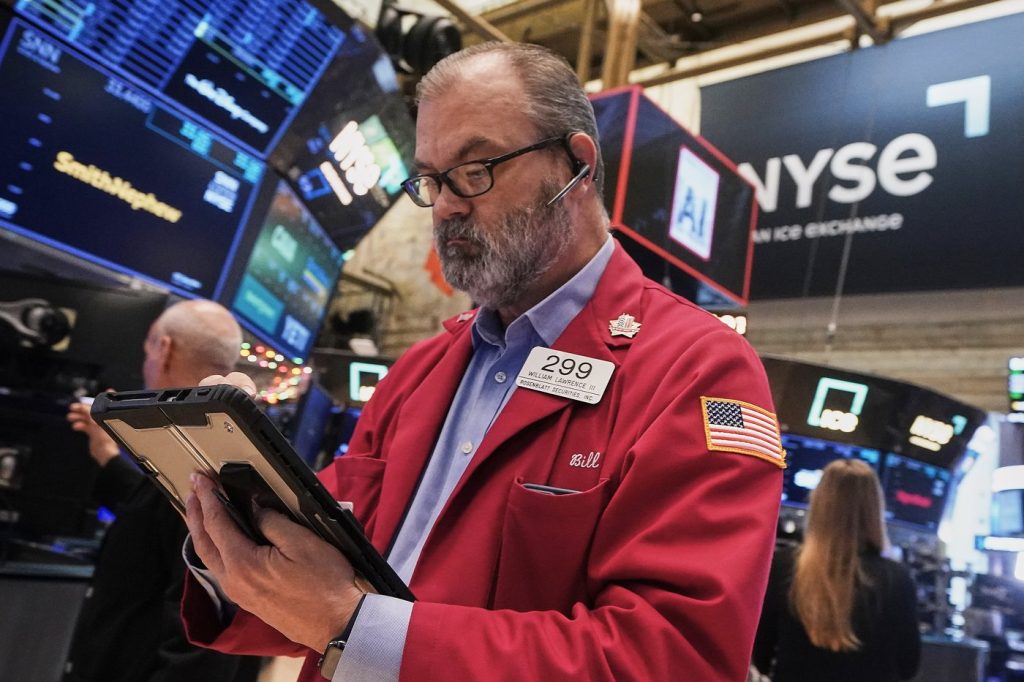
BANGKOK (AP) – Shares in Asia experienced a decline on Monday, triggered by a report from China indicating a drop in investment for November, which raised concerns about weak demand in the world's second-largest economy. This downturn followed a disappointing end to the previous week, where significant declines in popular artificial intelligence stocks caused Wall Street to retreat from record highs.
In Tokyo, the Nikkei 225 index fell by 1.5% to 50,092.10, as investors awaited the Bank of Japan's (BOJ) anticipated decision on raising its benchmark interest rate later this week. The BOJ's quarterly “tankan” survey, released on Monday, revealed a slight improvement in sentiment among major manufacturers, with the index of optimistic companies rising to 15 from 14, marking the highest level in four years. The index reflects the percentage of firms reporting favorable conditions against those experiencing negative conditions. Despite this uplift, outlook forecasts for the forthcoming quarter appeared less encouraging.
Japan's economy has shown signs of weakening, contracting at a 2.3% annual rate in the July-September quarter, marking the first decline in six quarters. An agreement between Japan and the U.S. concerning President Donald Trump’s elevated tariffs, which capped baseline import duties at 15%, has alleviated some uncertainties for large automakers and electronics firms. Analysts suggest the better-than-expected survey results may influence the BOJ to proceed with a rate hike of 0.25 percentage points, setting the key rate at 0.75%.
Meanwhile, South Korea’s Kospi index dropped 1.2% to 4,117.68, and in Hong Kong, the Hang Seng Index decreased by 0.7% to 25,786.45. Conversely, the Shanghai Composite index saw a small increase of 0.1%, closing at 3,892.45. Investment in China was reported to have decreased by 2.6% in November compared to a year earlier, indicating an overall decline of 11.1% in fixed asset investment for the first eleven months of the year. The Chinese government reported a 4% rise in retail sales and a 4.8% increase in factory output during January-November.
This data comes in the wake of a recent high-level meeting among China’s Communist Party officials that did not result in any significant policy changes, but continued to emphasize efforts to boost consumer spending and necessary investments to stimulate domestic demand. Zichun Huang from Capital Economics commented that while policy support may facilitate a partial recovery in the coming months, it is unlikely to prevent China's overall growth from remaining subdued throughout 2026.
In other developments across the region, Australia’s S&P/ASX 200 index slipped 0.7% to 8,640.60, while Taiwan's benchmark index saw a decline of 1.1%. On the futures market, contracts for the S&P 500 and Dow Jones Industrial Average were up by 0.3% early Monday.
On the previous Friday, the S&P 500 index fell by 1.1% from its all-time high, recording its worst day in three weeks and closing at 6,827.41. The Nasdaq composite index, primarily driven by tech stocks, saw a significant drop of 1.7%, concluding at 23,195.17. The Dow Jones Industrial Average decreased by 0.5%, settling at 48,458.05. The AI technology giant Broadcom significantly impacted the market by plummeting 11.4%, despite announcing stronger-than-expected quarterly profits. The performance was described by analysts as solid, with CEO Hock Tan attributing substantial 74% growth in AI semiconductor revenue as a key driver.
This downturn raised concerns regarding the sustainability of the AI boom, which had been highlighted the previous day when Oracle also experienced a steep decline of nearly 11%, despite posting larger quarterly profits than analysts had projected. Chipmakers Nvidia fell by 3.3%, while Oracle witnessed an additional drop of 4.5%. On Friday, stocks from companies reliant on consumer spending in the U.S. displayed relatively strong performance, with two out of every five stocks within the S&P 500 gaining ground. A drop in oil prices during the week also suggested potential relief for consumers.
In early trading on Monday, U.S. benchmark crude oil increased by 30 cents to $57.74 per barrel, with Brent crude, the international standard, rising by 29 cents to $61.41 per barrel. The U.S. dollar exchanged for 155.37 Japanese yen, down from 155.75 yen late Friday, while the euro remained steady at $1.1739.








