

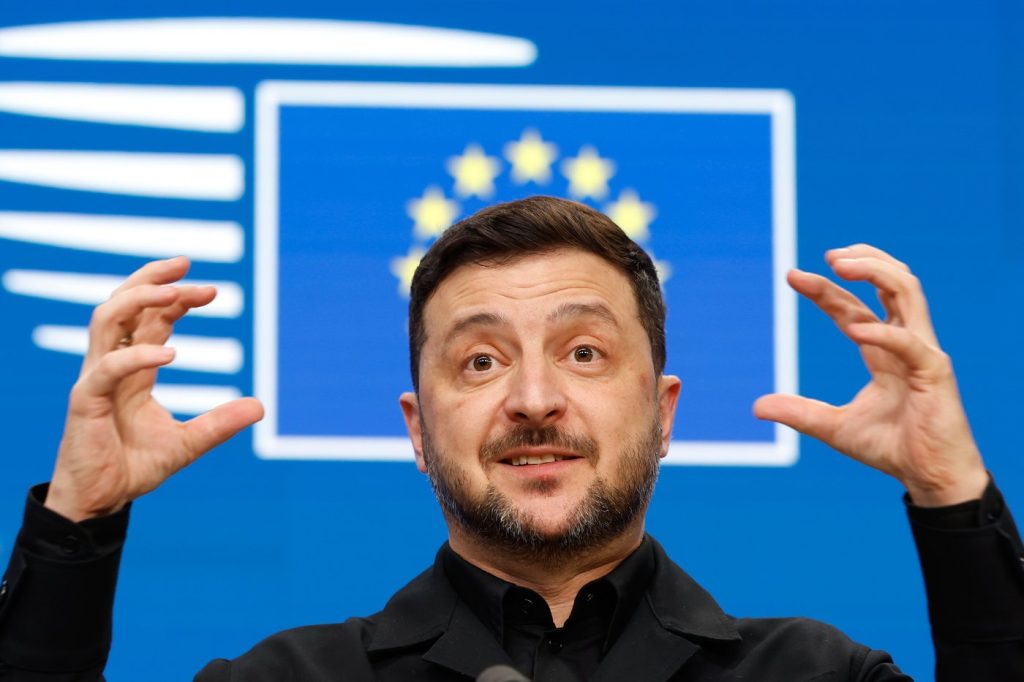
KYIV, Ukraine (AP) — The United States and Ukraine have reached a preliminary consensus on several significant issues in an effort to resolve the nearly four-year conflict with Russia. However, sensitive topics, particularly regarding territorial control in Ukraine's eastern regions and the management of the Zaporizhzhia nuclear power plant, remain unresolved, as stated by Ukrainian President Volodymyr Zelenskyy.
During a press briefing, Zelenskyy detailed a 20-point plan that emerged from extensive discussions held in Florida in recent days. The plan has been shared with Russian negotiators, and a response from Moscow is expected on Wednesday. Zelenskyy emphasized that the draft proposal aligns closely with Ukraine's interests, intertwining political and commercial motives to enhance security while promoting economic growth.
Central to the ongoing negotiations is the contentious territorial dispute involving the Donetsk and Luhansk regions, collectively known as the Donbas. Zelenskyy acknowledged this as "the most difficult point," indicating that these issues will be discussed at leadership level. Russia maintains maximalist demands, insisting that Ukraine must relinquish the territories it still controls in the Donbas, a stance that Ukraine has firmly rejected. Currently, Russia occupies most of Luhansk and approximately 70% of Donetsk.
In an attempt to facilitate a compromise, the United States has suggested transforming the contested areas into free economic zones. Ukraine, however, insists that any such arrangement should be subject to a referendum that allows the Ukrainian populace to determine their future. Zelenskyy stated that Ukraine seeks demilitarization in the region and the deployment of an international force to maintain stability.
Another contentious issue is the management of the Zaporizhzhia nuclear power plant, Europe's largest, currently under Russian occupation. The U.S. has proposed forming a consortium with equal stakes for Ukraine and Russia in the plant's management. In contrast, Zelenskyy has countered with a proposal for a joint venture between the U.S. and Ukraine, where the allocation of profits would be determined primarily by the Americans, likely sidelining Russia.
Zelenskyy noted, "We did not reach a consensus with the American side on the territory of the Donetsk region and on the ZNPP," referring to the nuclear plant. Despite these disagreements, he expressed that most positions have seen significant alignment. "In principle, all other consensus in this agreement has been found between us and them," he added.
The plan outlines that the contact line cutting across five Ukrainian regions should be frozen once the agreement is signed. Zelenskyy remarked on the difficulties of any arrangement regarding a free economic zone, emphasizing that it needs to be ratified by a referendum to ensure the decision-making power remains with the Ukrainian people. This would necessitate a 60-day period of peace to allow for the referendum process.
The draft also stipulates that Russian forces are to withdraw from regions such as Dnipropetrovsk, Mykolaiv, Sumy, and Kharkiv, with international forces monitoring the implementation along the contact line. Zelenskyy stressed the importance of these forces to prevent any covert entry by Russian military personnel disguised as civilians.
On the management of the Zaporizhzhia plant, Ukraine has proposed that the city of Enerhodar, associated with the plant, become a demilitarized free economic zone. This point emerged after significant discussions with the U.S., illustrating the complexities of the negotiations. While the U.S. has proposed joint management of the plant, Zelenskyy argued that the idea of collaborating with Russia in this context is unrealistic for Ukraine.
The draft agreement also ensures robust security guarantees for Ukraine, akin to NATO's Article 5, compelling Ukraine's allies to respond in case of renewed Russian aggression. There is mention of a separate bilateral document to delineate these security guarantees and a mechanism for monitoring the ceasefire using satellite technology and early warning systems.
Moreover, the draft includes provisions for maintaining Ukraine's military strength at 800,000 during peacetime and outlines a pathway for EU accession. Zelenskyy highlighted plans to accelerate a free trade agreement with the U.S. post-signing, while also seeking privileged access to European markets and funding for reconstruction efforts in war-torn regions.
The proposal articulates a goal of attracting $800 billion through a blend of equity, grants, loans, and private sector investments to address broad economic interests. Additionally, it mandates that Ukraine hold elections following the agreement and calls for the release of all prisoners since 2014, including civilian detainees and political prisoners.








