

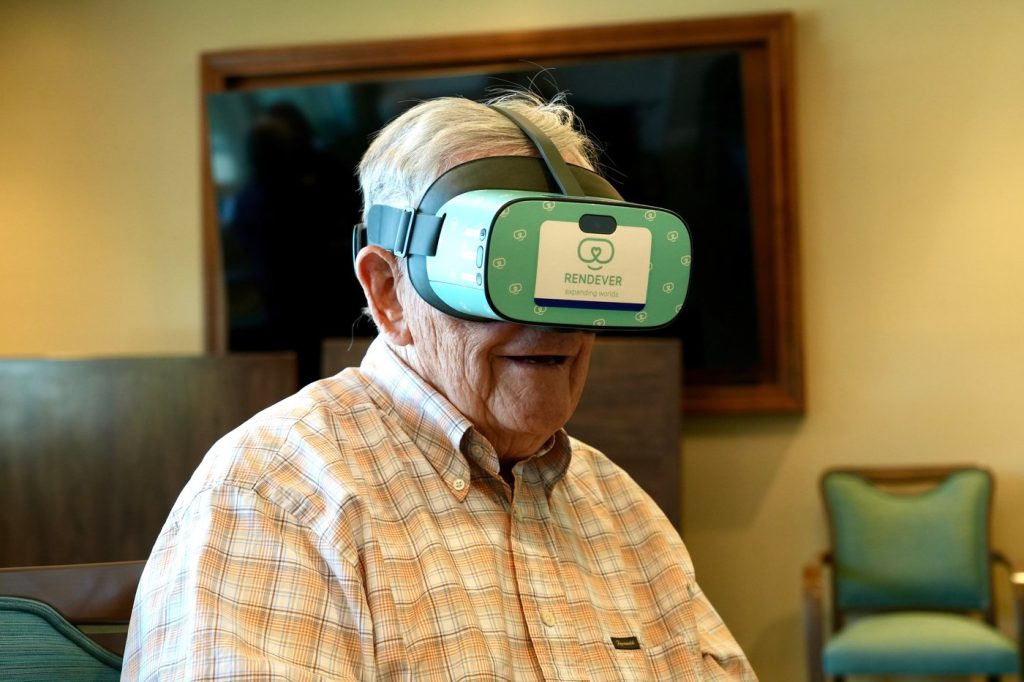
LOS GATOS, Calif. — The Terraces, a retirement community in Los Gatos, California, offers its elderly residents a unique opportunity to experience adventure and exploration through the use of virtual reality (VR) technology. Many of the residents, who are in their 80s and 90s, find it challenging to travel or engage in traditional adventurous activities, but the VR headsets provided by a company called Rendever can transport them to various locations and experiences in a matter of minutes.
The VR sessions allow residents to explore immersive environments, such as underwater with dolphins or soaring high during hang-gliding expeditions. Rendever has curated a selection of VR programming specifically for older adults, focusing on enhancing cognition and fostering social connections among the residents of over 800 retirement communities across the United States and Canada. The technology aims to combat feelings of isolation that can often accompany aging.
During a recent VR session at The Terraces, residents excitedly engaged with the experience, with some paddling their arms as they "swam" with dolphins in a VR program. An 81-year-old resident, Ginny Baird, expressed her delight, stating, “We got to go underwater and didn’t even have to hold our breath!” The reactions varied, with some residents gasping in amazement while “riding” in a virtual hot-air balloon.
Aside from the thrill of adventure, Rendever's technology allows older adults to revisit their childhood neighborhoods and hometowns, providing them with a sense of nostalgia. Sue Livingstone, 84, experienced a virtual trip back to her neighborhood in Queens, New York, and remarked on the emotional impact of revisiting her past. She emphasized that for some residents who stick closer to their comfort zones, the VR experience could entice them to step outside and engage more with technology.
As interest in the VR sessions grows among residents, Adrian Marshall, The Terraces’ community life director, noted how these experiences can serve as conversation starters, encouraging social interaction and connection among residents. Marshall described the VR program as a “human bridge” that helps them realize shared interests and experiences.
Rendever, based in Somerville, Massachusetts, is looking to expand its technology and its impact. Recently, the company received a grant of nearly $4.5 million from the National Institutes of Health to study ways to reduce social isolation among seniors living at home and their caregivers. Research has shown that VR programming can aid in maintaining cognitive functions, reinforcing memories, and fostering social connections with families and fellow residents in care facilities.
Experts like Katherine "Kate" Dupuis, a neuropsychologist, advocate for the careful, purposeful use of VR technology, highlighting its potential benefits when used appropriately. Similar sentiments are echoed by Pallabi Bhowmick, a researcher from the University of Illinois Urbana-Champaign, who believes that older adults are increasingly willing to adopt technologies that provide meaningful experiences. “The stereotypes that older adults aren’t willing to try new technology need to change,” Bhowmick argued, emphasizing the intergenerational connections that VR technology can foster.
Rendever's co-founder, Kyle Rand, was inspired to develop the VR platform after observing his grandmother's emotional struggles with aging. He recognized the profound human need for social connections and the shared experiences that can arise when individuals engage with each other through VR. The technology aims to facilitate new friendships among residents who may not be well-acquainted, encouraging them to bond over shared virtual experiences.
This burgeoning market is drawing competition, with companies like Mynd Immersive also providing VR services tailored for senior living communities. Both Rendever and Mynd's programs not only focus on creating social connections but also explore the potential of VR technology to slow the advancement of dementia and other cognitive impairments. For instance, Bob Rogallo, a resident with dementia, appeared to find joy during a virtual hike through Glacier National Park, a place he holds dear.
As more elderly residents experience the life-enhancing benefits of VR, transitioning from isolation to moments of joy and connection becomes possible. The interaction doesn't just occur in the digital realm; as seen in sessions across various communities, VR can evoke cherished memories and enable the elderly to engage with both their past and present.








