

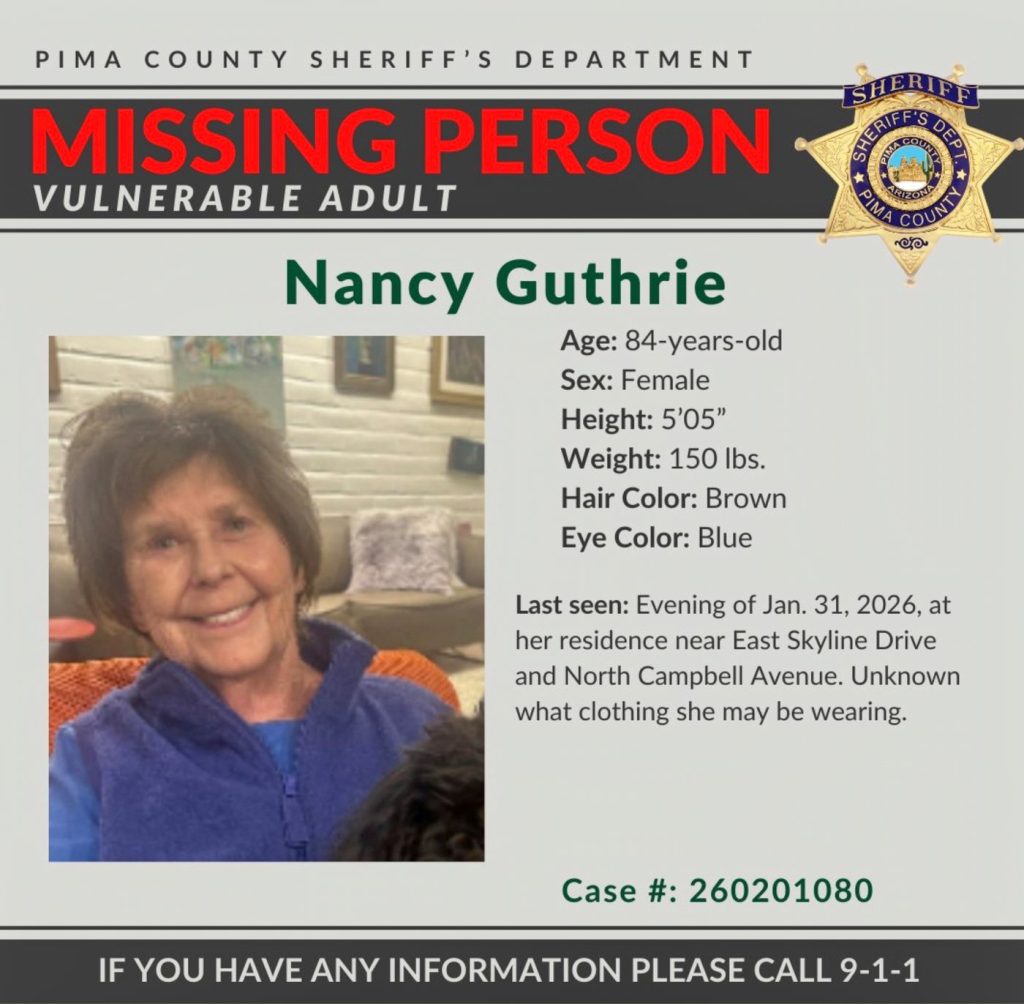
Shortly after the news emerged regarding the alleged abduction of “Today” show host Savannah Guthrie’s mother, Nancy Guthrie, social media platforms erupted with activity. Influencers rapidly relayed the timeline regarding the hours after Nancy, 84, was last seen and shared images of blood discovered on her front porch, which was confirmed to be a match for her. Various users went further to label individuals connected with the case as suspicious and filmed themselves walking through her neighborhood in efforts to locate her.
The demand for information on Guthrie, who authorities suspect was forcibly taken from her home near Tucson, Arizona, about a week ago, has sparked considerable online interest, drawing in a wave of amateur detectives. Despite ongoing investigations yielding no suspects or persons of interest thus far, the activity across platforms such as Instagram, TikTok, X, Facebook, and YouTube has garnered millions of views on potential tips and theories linked to her disappearance. However, such widespread discourse has unintentionally fueled rumors and necessitated law enforcement to clarify several crucial details.
Michael Alcazar, an adjunct professor at John Jay College of Criminal Justice and a retired NYPD detective, stated that the beneficial aspects of the surge in social media activity generally outweigh the negatives. “More people are aware; it keeps people alert,” he mentioned, suggesting that public awareness may lead to someone recalling vital details that could assist authorities. Alcazar drew parallels to the online attention surrounding Gabby Petito's case in 2021, noting that online discussions could potentially lead to significant discoveries.
Despite such potential advantages, there are downsides. Recently, Ashleigh Banfield from NewsNation roused uproar on her podcast by claiming that a family member of Guthrie was the primary suspect in the case, a statement she quickly amended to suggest that family members are typically scrutinized first. Unfortunately, this information spread rapidly on social media, prompting individuals to share images of the person mentioned. Pima County Sheriff Chris Nanos addressed these rumors in a news conference, asserting that they currently have no suspects or persons of interest, reiterating the importance of responsible information sharing.
Nanos emphasized caution in sharing information that could impede the investigation, saying, “You could actually be doing some damage to the case, you could do some damage to the individual, too.” Other social media posts have surfaced, including a medium expressing intuitive feelings about Guthrie's whereabouts and astrology interpretations suggesting possible scenarios.
Calvin Chrustie, a negotiation expert with over three decades of experience in cases of kidnapping and ransom, commended the public’s interest but cautioned against the spread of unverified information. He asserted that baseless speculations could complicate the recovery processes for both families and law enforcement efforts. “This stuff on X and other platforms that’s pure speculation is actually making it more difficult for families and making it more difficult for the police to secure the safe return of the hostage,” he remarked.
Julie Urquhart, an elementary school teacher from New Brunswick, Canada, has also engaged in discussions about the case across TikTok, Instagram, and Facebook. She noted that her motivation stemmed from having a mother around the same age as Guthrie's, expressing disbelief about the seamless disappearance. Urquhart reports that her information is sourced from credible national news outlets and official law enforcement updates, with one of her TikTok posts garnering over 4 million views. “That’s 4 million eyes that now saw that story and now maybe will see something or know something or know someone who does,” she highlighted.
The narrative surrounding Nancy Guthrie’s case demonstrates the dual-edged nature of social media in criminal investigations, where public interest can either aid in resolution or complicate ongoing efforts through misinformation.








