

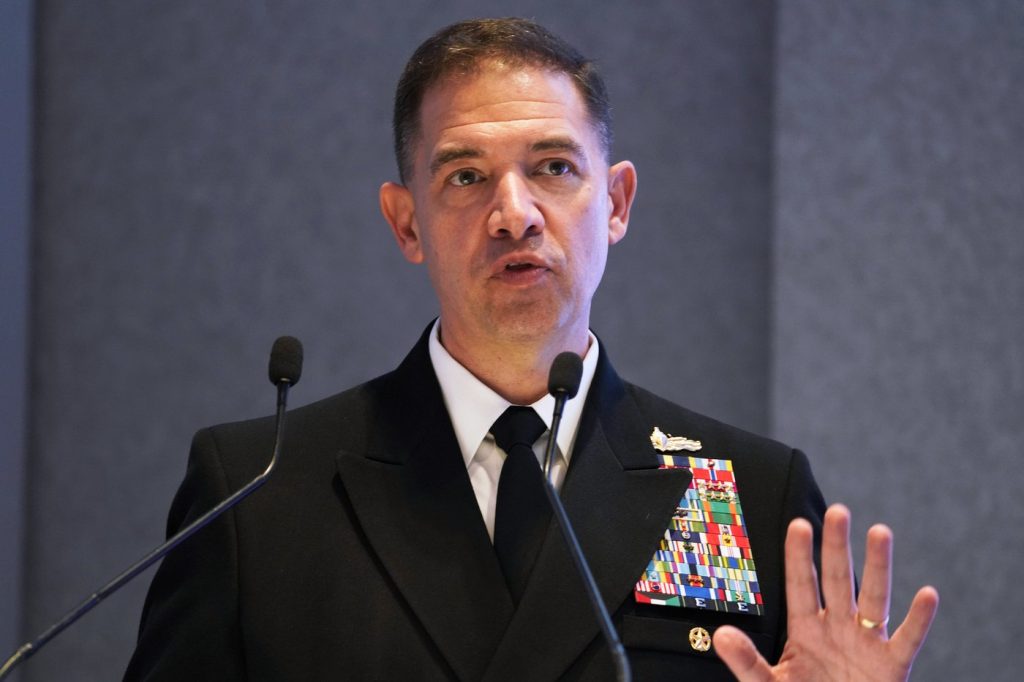
In an unprecedented move, U.S. President Donald Trump has engaged military officials in high-level diplomatic discussions, a strategy that marks a departure from traditional foreign policy approaches. Recently, the top U.S. commander in the Middle East, Adm. Brad Cooper, attended indirect talks in Oman concerning Iran's nuclear program, appearing in uniform to underscore America's military presence in the region. Meanwhile, Army Secretary Dan Driscoll has taken an active role in negotiations aimed at resolving the ongoing Russia-Ukraine conflict. According to sources, these decisions reflect the Trump administration's willingness to prioritize military leadership over seasoned diplomats in international discussions.
Adm. Brad Cooper's participation in the U.S.-Iran talks represents a significant deviation from the norm, as military leaders have not typically engaged in such diplomatic efforts. His involvement was intended to signal U.S. resolve and display military might amid rising tensions with Iran. As Trump indicated, the talks were "very good," but he cautioned that if Iran fails to reach an agreement over its nuclear program, the "consequences are very steep." The administration's strategy includes the considerable deployment of naval forces, such as the USS Abraham Lincoln, in the region, highlighting the potential for military action if negotiations falter.
The decision to involve military officials like Cooper stems from a broader trend under Trump's presidency, as noted by Elisa Ewers, a national security expert who criticized the administration for undervaluing skilled diplomacy. Ewers emphasized that effective diplomacy often requires significant time and effort and cautioned against relying on military solutions for foreign policy issues. Eliot Cohen, a former state department counselor, acknowledged the unconventional nature of these appointments but pointed out that U.S. presidents have historically used trusted individuals for diplomatic missions. Cohen noted a precedent for generals participating in arms control discussions during the Cold War, adding that exceptional situations often necessitate innovative approaches.
At the Omani talks, Cooper was accompanied by Steve Witkoff, a special envoy, and Jared Kushner, Trump's son-in-law, who are managing both the Iran discussions and Ukraine negotiations. The inclusion of military perspectives is seen as a tactic to reinforce U.S. positions. Defense analyst Michael O’Hanlon opined that Cooper's presence aimed to intimidate Iranian officials and assert American strength, although he doubted it would significantly change the negotiation dynamics due to pre-existing tensions.
Michael Singh, a former senior director for the Middle East at the National Security Council, defended Cooper's involvement, arguing that his military expertise would be beneficial in assessing potential concessions regarding Iran's nuclear capabilities—matters that require technical understanding beyond the capabilities of generalists like Witkoff and Kushner. Singh pointed out that Cooper's military background provides crucial insights into the negotiations.
The Biden administration has been noted for tapping military leadership in diplomatic roles more frequently, often to facilitate ongoing dialogues. This shift emphasizes the importance of maintaining diplomatic relations through continuous engagement. Driscoll's role, particularly in the context of the Russia-Ukraine talks, has evolved into a liaison position that strengthens U.S.-Ukrainian connection amid a complex geopolitical landscape. His military experience and relationships have reportedly helped sustain conversations between negotiating sessions.
As the talks progress, the inclusion of military leaders suggests an evolving approach to international diplomacy under the Trump administration, challenging conventional methodologies and raising questions about the balance between military power and traditional diplomatic channels. The administration's future endeavors will likely continue to reflect this unorthodox strategy as it navigates complex global issues involving Iran and Russia.








