

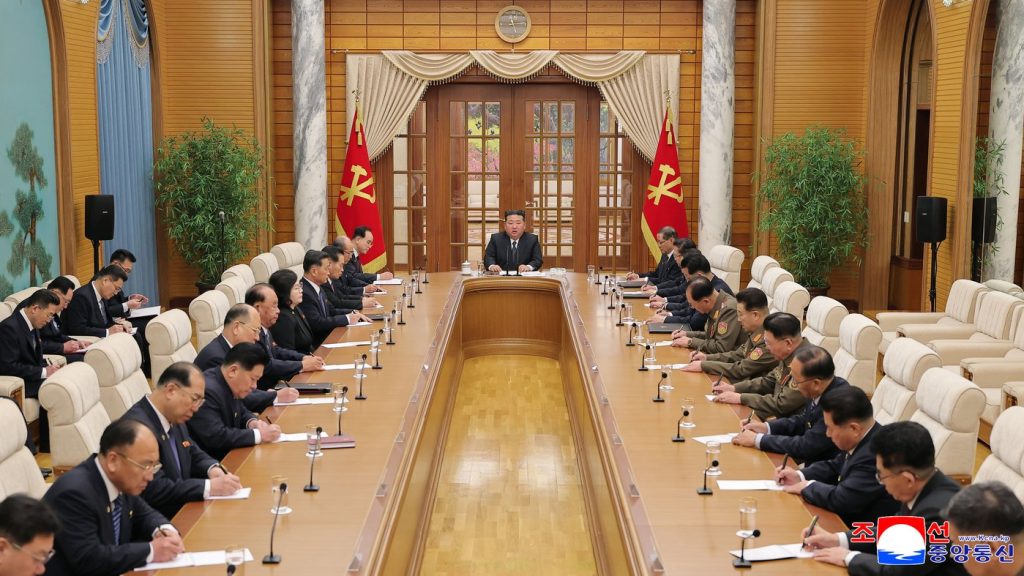
SEOUL, South Korea (AP) — North Korea is preparing to hold a significant political conference later this month, as reported by the country's state media on Sunday. Leader Kim Jong Un is anticipated to unveil his domestic and foreign policy agenda for the upcoming five years during this event.
The ruling Workers' Party congress, which Kim previously convened in 2016 and 2021, comes on the heels of advancing nuclear and missile programs and growing ties with Moscow due to the ongoing war in Ukraine. This has heightened tensions with both the United States and South Korea.
According to North Korea's official Korean Central News Agency, the party's political bureau convened under Kim's supervision and has set the congress for late February, although no specific dates or agenda details have been released yet.
The conference is expected to span several days, serving as a meticulously staged demonstration of Kim's authoritarian reign. In recent weeks, Kim has inspected various weapons tests and toured military and economic sites, with state media crediting him for the country's military enhancement and national development through his supposed "immortal leadership."
Kim's recent actions and statements indicate he may use the forthcoming congress to reaffirm his commitment to economic development driven by "self-sustenance" and mass mobilization. Additionally, he is likely to announce plans to bolster the capabilities of his nuclear-armed military, which includes upgrades to conventional weaponry and the integration of these forces with nuclear capabilities.
Experts speculate that Kim could further solidify his assertive foreign policy, which hinges on tighter cooperation with Moscow and Beijing. This shift is part of his efforts to adopt a more adversarial stance towards South Korea, particularly as he embraces the concept of a "new Cold War."
The future of diplomacy between Kim and the U.S. remains uncertain. Relations have been strained since Kim's second summit with former U.S. President Donald Trump collapsed in 2019 over unresolved sanctions linked to North Korea’s nuclear weapons program.
Since the start of Trump's second term in January 2025, Kim has dismissed overtures for dialogue, asserting that Washington must drop its insistence on denuclearization as a precondition for any future discussions.
As Kim enters his 15th year of leadership, he finds himself in a more stable position than during the onset of the previous congress in 2021, during the tumult caused by the COVID-19 pandemic. Back then, he admitted to failures in his past economic strategies and laid out a new five-year development plan aimed at 2025.
In that plan, Kim called for expedited enhancement of North Korea's nuclear arsenal and presented an extensive list of advanced military capabilities, including solid-fuel intercontinental ballistic missiles, multi-warhead delivery systems, tactical nuclear weapons, reconnaissance satellites, and nuclear-powered submarines.
Kim has adeptly leveraged global geopolitical instability for his own benefit, using Russia's invasion of Ukraine as an opportunity to accelerate weapon tests and deepen his alliance with Russian President Vladimir Putin. This alliance has included the acceptance of North Korean troops and substantial military supplies for use in the conflict.
Moreover, Kim has sought to reinforce relations with China, traditionally North Korea's main ally and economic supporter. In September, he visited Beijing for a World War II commemorative event, marking his first summit with Chinese President Xi Jinping in six years.
While Kim's strict control over information hinders precise evaluations, South Korean analysts suggest that North Korea's economy may have seen improvements over the last five years, potentially due to a gradual recovery in trade with China and an industrial uptick resulting from arms exports to Russia.








