

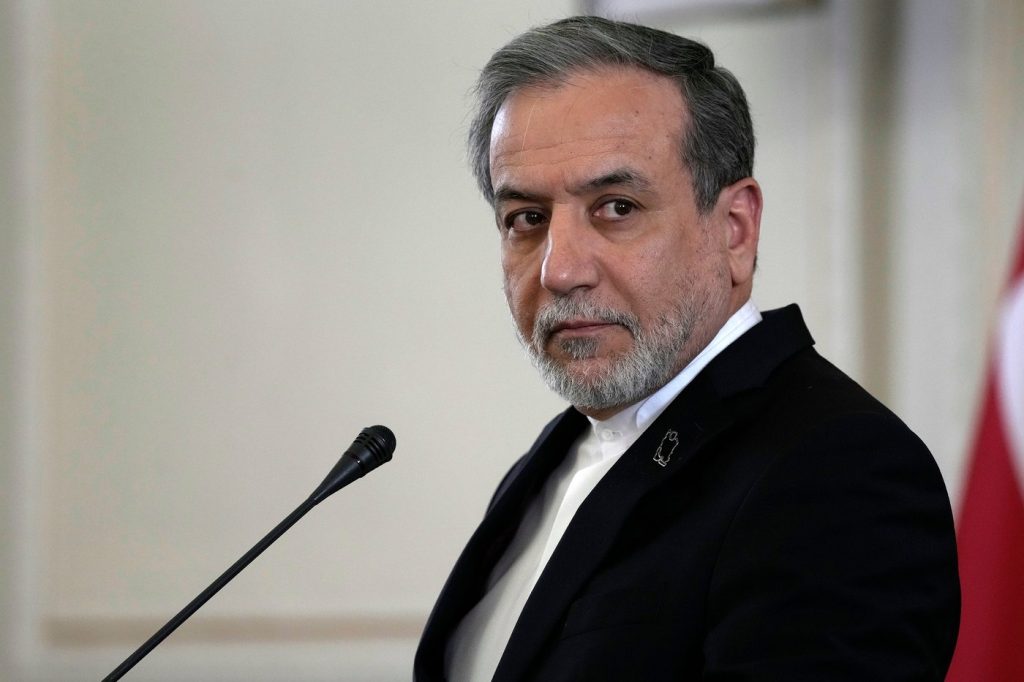
DUBAI, United Arab Emirates (AP) — Iranian Foreign Minister Abbas Araghchi emphasized on Sunday that the strength of Tehran lies in its ability to resist coercive pressures from major world powers. This assertive stance comes shortly after negotiations with the United States concerning Iran's controversial nuclear program, coinciding with a backdrop of nationwide civil unrest.
During a diplomatic summit in Tehran, Araghchi reiterated Iran's commitment to fulfill its uranium enrichment goals, a critical issue of contention with former President Donald Trump, who had previously ordered airstrikes on Iranian nuclear facilities during the short-lived 12-day Iran-Israel war in June.
While Iranian President Masoud Pezeshkian characterized the negotiations that took place in Oman with the U.S. on Friday as a "step forward," Araghchi's statements highlight the significant challenges that lie ahead. Concurrently, the United States has positioned the aircraft carrier USS Abraham Lincoln, along with additional naval and air support, in the Middle East, augmenting pressure on Iran to reach a satisfactory agreement and providing military leverage in case of an escalation.
In his remarks, Araghchi stated, "I believe the secret of the Islamic Republic of Iran's power lies in its ability to stand against bullying, domination, and pressures from others." He reassured, "They fear our atomic bomb, while we are not pursuing an atomic bomb. Our atomic bomb is the power to say no to the great powers." This proclamation highlights Iran's perspective of strength as rooted in resistance rather than nuclear armament.
The use of "atomic bomb" as a rhetorical device by Araghchi seems to be deliberate. Iran maintains that its nuclear ambitions are purely peaceful; however, Western countries and the International Atomic Energy Agency have asserted that Tehran had a well-structured military program aimed at developing nuclear weapons until 2003. The country has reportedly enriched uranium to levels of 60% purity, which is only a technical step away from achieving weapons-grade quality of 90%. Throughout recent years, Iranian officials have frequently alluded to the potential pursuit of nuclear weapons, despite referencing Supreme Leader Ayatollah Ali Khamenei's religious edict, or fatwa, which asserts that Iran will not develop a nuclear bomb.
Pezeshkian, who is believed to have received Khamenei's approval to engage the U.S. in talks, publicly discussed the negotiations on social media, asserting that the dialogues facilitated by regional partners constituted a step forward. "Dialogue has always been our strategy for peaceful resolution ... The Iranian nation has always responded to respect with respect, but it does not tolerate the language of force," he stated, reflecting Iran's enduring commitment to diplomatic efforts.
The timeline and venue for any subsequent discussions remain uncertain. Following the talks on Friday, Trump remarked, "Iran looks like they want to make a deal very badly — as they should," indicating that the U.S. perceives a strong desire from Iran to reach an agreement.
Moreover, during the negotiations, U.S. Navy Admiral Brad Cooper, who commands American military operations in the region, was present in Oman. His involvement was presumably intended to serve as a tangible reminder of the U.S. military's capabilities in proximity to Iran. Post-negotiations, Cooper joined U.S. special envoy Steve Witkoff and Jared Kushner, Trump’s son-in-law, on board the USS Lincoln, further underscoring the military underpinning of the ongoing diplomatic efforts.
Araghchi's remarks reflect a significant awareness of the potential for American military action, especially following past incidents where the U.S. launched strikes during negotiations. He expressed concerns regarding the implications of any setbacks in the ongoing discussions, emphasizing, "If you take a step back (in negotiations), it is not clear up to where it will go."








