

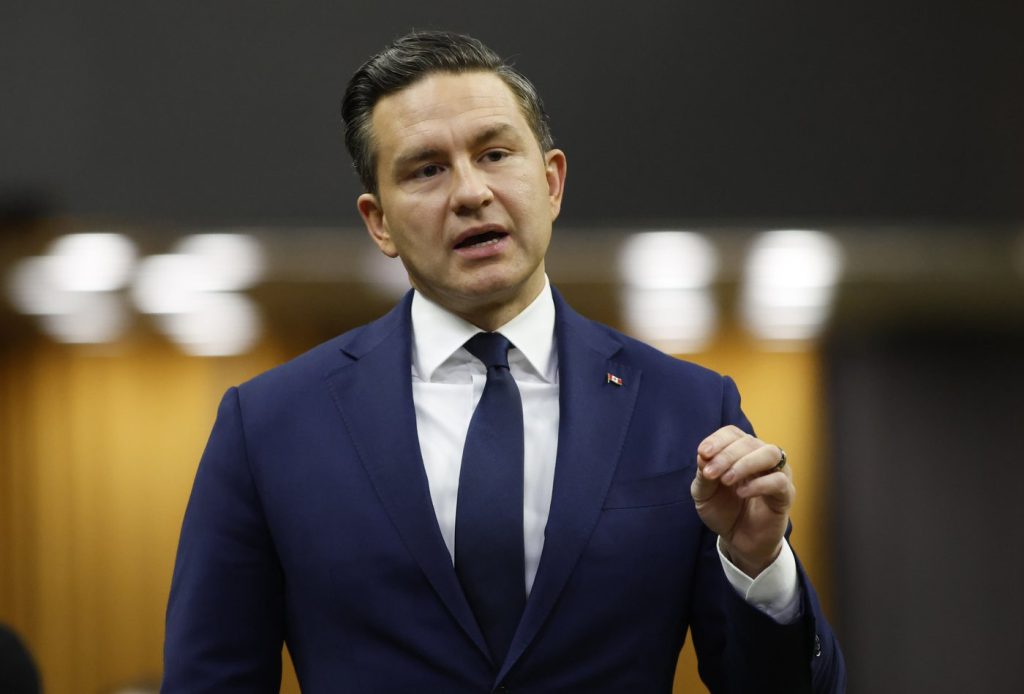
OTTAWA — The Opposition Conservatives are pressing the federal Liberal government to alleviate the tax burden on severance packages for General Motors workers who have been laid off in Ingersoll, Ontario. Conservative Leader Pierre Poilievre, along with labour critic Kyle Seeback and local MP Arpan Khanna, sent a letter to Finance Minister François-Philippe Champagne, advocating for an exemption from the withholding taxes that significantly reduce severance pay.
In the draft letter obtained by The Canadian Press, the Conservatives highlight that high taxes on the substantial lump-sum severance payments could deprive laid-off employees of “tens of thousands of dollars,” exacerbating their financial hardships during an already challenging time. They emphasize that waiting until after tax season to reclaim those funds is merely impractical for workers who have recently lost their regular salaries, leaving them struggling to meet essentials like mortgage and grocery payments.
The letter states, “These men and women worked hard, played by the rules, and built things this country depends on. The least your government can do is stop taking their money at the worst possible moment.” Poilievre urges the finance minister to utilize existing authorities to reduce the amount of tax withheld on severance payments for those affected by the GM CAMI layoffs.
This appeal comes at a critical time as Canada is on the brink of the tax-filing season, and just days after Prime Minister Mark Carney introduced a new strategy aimed at revitalizing the automotive sector. General Motors had earlier announced its plan to halt the production of BrightDrop electric vehicles at the CAMI Assembly plant, citing lower-than-expected market demand and challenging regulatory conditions in the U.S. This closure has resulted in over a thousand employee layoffs, while additional layoffs are anticipated at GM's Oshawa Assembly, impacting around 500 employees and potentially affecting up to a thousand workers in the supply chain.
Unifor, the union representing the affected GM workers, has openly criticized former U.S. President Donald Trump, blaming his administration for destabilizing Ontario's auto sector with imposed tariffs and disruptive policies that have adversely affected the U.S. electric vehicle market.
Prime Minister Carney's newly unveiled automotive industrial strategy, introduced last Thursday, aims to attract investments in the sector and establish a “sovereign path” for reducing automotive emissions. The strategy seeks to eliminate the sales mandate for electric vehicles (EVs) while implementing stricter emissions standards and reinstating the EV rebate program. This initiative follows Carney's negotiations in Beijing, where he secured a minimal tariff rate for a specified quota of Chinese EV imports into Canada. Additionally, the Canadian government is in discussions with both Korean and Chinese investors regarding opportunities in the Canadian automotive landscape.
However, the Conservatives have dismissed Carney's auto strategy as ineffective, arguing it fails to provide real assistance to workers within the automotive industry who are affected by recent layoffs. The letter reads, "Canadians are still waiting for your government to deliver the trade deal with the United States you promised by July 21, 2025, and a clear plan to protect Canadian jobs. Instead of presenting a serious plan to defend our auto workers, you've just announced a rebate that will subsidize American-made EVs."
As Canada prepares for discussions this year regarding the renewal of the Canada-United States-Mexico Agreement (CUSMA), which is under review, Carney has reiterated his goal of eliminating all tariffs, although he acknowledges that this objective contrasts sharply with that of the Trump administration. Thus, Canada must “prepare for all possibilities” in the evolving geopolitical and trade landscape.








