

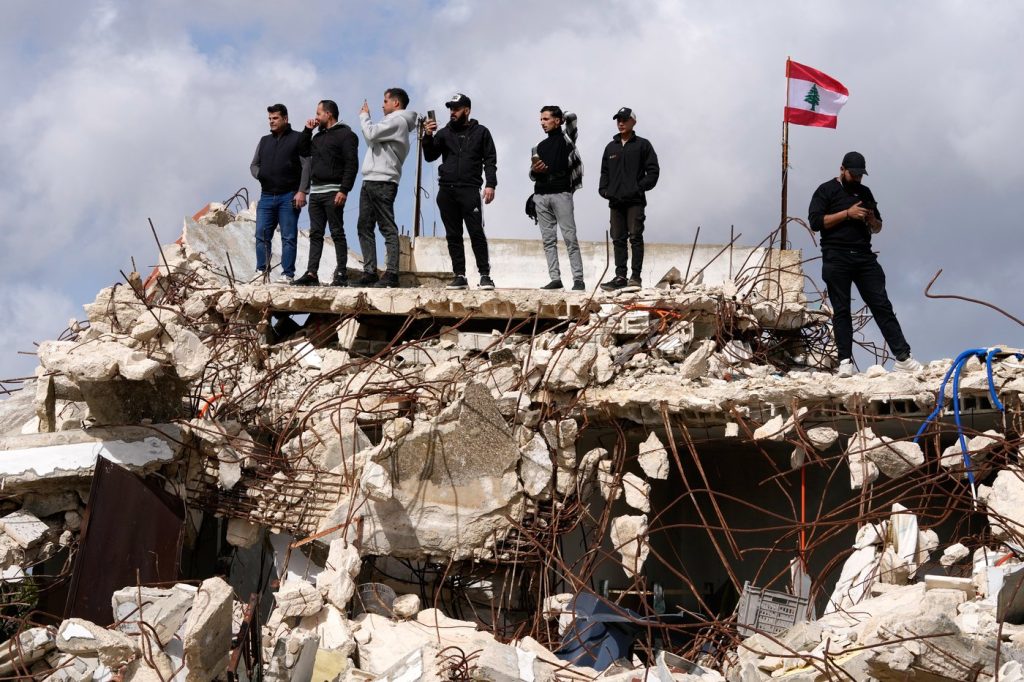
BEIRUT (AP) – Early Monday morning, Israeli forces conducted an operation in southern Lebanon, apprehending a local official affiliated with the Sunni Islamist group al-Jamaa al-Islamiya, which is allied with the Palestinian militant group Hamas. The Israeli military and Lebanese state media confirmed that the official, Atwi Atwi, was seized in the village of Hebbarieh, located in the Hasbaya region, close to the Israeli border. Following his seizure, Atwi was taken to Israel for questioning.
On the same day, an Israeli drone strike targeted a vehicle in the southern Lebanese village of Yanouh, resulting in the deaths of three individuals, including a child. Lebanon's state-run National News Agency reported on the strike, but there was no immediate comment from Israel regarding the incident.
A statement from the Israeli military characterized the operation that led to Atwi's apprehension as a “targeted intelligence-based operation.” However, the military did not release the name of the official involved. The Islamic Group, to which Atwi belongs, strongly condemned the seizure, asserting that it reflects the ongoing daily attacks and violations of Lebanese sovereignty by Israel. The group called on the Lebanese government to advocate for Atwi's release.
The Islamic Group functions as Lebanon's branch of the Muslim Brotherhood, a broad pan-Islamist political organization, and has an armed wing referred to as the Fajr Forces. In the aftermath of the Israel-Hamas war that erupted in October 2023, the Fajr Forces allied with the Lebanese Shiite militant group Hezbollah. This coalition began launching rockets into Israel, claiming that these actions were in support of Hamas, which is based in Gaza.
The Muslim Brotherhood has been designated as a terrorist organization in many parts of the Middle East. Notably, the Trump administration classified the Lebanese, Jordanian, and Egyptian branches of the Brotherhood as terrorist entities last month. Mohammed Takkoush, the leader of al-Jamaa al-Islamiya, noted during the 14-month war between Hezbollah and Israel that his group and Hezbollah had put aside their differences over conflicts in Syria and Yemen to unite against Israel.
The escalation of hostilities commenced on October 8, 2023, with Hezbollah initiating attacks on Israel one day after Hamas launched an assault in southern Israel. This spurred Israel to respond with extensive bombardments across Lebanon, which significantly weakened Hezbollah and was followed by a ground invasion. The conflict came to a halt with a U.S.-brokered ceasefire in 2024. Since then, Israel has reportedly carried out almost daily airstrikes and ground incursions into Lebanon, stating that these operations are aimed at dismantling Hezbollah's strongholds and addressing perceived threats against Israel.
The Israel-Hezbollah conflict has had catastrophic consequences, resulting in over 4,000 fatalities in Lebanon, including hundreds of civilians, while also causing an estimated $11 billion in damage and destruction, according to the World Bank. In contrast, Israel reported 127 deaths during this period, with 80 of those being military personnel.
The continuing hostilities and geopolitical tensions in the region illustrate the complex and often volatile relationship between Israel, Lebanon, and their respective militant groups, as well as the broader implications of internal and regional conflicts.








