

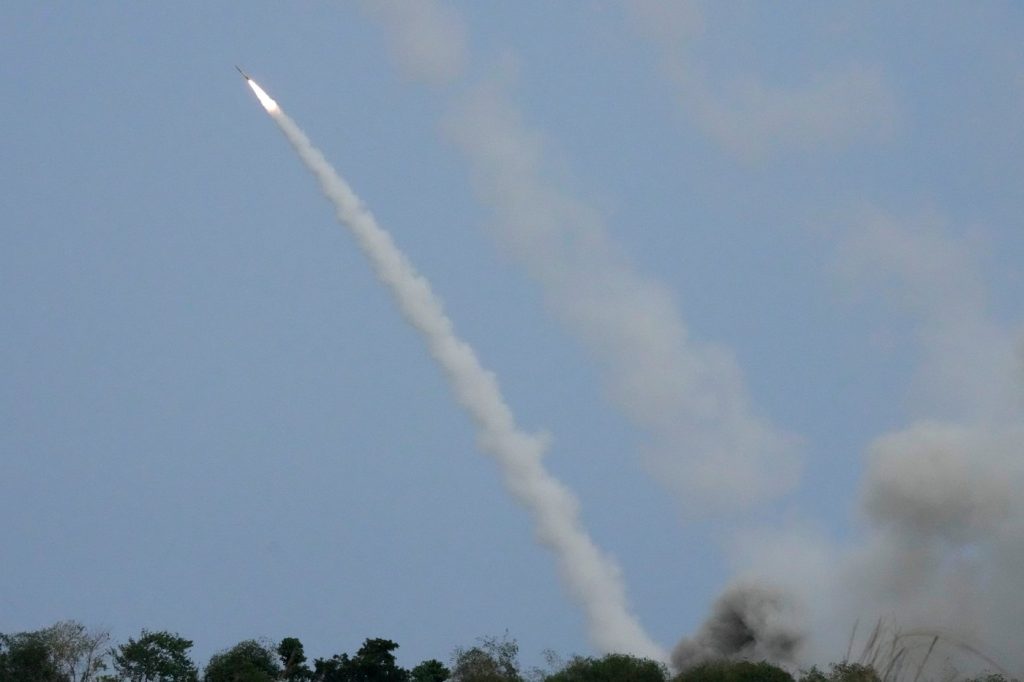
MANILA, Philippines (AP) The United States is set to enhance its military presence in the Philippines by deploying advanced missile systems aimed at deterring aggression in the South China Sea. On Tuesday, U.S. and Philippine officials condemned what they described as China’s “illegal, coercive, aggressive, and deceptive activities” in the region.
In response to the planned deployments, Beijing has voiced strong concerns regarding the installation of a U.S. mid-range missile system known as the Typhon, scheduled for deployment in northern Philippines in 2024, along with an anti-ship missile launcher that was introduced in the previous year. The Chinese government has accused the U.S. of attempting to contain its rise and has labeled the missile systems as threats to regional stability.
China has formally requested the Philippines to withdraw these missile launchers, a demand that has been categorically rejected by Philippine officials under President Ferdinand Marcos Jr. who has reaffirmed the Philippines' commitment to its defense agreements with the U.S.
During annual security talks held in Manila, U.S. and Philippine officials discussed broader defense strategies, economic cooperation, and collaboration with regional allies. A joint statement released on Tuesday outlined specific defense and security initiatives for the year, including joint military exercises, U.S. support for the modernization of the Philippine Armed Forces, and the deployment of cutting-edge missile and unmanned systems to the country.
The statement emphasized the allies’ commitment to ensuring freedom of navigation and lawful activities in the waters for all nations. Both sides also condemned China’s assertive actions in the South China Sea, recognizing their detrimental impacts on regional peace, stability, and economic conditions throughout the Indo-Pacific.
Reports indicate a rise in confrontations between Chinese and Philippine coast guard forces in disputed waters in recent years. Other countries such as Vietnam, Malaysia, Brunei, and Taiwan are also entangled in territorial disputes within the same region.
Although specifics on the planned missile deployments were not disclosed, Philippine ambassador to Washington, Jose Manuel Romualdez, indicated that discussions included the potential deployment of upgraded U.S. missile launchers that the Philippines might consider purchasing in the future. He described the missile systems as “sophisticated” and expressed hope that these advancements would eventually enable the Philippines to acquire similar systems independently.
Since their deployment, the Typhon missile system and the Navy Marine Expeditionary Ship Interdiction System have remained operational in the Philippines. During joint military drills, U.S. forces have familiarized Filipino troops with these advanced missile systems to enhance their operational readiness.
Romualdez clarified that the intent behind the U.S. missile deployments in the Philippines is purely defensive, stating, “It’s purely for deterrence,” and emphasizing that any aggressive action from China only bolsters the resolve of the Philippines to enhance its military capabilities.
The Typhon missile launchers, capable of shooting the Standard Missile-6 and the Tomahawk Land Attack Missile, can reach targets over 1,000 miles (1,600 kilometers), effectively putting significant portions of Chinese territory within range from Luzon in the north. Additionally, the anti-ship missile launcher deployed on Batan Island faces the strategically crucial Bashi Channel, a pivotal route for international trade and military maneuvers.








