

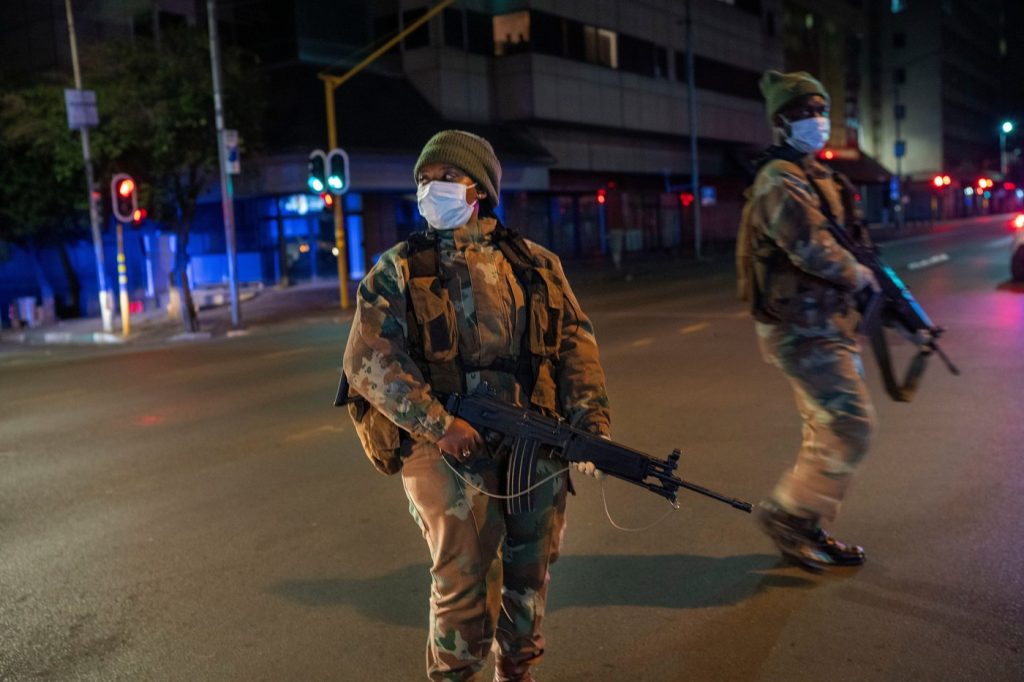
JOHANNESBURG (AP) - In a significant development for South Africa, President Cyril Ramaphosa announced earlier this month plans to deploy the military in high-crime areas as part of efforts to combat organized crime, gang violence, and illegal mining. This initiative is notable for a nation regarded as the leading democracy on the African continent.
Ramaphosa described the current wave of organized crime as "the most immediate threat" to both the democracy and economic stability of South Africa. Soldiers are set to patrol neighborhoods primarily in three of the country’s nine provinces, particularly in regions known for severe violent crime rates, although a specific timeline for deployment has yet to be disclosed. Critics argue that sending in the army indicates a failure of the Ramaphosa government's approach to crime control.
One of the areas affected is Cape Town, South Africa's second-largest city with approximately 3.8 million residents, renowned for its beauty but plagued by violence in its outskirts, particularly the Cape Flats. This area is infamous for lethal gang conflicts, where groups such as the Americans, Hard Livings, and Terrible Josters engage in fierce battles over control of the illegal drug trade while also participating in extortion and contract murders. Tragically, innocent bystanders often fall victim to gang-related shootings, raising serious concerns about public safety.
According to crime statistics, three police precincts in and around Cape Town account for the highest crime rates in South Africa. Ramaphosa stated that one contingent of the army will be stationed in the Western Cape province, which alone reports around 90% of the country’s gang-related homicides. Additionally, he mentioned that troop deployments would also occur in Gauteng—home to Johannesburg, South Africa's most populous city—and the Eastern Cape province.
Another critical issue is illegal mining, particularly in Gauteng, where abandoned mine shafts have become a breeding ground for criminal activity. The so-called zama zamas, often led by well-armed syndicates, exploit vulnerable individuals from impoverished communities to search for leftover gold at these sites. These gangs are frequently associated with serious violence, including a shocking incident in 2022 when approximately 80 alleged illegal miners were charged with raping eight women at a film shoot in an abandoned mine.
Authorities estimate around 30,000 illegal miners operate in South Africa's 6,000 abandoned shafts, contributing to a multibillion-dollar black market. The illegal mining trade is dominated by migrants from neighboring countries such as Lesotho, Zimbabwe, and Mozambique, exacerbating local tensions and resentment towards both criminal networks and foreigners.
Ramaphosa's deployment decision is particularly sensitive given the country's history of military use during the apartheid era, when troops were often sent to quash protests. Aware of this history, Ramaphosa stressed the importance of deploying the army "for a good reason," asserting that the increase in violent crime warranted a military response, which would operate under police authority.
This is not the first military deployment under his administration; in 2023, troops were dispatched following a series of truck burnings, and in 2021, about 25,000 soldiers were mobilized to quell riots triggered by the imprisonment of former President Jacob Zuma. Additionally, military enforcement of strict lockdown rules during the early COVID-19 pandemic raised concerns about the militarization of public safety.
Experts in crime prevention have expressed doubts regarding the efficacy of using the army to tackle such complex issues, arguing that military personnel lack the expertise necessary for domestic law enforcement. However, Police Minister Firoz Cachalia has defended the initiative, asserting that the army would support police operations in particularly violent areas, with the deployment being time-limited and aimed at stabilizing regions where violence has reached alarming levels.








