

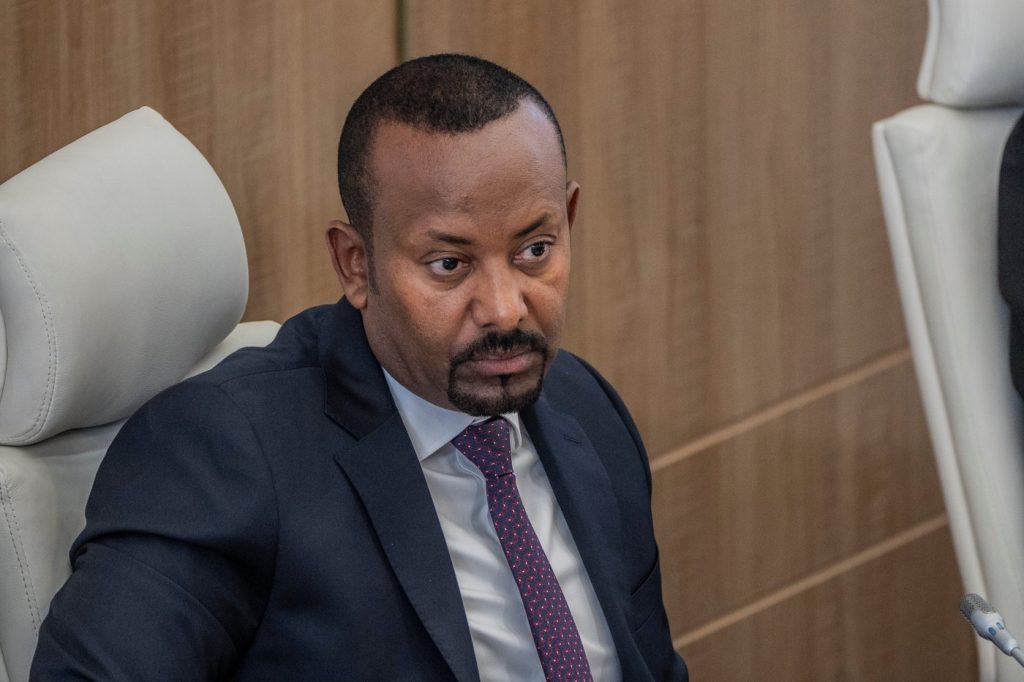
KAMPALA, Uganda (AP) — To his supporters, Ethiopian Prime Minister Abiy Ahmed represents a renaissance figure aiming to rejuvenate the historical greatness of Ethiopia. However, critics describe him as a provocateur who risks igniting conflict in the increasingly volatile Horn of Africa as he insists on sovereign access to the sea through Eritrea, an increasingly hostile neighbor.
Recently, at a stadium in southern Ethiopia, Abiy organized a provocative military parade showcasing Ethiopia’s special forces executing maneuvers that were interpreted as a direct message to Eritrea. A striking banner declared that Ethiopia would not remain landlocked "whether you like it or not," featuring imagery of a soldier breaking down a door as he aimed for the strategic port of Assab.
Assab has belonged to Eritrea since its independence in 1993, following a lengthy guerrilla conflict with Ethiopia. Most of Ethiopia’s trade currently transits through Djibouti’s port, which incurs high costs—about $1.5 billion annually, a figure that surpassed Ethiopia’s foreign exchange reserves until recently, according to the Africa Practice consulting firm.
This dire economic situation has partly fueled Abiy's controversial efforts to forge a sea access agreement with Somaliland, which angered Somalia and escalated regional tensions. The standoff over Assab heightens fears of potential war, which could pit Abiy against Eritrean President Isaias Afwerki and possibly rebellious leaders from the Tigray region.
While an outbreak of conflict is not inevitable, the International Crisis Group warns that a lack of international intervention could lead to a new regional war with complex ramifications. Abiy, who came to power in 2018 as a reform-minded leader, has been central to this escalation.
His peace overtures with Eritrea following years of cold relations earned him the 2019 Nobel Peace Prize. Nonetheless, just a year later, he oversaw a military campaign against the Tigray People's Liberation Front (TPLF), which plunged Ethiopia into a brutal civil war, marked by horrific acts of violence before a peace agreement was reached in 2022.
Now, as tensions flare over the possibility of military engagement regarding Assab, analysts have noted a significant military buildup along the Eritrean border. Reports suggest that the Tigrayan leadership is coordinating with Eritrea against Ethiopian forces. United Nations Secretary-General António Guterres has called for adherence to a 25-year-old border treaty, while regional players have suggested initiating talks.
Within Ethiopia, internal clashes have persisted, with Tigrayan officials accusing federal forces of conducting drone attacks. Ethiopia retaliates by claiming that Eritrea is preparing for war and that Eritrean forces are operating within Tigray, which directly borders Eritrea. Eritrea, in turn, accuses Ethiopia of harboring intentions to seize the port of Assab, a claim fueled by Abiy’s recent military display in Hawassa.
Abiy envisions a renewed Ethiopia characterized by unity and progress, encapsulated in his philosophy of "medemer." He has set ambitious infrastructure goals, including the completion of the Grand Ethiopian Renaissance Dam—contested by Egypt—and visions for transforming Addis Ababa into an attractive urban center. His plans include a nuclear power initiative, the construction of 1.5 million housing units, and a $10 billion project for Africa's largest airport outside Addis Ababa.
Yet, Abiy faces considerable challenges: Ethiopia is the world’s most populous landlocked nation, home to more than 130 million people. Moreover, ethnic discord continues to disturb regions like Amhara and Oromia, where federal forces clash with various militant groups. Engaging in a military conflict over a seaport would significantly hinder Abiy's broader aspirations by drawing resources away from critical infrastructure projects.
The Eritrean government dismisses Abiy's provocations as diversionary, highlighting internal struggles within Ethiopia, including intensifying hunger in different regions. Yemane Gebremeskel, Eritrea's government spokesman, regularly criticizes Abiy's political party and claims it engages in toxic rhetoric that threatens the territorial integrity of Eritrea.








