

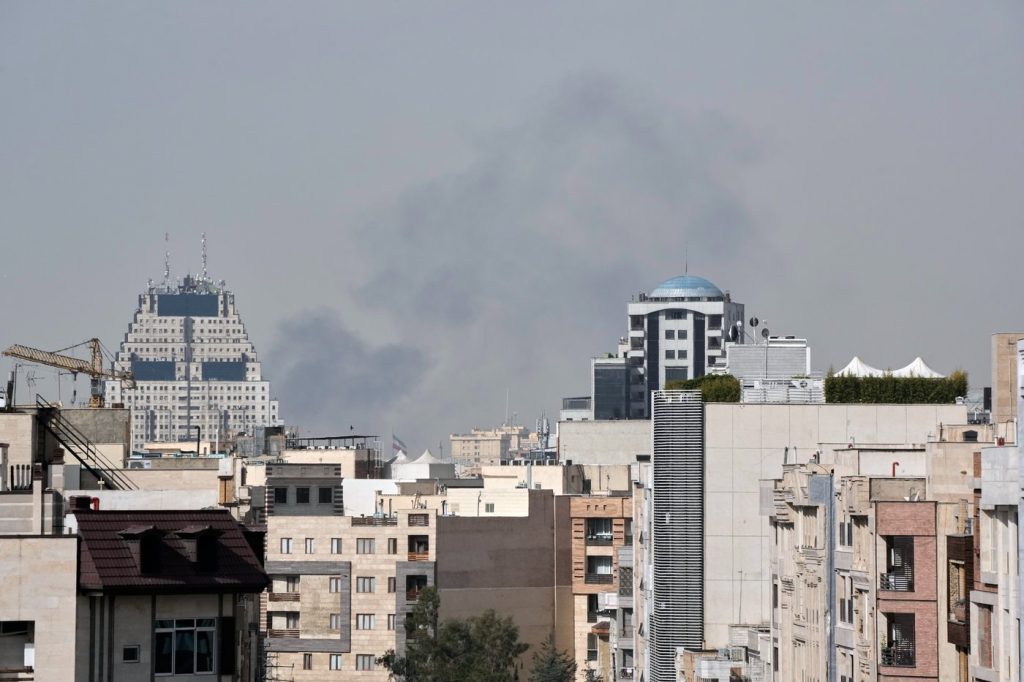
The United States and Israel launched a military attack on Iran on Saturday, marking a significant escalation in tensions between the nations. The first strikes reportedly occurred near the offices of Iran's Supreme Leader Ayatollah Ali Khamenei. Iranian media indicated that a series of strikes took place across the country, with smoke visible rising from Tehran.
In a video statement, President Donald Trump announced the initiation of "major combat operations in Iran," asserting that Iran has continued its nuclear program and is developing missiles capable of threatening the U.S. He indicated that this military action was a necessary response to Iran’s provocative behavior.
In response, Iran's Supreme National Security Council confirmed that armed forces had commenced a "decisive response," urging civilians to avoid targeted zones and reassuring the public that provisions for basic necessities were in place. Schools and universities were ordered to close, while banks remained operational.
The German government reported that it was informed in advance about the Israeli strikes, emphasizing its close coordination with European partners. Germany's crisis management team convened to assess the situation, and citizens in Iran were advised to register for safety updates.
Sources indicated that Iranian officials had previously met with allied Iraqi militias to discuss response plans in case of a U.S. attack. The officials conveyed that U.S. forces in Iraq, particularly in the Kurdish region, could be targeted as part of the counteraction strategies. Notably, Kataib Hezbollah, an influential Iraqi militia, called for its members to prepare for a sustained conflict.
Israeli media reported damage to a building in northern Israel, attributed to falling shrapnel from missile defense systems. The Israeli military subsequently issued warnings in Persian for citizens near military sites in Iran to evacuate for their safety.
The Iranian Foreign Ministry declared that the nation would not hesitate to confront what it labeled military aggression. The ministry stated it was prepared for both negotiations and defense, asserting that the armed forces would respond decisively to any threats.
Qatar's Defense Ministry announced that its military had intercepted several incoming missiles, noting that the Qatari Armed Forces have the necessary capabilities to protect the nation. Meanwhile, explosions were reported in Qatar as Iran initiated its counterattacks, targeting U.S. military installations in the region.
Reactions in the U.S. Congress reflected political divisions over the military actions. Republican Senator Lindsey Graham praised the operations, suggesting they could liberate the Iranian people, whereas Democratic Representative Ruben Gallego raised concerns that young working-class Americans should not bear the costs of a conflict. Conversely, Republican Representative Thomas Massie criticized Trump for engaging in acts of war without congressional approval.
The United Arab Emirates closed its airspace due to the ongoing strikes, significantly affecting global aviation as it is home to major airlines. Bahrain confirmed that it had been targeted by foreign aggression, condemning the attacks as a violation of its sovereignty and initiating emergency measures.
As Israeli air defenses were activated in response to incoming missile threats, explosions were reported across northern Israel and sirens were activated in Jordan. Israel claimed that the operation against Iran was a carefully planned joint military effort with the U.S., aiming to remove perceived threats posed by Iran.
Amid the escalating conflict, both Israel and the U.S. seemingly entered a coordinated military campaign designed to weaken Iran's operational capabilities. This operation appears to reflect broader military strategies aimed at establishing air superiority over Iranian territory.
This conflict has raised concerns over potential U.S. casualties, with President Trump acknowledging that military operations may result in American lives lost. Despite expressing frustration over negotiations with Iran just days before the strikes, he maintained that the U.S. could no longer tolerate Iran's nuclear ambitions.
The U.S. military build-up in the region has been significant, including the deployment of aircraft carriers and thousands of service members, indicating readiness for potential large-scale military operations. Following the initiation of hostilities, it remains to be seen how these developments will further impact regional stability and international relations.








