

BANGKOK (AP) — Crude oil prices remained elevated above $100 a barrel on Monday as ongoing conflicts in the Middle East continued to affect global markets. Reports indicated an increase in attacks attributed to Iran as the war shifted into its third week, contributing to mixed outcomes for share prices worldwide.
The price of Brent crude, which serves as the international benchmark, experienced a 2.5% increase reaching $105.70, marking an over 40% rise since the onset of the conflict. Meanwhile, U.S. benchmark crude rose by 1.6%, bringing its price to $100.29 per barrel, a substantial increase of nearly 50% since the war began. Despite these increases in oil prices, U.S. futures showed moderate optimism, with the S&P 500 futures climbing 0.6% and those for the Dow Jones Industrial Average rising by 0.5%.
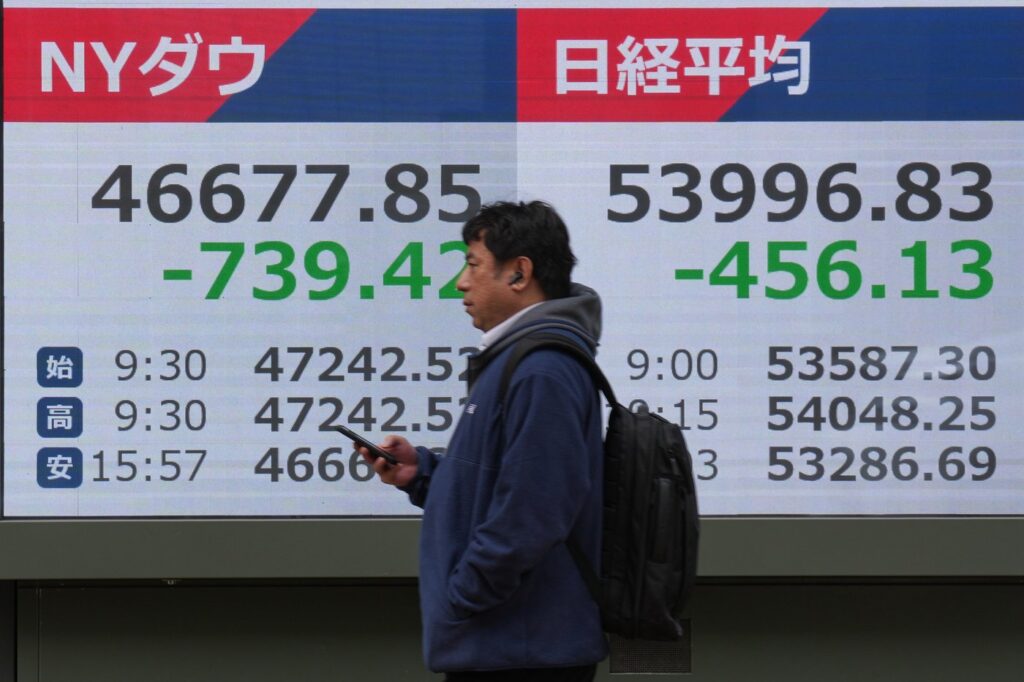
In early European trade, Germany's DAX index fell slightly by 0.1% to 23,423.51, while France's CAC 40 decreased by 0.2% to 7,893.16. Conversely, the UK's FTSE 100 increased by 0.2% to 10,276.43. In Asia, Japan's Nikkei 225 dropped 0.1% to 53,751.15, but South Korea's Kospi index gained 1.1% to reach 5,549.85. Hong Kong’s Hang Seng index rose 1.5% to 25,834.02 following robust economic data from China, though the Shanghai Composite index fell by 0.3% to 4,084.79. In Australia, the S&P/ASX 200 index lost 0.4%, closing at 8,583.40. Taiwan's Taiex also saw a slight decline of 0.2%, while India's Sensex remained relatively unchanged.
On the previous Friday, Wall Street faced worsening losses driven by escalating oil prices, which once again surpassed the $100 mark, intensifying inflationary pressures on the global economy. The S&P 500 index ended the day down by 0.6%, cumulatively down 3.1% for the year. The Dow Jones Industrial Average saw a loss of 0.3%, and the Nasdaq composite fell by 0.9%, marking a third consecutive week of declines for these indices.
Since being targeted by the United States and Israel over two weeks ago, Iran has been actively engaging in retaliatory strikes against Israel, American military bases, and the energy infrastructures of its Gulf Arab neighbors using drones and missiles. Moreover, Iran has impacted global oil transportation by effectively disrupting cargo traffic through the Strait of Hormuz, a crucial maritime pathway through which approximately one-fifth of global oil flows. The closure of this strait has caused producers to cut output, as their crude oil now lacks a transportation route. Independent research firm Rystad Energy reports that more than 12 million barrels of oil equivalent per day have been taken offline since the strait's closure.
Market analysts suggest that uncertainty prevails as oil traders operate with limited clarity regarding supply routes and production capabilities. Stephen Innes of SPI Asset Management characterized the current market conditions as operating "in the fog," noting the strait's usual capacity to handle around 25 oil and LNG tankers daily.
If conflicts continue to restrict oil production and transport from the Persian Gulf, it could precipitate a significant surge in inflation. To counterbalance the rising prices, members of the International Energy Agency have made available a record 400 million barrels from emergency reserves. However, this measure has yet to restore market confidence effectively.
The potential for inflation has introduced challenges for the Federal Reserve as it aims to lower interest rates to stimulate the economy. At its upcoming policy meeting, the U.S. central bank is not expected to reduce rates amid these inflation concerns. Recent reports displayed that consumer prices increased by 2.8% in January compared to the previous year, with core prices, excluding food and energy, rising 3.1%, marking the sharpest jump in nearly two years. Despite the inflation, consumer spending remained robust, growing at a steady pace of 0.4% in January, fueled by a similar increase in incomes.
Furthermore, Wall Street received an update on U.S. economic growth, revealing that the economy expanded at a sluggish annual rate of 0.7% during the October-December quarter, a downgrade from earlier estimates affected by a partial government shutdown that lasted 43 days.
In currency trading on Monday morning, the U.S. dollar slipped slightly against the Japanese yen, moving from 159.55 to 159.34 yen, while the euro appreciated to $1.1441 from $1.1425.








