

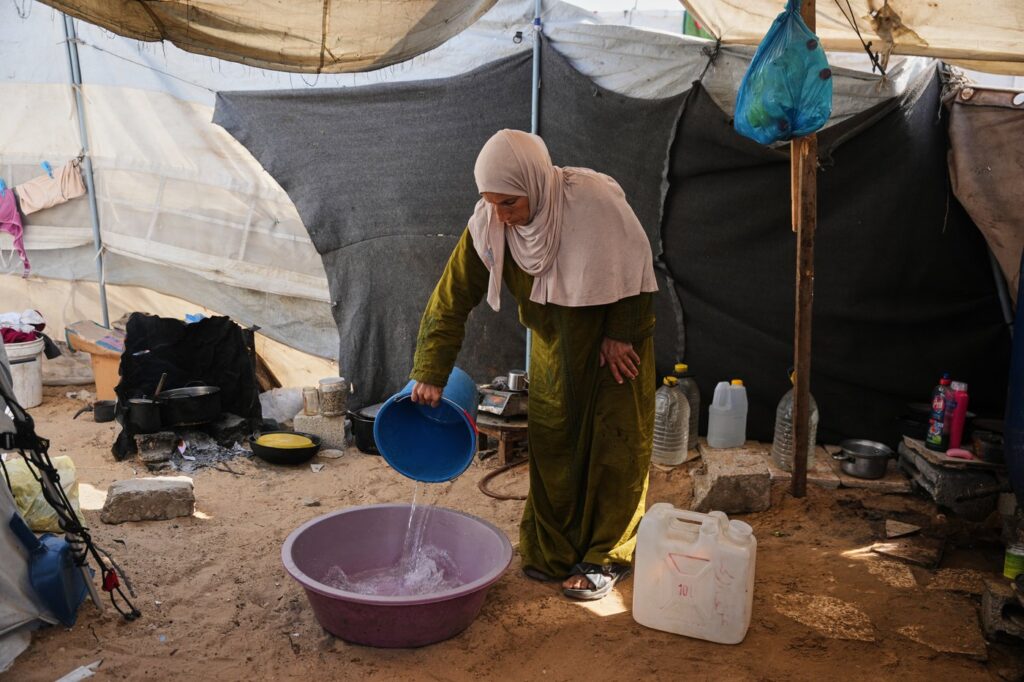
DEIR AL-BALAH, Gaza Strip (AP) – In the chaotic surroundings of Muwasi, a sprawling tent camp in Gaza, the Abu Daqqa family experiences the dire impacts of ongoing water shortages. Each time water trucks arrive, the family competes with hundreds of others for access, scrambling to fill dented plastic jerry cans. Yehia Abu Daqqa, who is tasked with rationing the scarce resource, carefully distributes one can to each of her children and pours water into a sippy cup for her youngest daughter. “When the water truck arrives, 500 to 1,000 people throw themselves at it. They start fighting. It’s real suffering,” she explained.
Despite a ceasefire between Israel and Hamas that was established over six months ago, Palestinians in Gaza continue to face significant water shortages. The United Nations reports that nearly 90% of Gaza's water infrastructure has been destroyed, including desalination and sewage treatment facilities. Before the conflict, water was supplied through trucks and underground pipes, but the destruction has left many reliant on irregular truck deliveries. The reconstruction of this critical infrastructure remains a priority, yet progress has stalled as Israel demands the disarmament of Hamas as a precondition.
The WASH Cluster, a United Nations-led organization focused on water and sanitation, estimates that 80% of Gaza’s residents depend on water deliveries from trucks to distribution points. Azmy Abu Lehya highlights the unpredictability of this service, stating that on some days he must walk more than 500 meters to fetch water, while on other days, no trucks arrive at all. “On two days, the water trucks come, and on the other two days, they don’t,” he lamented.
Official Israeli sources assert that they do not limit the importation of water. COGAT, Israel's military body overseeing humanitarian issues, claims that they ensure sufficient flow through pipelines for sanitation, sewage, drinking, and washing, and that they do not restrict bottled water imports either. Nevertheless, many Gazans find bottled water prohibitively expensive due to the widespread destruction and lack of stable income opportunities.
Sharif Abu Helal, a resident of Muwasi, expresses frustration at the exorbitant costs, contemplating the reality of providing for his eight family members. “I am not ready to buy each person a bottle of water. Is a gallon of water enough for them?” he questioned. Compounding the issue, essential items required for cleaning and transporting water, such as pipes, fuel, and chemicals like chlorine, are often categorized by Israel as dual-use materials. These materials are restricted due to concerns over potential repurposing for military use.
Throughout the ongoing conflict, water shortages have persisted, with damaged pipelines and attacks on water trucks exacerbating the situation. In a recent report, Doctors Without Borders (MSF) accused Israel of using water as a weapon of war, describing the systemic deprivation of water as part of a campaign of collective punishment. The report stated that as Gazans struggle with a lack of water, Israeli authorities manipulate aid supplies, allowing only minimal assistance to trickle into the territory.
MSF, which is the second-largest provider of water in Gaza, indicated that obstacles frequently hinder the entry of essential infrastructure. According to interviews conducted in late 2025, MSF highlighted the reality of salvaging old parts to construct desalination or water treatment facilities due to the restrictions on importing necessary materials. The organization pointed out the severe implications for the 2.1 million residents of Gaza, leading to sewage overflows and the spread of waterborne diseases.
Amidst these challenges, COGAT refuted MSF’s allegations, describing them as a “desperate attempt to regain legitimacy.” They claimed Israel permits approximately 70,000 cubic meters of water into Gaza daily, translating to about 33.3 liters (8.8 gallons) per person. However, humanitarian agencies argue that at least 15 liters (4 gallons) per person are required daily to meet basic needs for cleaning, washing, drinking, and bathing.








