

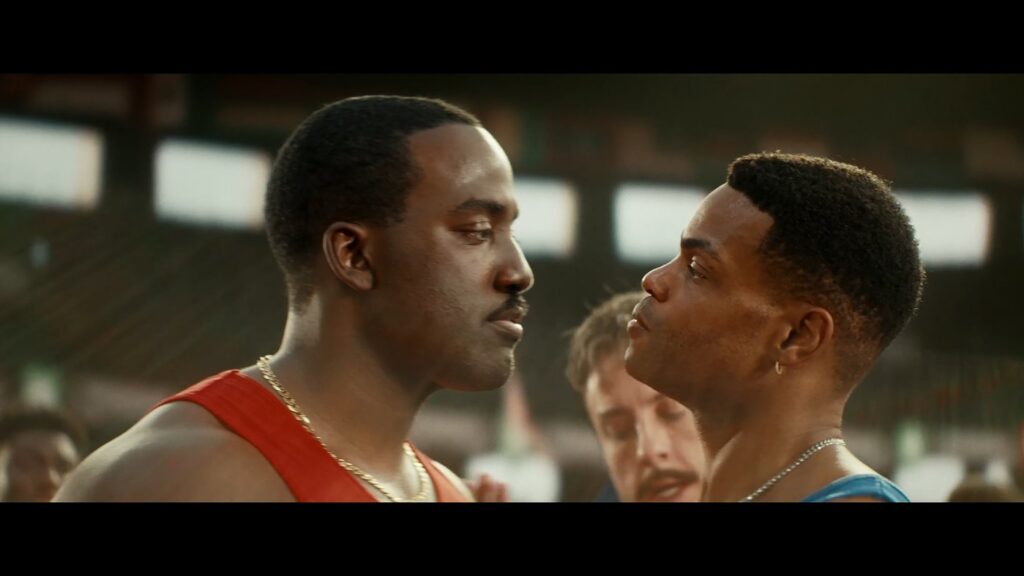
TORONTO — Anthony Q. Farrell faced a significant consideration when he was invited to write a comedy centered on the doping scandal of Canadian sprinter Ben Johnson. "My first thing was: Is Ben involved?" he indicated during a recent video call. Farrell emphasized the importance of ensuring that the narrative wouldn’t exploit Johnson's identity. "It has to feel like it’s from him. He’s gotta be the source," he added. When the production company confirmed that Johnson was involved, Farrell committed to the project.
This approach contrasts sharply with recent incidents in Hollywood, with public figures such as Daryl Hannah and Pamela Anderson criticizing producers for what they perceive as misrepresentations of their stories for entertainment purposes. These complaints highlight the ongoing ethical and legal considerations that writers and producers must navigate when adapting true stories for the screen.
In Farrell's case, he found it particularly crucial to involve Johnson in "Hate the Player: The Ben Johnson Story," set to stream on GameTV on March 26 and on Paramount Plus the following day. He remarked, "Most Caribbean-Canadian people, we're all very protective of the Ben Johnson story. We felt like he didn’t get a fair shake." Johnson infamously won gold in the 100-metre sprint at the 1988 Seoul Olympics, only to be stripped of his medal two days later after testing positive for a steroid.
"Hate the Player" is a satirical six-part miniseries that narrates the events from Johnson’s perspective as he attempts to create a documentary about the scandal. Farrell mentioned that Johnson took an active role in the development process, engaging in lengthy conversations with him and actor Shamier Anderson, who plays Johnson. However, other real-life characters, such as rival sprinter Carl Lewis, did not participate in the writing process.
Farrell acknowledged the tendency for secondary characters to be simplified in narrative arcs, especially in a mockumentary format where the protagonist's viewpoint is central. He articulated, "Ben’s point of view is the most important part of telling the story... because not only is it interesting, it’s comedic, it’s funny." The overtly satirical framing of the show suggests to audiences that it does not serve as a factual representation of events, which offers some reprieve against criticism of character portrayals.
Conversely, FX's "Love Story," which dramatizes the relationship between John F. Kennedy Jr. and Carolyn Bessette-Kennedy, lacks this explicit comedic framing, causing confusion about the depiction's accuracy. Following her portrayal, Daryl Hannah accused the producers of severely distorting her character to create a villainous representation. In her New York Times guest essay, Hannah objected to the show’s depiction of her actions and behaviors, claiming they were untrue and damaging to her reputation.
James Nadler, a professor and former lawyer, explained that defamation lawsuits can arise when falsehoods presented in media injure someone’s reputation. Hannah noted that misrepresentation has resulted in hostile receptions and could adversely affect her advocacy work. Producer Nina Jacobson defended the show’s treatment of Hannah's character as an antagonist but asserted that they aimed to portray her with grace.
Other cases of misrepresentation in media have also surfaced, such as Netflix's settlement with Rachel DeLoache Williams, a character depicted unfavorably in "Inventing Anna." Nadler pointed out that producers must be aware of the potential legal ramifications of dramatizing real-life stories, which often leads to precautions, like changing character names or details to avoid litigation. However, this can challenge the development of compelling composite characters.
The Kennedy family's objections to "Love Story," including remarks from John F. Kennedy Jr.'s nephew Jack Schlossberg, further complicate the narrative. Schlossberg urged viewers to approach the series as fiction rather than fact, criticizing executive producer Ryan Murphy for profiting off someone else’s life story.
In discussions of ethical production practices, Elaine Chang, a cultural studies professor, suggested that producers should clarify their intentions for depicting true events. She highlighted cases like Anderson's, who expressed outrage over the series "Pam & Tommy," which chronicled her life without her consent. Anderson described it as exploitative, expressing a desire for an apology from those involved.
Director Craig Gillespie, however, asserted that the story aimed to critique the destructive nature of the internet and its implications in contemporary society, which Chang found insufficient as justification for the portrayal. She condemned the exploitation inherent in reimagining someone’s life experiences without their input.








