

ATLANTA — On Tuesday, hundreds of flights across the United States were canceled or delayed as the aftermath of powerful storms wreaked havoc on air travel, disrupting numerous cities. The chaos was compounded by longer lines at airport security checkpoints due to a partial government shutdown, which has strained staffing for screeners.
This partial shutdown, which began on February 14, has resulted in decreased staffing at various security checkpoints, coinciding with the busy spring break travel period and the arrival of NCAA March Madness fans. According to flight-tracking service FlightAware, more than 750 flights scheduled to operate within, into, or out of the U.S. were canceled as of early Tuesday, while approximately 1,300 flights faced delays.
The previous day, flight disruptions were significant, especially affecting major airports such as New York's LaGuardia, Chicago's O'Hare International, and Atlanta's Hartsfield-Jackson International. The storm system that hit the Midwest transitioned eastward, bringing high winds with gusts nearing 50 mph in parts of New York, as reported by the National Weather Service.
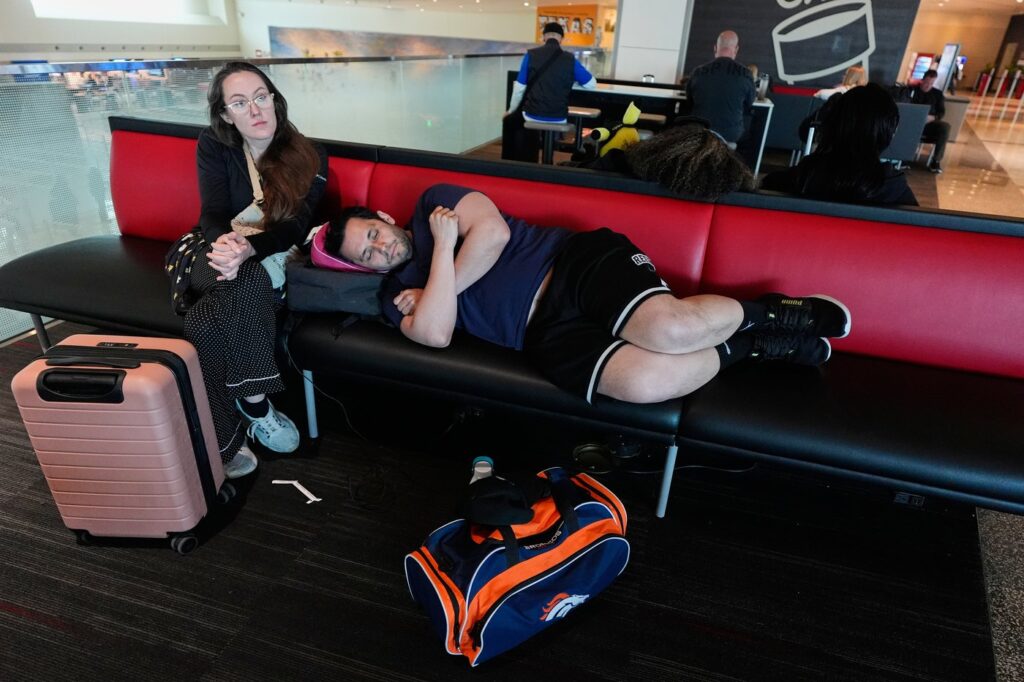
Travelers expressed frustration over the situation. For instance, Kelly Price, who was attempting to return to Colorado from a family vacation in Orlando, Florida, faced a canceled flight early Monday, leaving her family to spend the night on the airport floor. The earliest they could rebook was for Tuesday afternoon.
In Chicago, the storm led to approximately 600 flight cancellations at O'Hare, over 470 out of Atlanta, and around 450 at LaGuardia Airport, according to FlightAware. Ground stops were ordered by the Federal Aviation Administration at Hartsfield-Jackson and Charlotte Douglas International, with delays also affecting JFK and Newark Liberty International Airport due to severe weather conditions.
Another traveler, Danielle Cash, was stranded in St. Louis while trying to return to Tampa, Florida, after a weekend trip to Las Vegas. She reported significant unplanned expenses for a hotel room in snowy St. Louis and also remarked on the drastic temperature differences she encountered during her travels.
The current government shutdown primarily affects the Department of Homeland Security, which includes the Transportation Security Administration (TSA), resulting in financial difficulties for many TSA employees. As they missed their first full paycheck over the weekend, some TSA agents are facing issues such as eviction notices and unable to afford transportation to work. Since the shutdown began, more than 300 TSA agents have reportedly quit their positions.
Due to the ongoing circumstances, TSA union leaders have warned travelers that longer security lines could persist. Despite the financial strains, many TSA staff have continued to report to work. This situation has prompted some airports to recommend travelers arrive at least three hours early. For instance, New Orleans’ Louis Armstrong International Airport issued a travel advisory concerning the impacts of the shutdown.
Amidst growing concerns, travelers at Atlanta's Hartsfield-Jackson arrived as much as four hours prior to their scheduled flights to mitigate potential delays. Mel Stewart, a passenger at the airport, criticized the current political situation, stating that the impact on TSA workers, who are integral to maintaining airport operations, should not be overlooked.
Such ongoing challenges underscore the broader implications of government operations on the aviation industry and the traveling public, particularly during high-demand seasons.








