

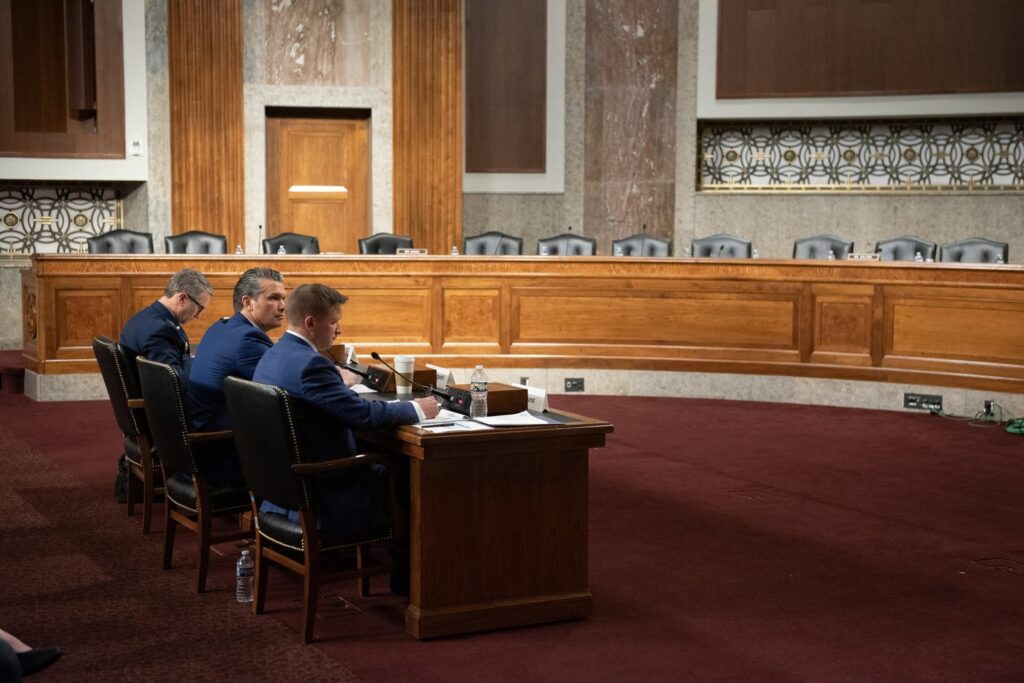
Many Republicans have expressed concerns over President Donald Trump's military engagements in Iran, particularly with a significant deadline approaching on May 1 for Congress to take action. This deadline, set by the War Powers Resolution of 1973, requires Congress to either declare war or authorize the use of force within 60 days of military hostilities commencing. As this deadline approaches, Congress has remained inactive, with GOP lawmakers deferring to the Trump administration.
Despite calls for congressional oversight, the Trump administration has dismissed the necessity for authorization, arguing that the conflict effectively ended with a ceasefire that began in early April. Senate Majority Leader John Thune, R-S.D., indicated that he does not foresee a vote to authorize military action in Iran, stressing the need to consider party members' perspectives. He stated, "I’m listening carefully to what the members of our conference are saying, and at this point, I don’t see that."
The current political climate presents challenges for Republicans, with increasing public dissatisfaction regarding the war and its influence on gas prices. However, many GOP lawmakers continue to support Trump's leadership during the conflict or are willing to await further developments. Senator Kevin Cramer from North Dakota expressed his openness to supporting a war authorization if requested by Trump, but he also questioned the constitutional validity of the War Powers Resolution.
Some Republican senators have voiced a desire for Congress to eventually assert its authority over military actions. Alaska Senator Lisa Murkowski stated her intent to introduce a limited authorization for military force after the Senate's one-week recess if the administration fails to present a credible strategy for addressing the conflict. She emphasized the importance of accountability and Congressional involvement, stating, "I do not believe we should engage in open-ended military action without clear accountability."
A subset of GOP senators contend that there should be a vote regarding military authorization. Maine's Senator Susan Collins, who notably voted with Democrats to halt the war, insisted that the president's powers as commander-in-chief are not limitless and that the 60-day deadline is a legal obligation. Alongside Collins and Murkowski, Senators John Curtis of Utah, Thom Tillis of North Carolina, and Josh Hawley of Missouri have also indicated a preference for Congressional input on military actions.
Majority Leader Thune recommended that the White House enhance its communication with lawmakers through regular briefings and hearings to maintain support from Congress regarding military operations in Iran. He acknowledged the importance of providing lawmakers with insights from military leaders to foster a sense of comfort and security regarding the ongoing situation.
The War Powers Resolution outlines that the President has a grace period of 60 calendar days after informing Congress of military involvement to either cease operations or gain authorization. While the deadline approaches on Friday, Administration officials have claimed that the current ceasefire effectively halts the timeline according to the law. Defense Secretary Pete Hegseth stated that the 60-day clock pauses during the ceasefire, while a senior administration official asserted that active hostilities had ceased, a view met with skepticism from Congressional Democrats.
Democratic Senator Tim Kaine of Virginia questioned the administration's interpretation of the War Powers Resolution, asserting that the statute's deadlines should not be disregarded. Additionally, Senator Adam Schiff, D-Calif., pointed out that U.S. military operations are ongoing, as warships remain deployed despite a halt on airstrikes against Iran, arguing that this does not negate the legal timeline imposed by the War Powers Resolution.
Despite the administration's stance, skepticism remains among Congressional leaders regarding adherence to legal frameworks concerning military actions. Representative Adam Smith, the ranking Democrat on the House Armed Services Committee, expressed his doubts regarding the Trump administration's willingness to follow the law.








