

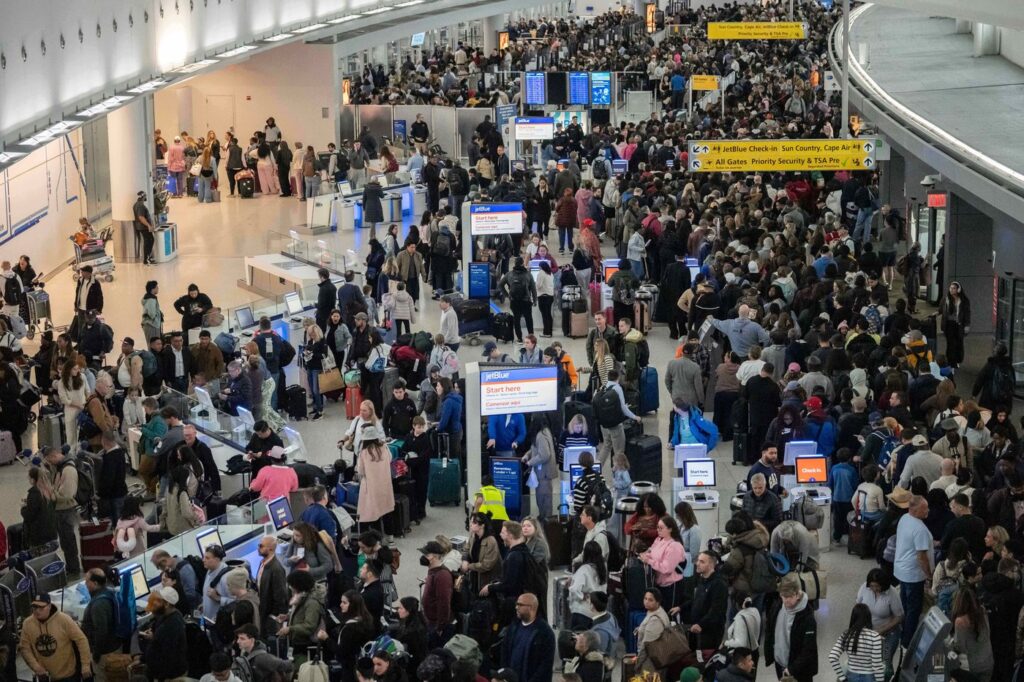
In a recent move addressing significant security line congestion at U.S. airports, President Donald Trump has ordered federal immigration agents to assist airport security efforts. The decision comes as air travelers face hours-long waits due to the partial government shutdown, which has left many Transportation Security Administration (TSA) workers without pay. The involvement of U.S. immigration officers aims to alleviate the burden on TSA agents as negotiations around funding for the Department of Homeland Security (DHS) continue to stall.
On Sunday, Trump reiterated his plan to deploy immigration officers starting Monday unless a funding agreement was reached with Democrats. This initiative involves directing Customs and Immigration Enforcement (ICE) agents to manage exit lanes and verify passenger identification, thus enabling TSA personnel to focus more on screening lines. Hundreds of thousands of homeland security workers, which includes TSA, U.S. Secret Service, and Coast Guard personnel, have been working without pay since Congress failed to renew DHS funding in the previous month.
Tom Homan, the White House border czar, spearheading this operation, has engaged in discussions with a bipartisan group of senators regarding the ongoing shutdown. While he labeled the discussions as “good conversations,” he indicated no consensus had been reached yet. Concurrently, the Senate was expected to consider the nomination of Senator Markwayne Mullin as Trump's next DHS secretary, with a vote potentially occurring as early as Monday.
During interviews, Homan explained that the specific responsibilities and number of ICE agents at airports were still being determined in collaboration with TSA leadership. He mentioned that major airports facing the longest wait times, such as those exceeding three hours, would be prioritized. The role of immigration officers could involve monitoring exits currently overseen by TSA agents, thereby allowing those agents to focus on passenger screening processes.
Homan noted that ICE agents already perform investigative work at several airports, particularly regarding smuggling, and asserted that a well-trained ICE officer could ensure proper monitoring and security in exit areas. This would, in turn, allow TSA personnel to better manage the security lines. He further suggested that ICE agents could assist by checking IDs before travelers enter screening areas, describing the effort as “a force multiplier” to enhance airport security.
Trump, via social media, confirmed that ICE agents would be deployed to airports to support TSA officials during the government shutdown period, which has already caused distress among travelers at airports across the nation. At Hartsfield-Jackson International Airport in Atlanta, long lines were reported, causing anxiety among passengers who were unsure whether they would make their flights on time. Meanwhile, at New York's John F. Kennedy International Airport, conditions appeared more chaotic, with large crowds gathering and TSA staff attempting to manage the situation with megaphones.
Transportation Secretary Sean Duffy expressed concern over the unpredictable wait times passengers face, suggesting that uncertainty about how early they need to arrive at the airport adds to the overall stress of air travel during the shutdown. Duffy stated that the administration’s goal is to reduce this confusion and make travel easier for the public. In defense of their concerns, House Democratic leader Hakeem Jeffries criticized the deployment of ICE agents, citing worries based on past conduct of immigration officers in various operations.
This unfolding scenario highlights the tension within U.S. government operations amid the shutdown, raising questions about accountability and the adequacy of resources. As negotiations continue, the situation at airports remains a pressing issue for both travelers and federal employees grappling with the implications of ongoing funding disputes.








