

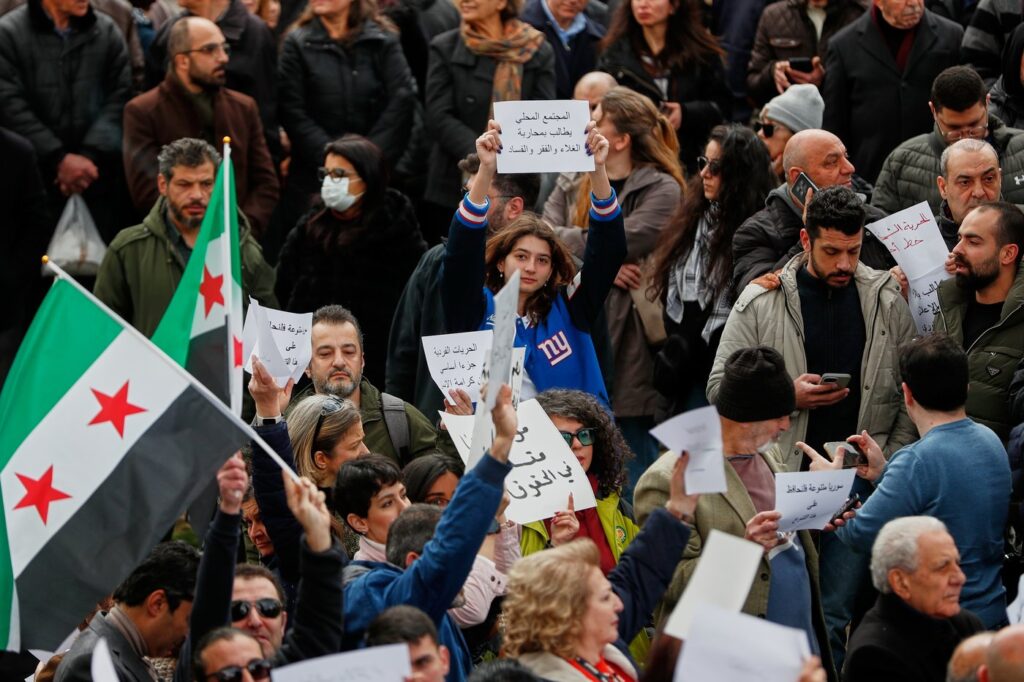
DAMASCUS, Syria - On Sunday, large crowds of Syrians took to the streets in protest against the government's recent restrictions on the sale and consumption of alcohol in Damascus. This significant demonstration reflects growing concerns within the cosmopolitan capital about potential threats to longstanding secular freedoms under Syria's newly established Islamist government.
Hundreds of residents representing various religious sects gathered in Bab Touma, a predominantly Christian neighborhood, chanting slogans such as "Syrians are united!" and holding signs advocating for the protection of personal liberties and the rights of religious minorities. Isa Qazah, a 45-year-old sculptor from the area, voiced the sentiment of many by stating, "This is not about whether we want to drink alcohol, this is about personal freedom. We have come here to defend an idea."
Despite the heavy presence of armed security forces surrounding the protest, the demonstration proceeded without incident. The controversy intensified last week when the governor of Damascus issued a decree prohibiting "the provision of alcoholic beverages of all kinds in restaurants and nightclubs" across the city. According to this decree, establishments will have three months to comply, either by removing their alcohol menus or by converting their licenses to operate as cafes.
This controversial decision, labeled as being made "at the request of the local community," has come as pressure mounts on the interim government, led by former Islamist rebel President Ahmed al-Sharaa, from hard-line factions advocating for more conservative Islamic values. Although al-Sharaa has yet to publicly comment on the alcohol restrictions, he faces the challenge of balancing these pressures with a commitment to pluralism and unity.
The backdrop of this unrest is significant, as Syria has been grappling with the aftermath of 14 years of civil war and decades of dictatorship. The former president, Bashar Assad, who belonged to the Alawite religious minority, supported a secular ideology to maintain the loyalty of minority groups in a predominantly Sunni nation. Under his regime, while civic and political freedoms were severely limited, there was relative freedom regarding alcohol consumption and secular lifestyles.
As al-Sharaa assumed interim leadership, he pledged to unite the country while respecting its diversity. Nevertheless, many citizens remain apprehensive amidst reports of sectarian violence, including numerous recent attacks targeting Alawites and Druze communities by pro-government Sunni fighters. These tensions are compounded by the new alcohol restrictions, which allow the sale of alcohol in select Christian neighborhoods while severely limiting its sale elsewhere in the city.
Protesters voiced their fears that the restrictions on alcohol could exacerbate existing sectarian tensions, with critics arguing that the decree unjustly frames Christians as responsible for what the authorities term "violations of public morals." Although Islamic law typically prohibits alcohol consumption, many secular Muslims live in Damascus, adding to the complexity of the issue.
Fawaz Bahauddin Khawja, a Christian lawyer at the protest, criticized the decree's implications, stating, "How are our neighborhoods violating public etiquette? The division this creates is unfair and irresponsible." He emphasized the importance of unity among Syrians, asserting that "the only flag we raise is the Syrian flag."
In response to the mounting criticism leading up to the protest, Damascus authorities released a statement apologizing to the city's Christian population for any misunderstanding regarding the decree. They clarified that hotels would be exempt from the alcohol restrictions and attempted to reassure the public that the decision was not an infringement on personal freedoms. They maintained that regulation of alcohol sales is standard across nations, albeit with variations in enforcement.








