

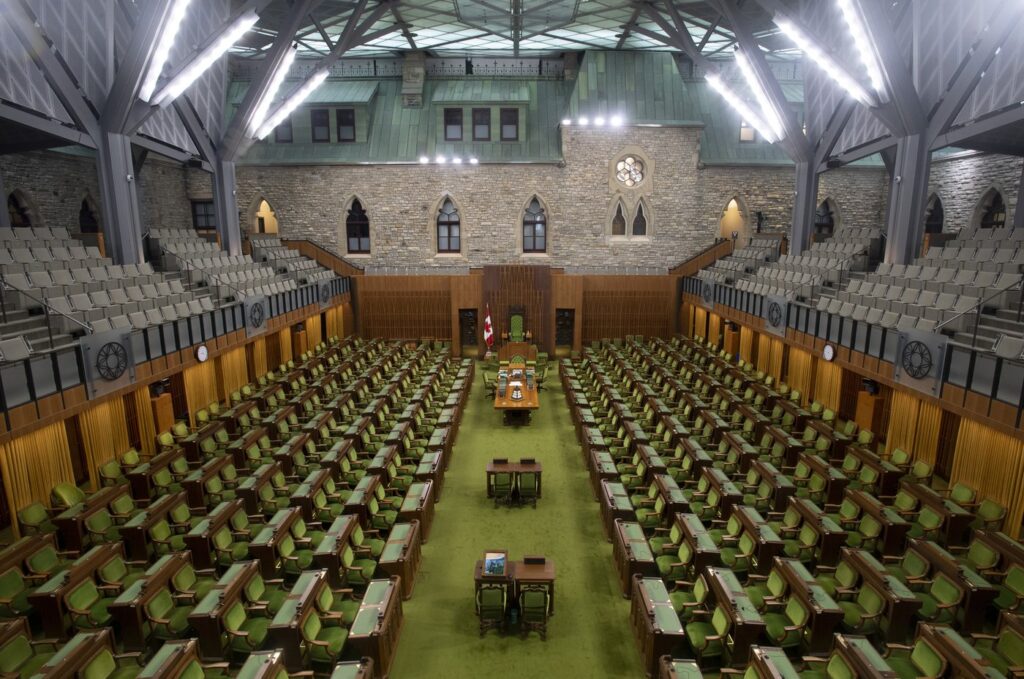
OTTAWA – Contrary to popular belief, the choice made by voters in the Montreal-area riding of Terrebonne during the April 13 byelection will significantly impact the legislative process in the House of Commons. The procedural rules of the Commons indicate that in the current Parliament, the magic number for a government to operate freely is not the commonly thought figure of 172 seats—representing a majority of the 343 seats—but rather 173 seats.
Presently, there are three vacant seats in the House. Observers speculate that the Liberal party is expected to retain its two strongholds in the Toronto area, raising their total to 172 seats. A potential win for Liberal candidate Tatiana Auguste in Terrebonne could thus render the question of legislative control moot.
The Liberals previously won the Terrebonne riding by just one vote in April 2025 against Bloc Québécois candidate Nathalie Sinclair-Desgagné. However, the Supreme Court of Canada annulled that election result last month following a challenge by the former Bloc MP concerning irregularities in the voting process.
Should Sinclair-Desgagné succeed in the upcoming contest, the situation could culminate in the Liberals holding 172 seats while the opposition commands 171. The current Assembly has elected a Speaker from the Liberal party, which holds significant weight given the narrow margins.
It is notably uncommon for the Speaker to cast votes in the House of Commons. According to established procedures, the Speaker employs a “casting vote” solely in the event of a tie. In such a scenario, the Speaker would also face the challenge of balancing impartiality with constituency representation. The Speaker is, in theory, allowed to vote according to personal conviction, similar to other Members of Parliament (MPs). Nonetheless, convention dictates that the Speaker typically votes to uphold the status quo.
Current Speaker Francis Scarpaleggia, representing Montreal, has indicated through his office that he adheres to prevailing practices in voting situations. For third readings, which represent one of the final stages of legislation, he would vote against a measure to preserve existing conditions. Conversely, at earlier legislative stages, he might vote in favor to stimulate discourse among MPs.
Ultimately, this indicates that even if the Liberals command 172 seats, they would still require the backing of at least one additional MP to successfully advance any legislative bills. A major point of contention would arise when the Speaker must vote on matters of confidence—a category that includes financial legislation such as the federal budget.
If faced with a tie during the critical stage of voting on the budget bill, the Speaker’s decision would hinge on a nuanced interpretation of what “status quo” entails in that scenario. His office stated that this would necessitate a case-by-case decision, providing no definitive leanings on how the Speaker might choose to vote regarding confidence matters.
Geneviève Tellier, a political studies professor at the University of Ottawa, asserted that the Liberal government appears prepared to utilize any means necessary to maintain power and advance legislation with its current resources. She indicated that if the need arises for an extra vote, the government might consider appointing someone from the Opposition to the Speaker’s role. The scenario leaves room for speculation regarding the repercussions following a possible prorogation of Parliament by Prime Minister Mark Carney, which would prompt a new election for the Speaker.
In case of a deadlock, Carney could rationalize calling for a general election. Given the complex factors in play, the dynamics in the House of Commons are set to be truly pivotal in the upcoming legislative session.








