

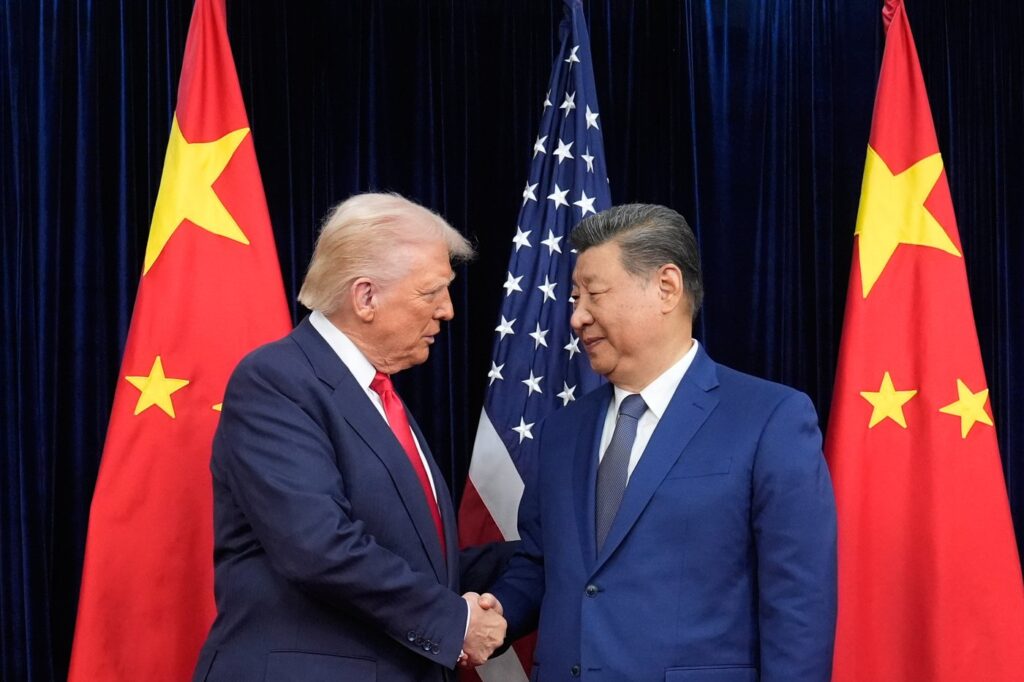
In a recent return to the White House, President Donald Trump has shifted his stance on Taiwan, leading to concerns ahead of his upcoming summit with Chinese President Xi Jinping. The current approach raises questions about whether Trump would be willing to reduce support for Taiwan, an island democracy claimed by Beijing. In December, Trump authorized an unprecedented $11 billion arms package for Taiwan—the largest ever directed to the island—but has yet to proceed with its delivery while reportedly discussing the sale with Xi.
Additionally, Trump has criticized Taiwan for allegedly "stealing" America's semiconductor industry and has suggested that Taiwan should financially compensate the U.S. for its protection. He has employed the threat of substantial tariffs to encourage Taiwan to make significant investments in U.S. semiconductor manufacturing while urging Taipei to purchase billions in U.S. liquefied natural gas and crude oil.
This rhetoric has fueled speculation in Beijing, Taipei, and Washington about the U.S. commitment to Taiwan's defense. Retired U.S. Navy Rear Admiral Mark Montgomery voiced concerns that Taiwan could become a bargaining chip during the upcoming discussions between Trump and Xi. He stated, "I do worry that we have a transactional president and a transactional opportunity could arise, and then we would have a challenge."
Chinese officials have indicated that Taiwan will be a central topic in the discussions between Trump and Xi. Chinese Foreign Minister Wang Yi raised the issue during talks with Secretary of State Marco Rubio, emphasizing the need for the U.S. to "make the right choices" regarding Taiwan to maintain stability between the two nations. Rubio maintained that U.S. policy towards Taiwan has not changed, stating, "We don’t want to see any forced or compelled change in the situation. It would be destabilizing to the world."
White House officials have highlighted that during Trump's second term, he has approved more military sales to Taiwan than the $8.4 billion authorized by President Joe Biden during his four years in office. Taiwan's lawmakers recently approved $25 billion for arms purchases, although this was less than the earlier proposed $40 billion by Taiwan President Lai Ching-te. A senior Trump administration official expressed disappointment that the parliament did not fully fund Lai's proposal.
With rising tensions and concerns, Taiwan's officials have expressed unease over China's aggressive rhetoric but were somewhat reassured by Rubio's comments reinforcing the unchanged U.S. policy. National Security Bureau Director-General Tsai Ming-yen conveyed that the U.S. has reiterated its position on Taiwan through various channels, suggesting that while China might engage in some maneuvering, the U.S. stance remains consistent.
Experts are analyzing how far Xi might push Trump towards accepting Beijing's perspective on Taiwan. Since viewing Taiwan as a renegade province destined for annexation, China has sought to limit formal diplomatic relations between countries and Taipei. Although the U.S. acknowledges China's claim over Taiwan, it does not explicitly endorse it and has historically opposed unilateral changes to the status quo.
Meanwhile, there are concerns about how Trump's transactional nature might influence U.S.-Taiwan relations, with some analysts suggesting that Trump might be inclined to consider concessions in the arms sales or U.S. official visits to Taiwan. Trump has previously suggested discussing arms sales with Xi, signaling a potential shift in established U.S. policy.
Furthermore, a dispute between Japan and China regarding Taiwan has also raised the stakes, with Japanese Prime Minister Sanae Takaichi asserting that a Chinese attack on Taiwan could threaten Japan's survival and necessitate military action. Trump has had discussions with both Takaichi and Xi but has largely refrained from addressing this conflict directly.
As the summit approaches, Taiwan's critical role in the global semiconductor supply chain may provide it with leverage. Experts believe that Trump is aware of Taiwan's significance to U.S. economic interests, suggesting that drastic policy changes concerning Taiwan may be unlikely. However, analysts remain vigilant for any off-the-cuff remarks from Trump that could signal a shift in U.S. support for Taiwan.








