

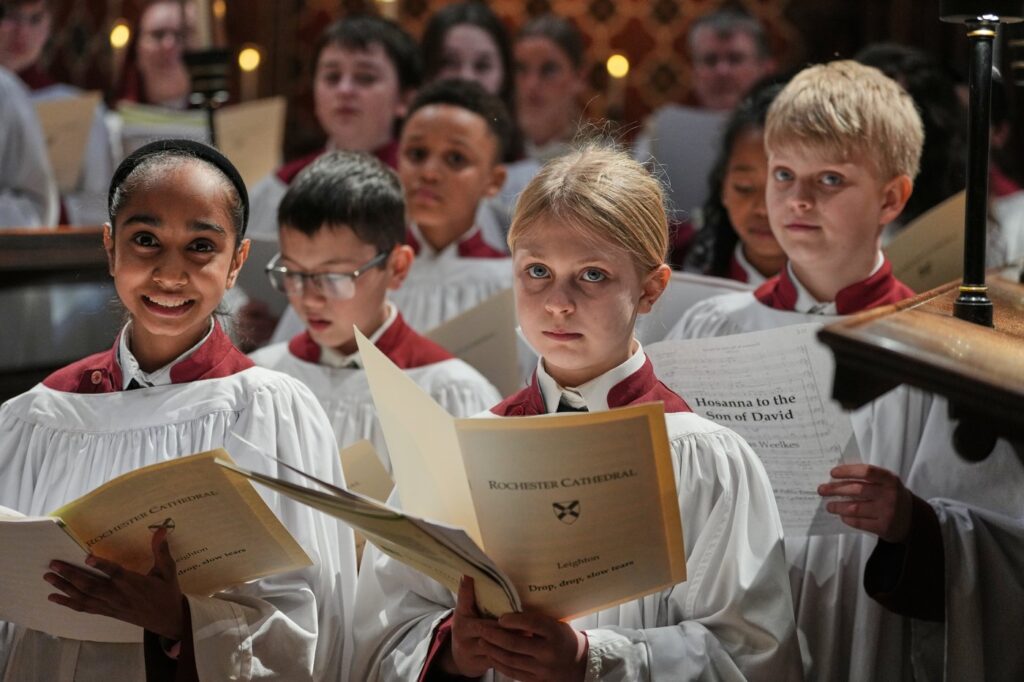
LONDON (AP) — On a somber afternoon shortly before Easter, a group of schoolchildren entered a side building at Rochester Cathedral, ready for a transformation. They shed their jackets and backpacks, donning traditional burgundy cassocks and white surplices. With their uniforms in place, they made their way into the cathedral, where they united their voices as a choir and embraced a choral tradition that has persisted within the Church of England for nearly 500 years.
Adrian Bawtree, the choir’s music director, emphasized the importance of this musical heritage, stating, “I think for me, it’s one of the sounds of our country.” He highlighted the experience of being in a cathedral, describing it as a sacred space that allows individuals to immerse themselves in music, leaving them transformed after just 30 minutes.
The pinnacle of this choral tradition is Choral Evensong, an evening service composed of hymns, psalms, and prayers established by Archbishop Thomas Cranmer, the first Protestant archbishop of the Church of England, in 1549. During this service, the choir performs, while the congregation participates mainly through listening.
However, this rich tradition faces significant challenges. Modern lifestyle demands, decreasing church attendance, and limited funding make it increasingly difficult to discover and nurture new generations of choristers. To combat this decline, advocates have initiated a campaign urging the government to recognize English choral services as a vital aspect of Britain's cultural identity under a U.N. program aimed at safeguarding “intangible cultural heritage” alongside historic monuments and natural sites.
The U.K. government is currently seeking nominations for a nationwide catalog of cultural traditions to be preserved, encompassing everything from Morris dancing to the craft of dry stone walling. According to the government, protecting these traditions is essential for fostering community identity and strengthening the economy, particularly as heritage tourism contributes billions of pounds to annual revenues.
While many learn about English choral services through the enchanting voices of choristers clad in flowing robes at royal weddings and carol services, numerous choirs perform daily in far more modest settings, and many of them are facing significant challenges. The Cathedral Music Trust, established in 1956 to address the decline of church music post-World War II, reported that it distributed £500,000 ($661,000) last year to 28 cathedrals and churches across the country. For instance, Rochester Cathedral allocates about £250,000 ($330,000) annually for music, reflecting both the financial commitment required and the struggles present among provincial cathedrals.
Trust CEO Jonathan Mayes expressed optimism, noting that recognition of the English choral tradition could attract crucial attention and funding for choirs that serve as vital training grounds for both religious and secular musicians. He remarked, “Whilst it happens every day, it is actually quite fragile. It takes an awful lot of work and it takes a lot of funding to actually make it happen and that doesn’t come without effort.”
The historical significance of preserving Evensong cannot be overstated, as the service played a key role in the evolution and dissemination of the modern English language. Diarmaid MacCulloch, a Christianity scholar and emeritus professor at the University of Oxford, explained that the service is rooted in the Book of Common Prayer, which Cranmer compiled to ensure English became the language of the Church of England following its split from the Latin-dominant Catholic Church during the Protestant Reformation. The goal was to create services accessible to everyone.
MacCulloch added that Evensong has acted as a dramatic narrative performed by the people of England since 1549, holding more significance in terms of public consciousness than any of Shakespeare's plays. Despite some modern adaptations, the structure of the service remains largely unchanged, still recognizable to both Queen Elizabeth I and Queen Elizabeth II, reflecting its remarkable longevity.
Bawtree, who oversees the youngest choristers aged 9-13 and a youth choir for older children, aims to keep this tradition alive. He recalls his first encounter with church music during his childhood, describing it as a transformative experience. He hopes to pass that passion on to future generations, inviting everyone, regardless of belief, to enjoy the beauty of choral music experienced in services like Evensong. He noted, “We talk in the world of mindfulness and the power of music to transform lives. This is an extraordinary arena where that can happen.”








