

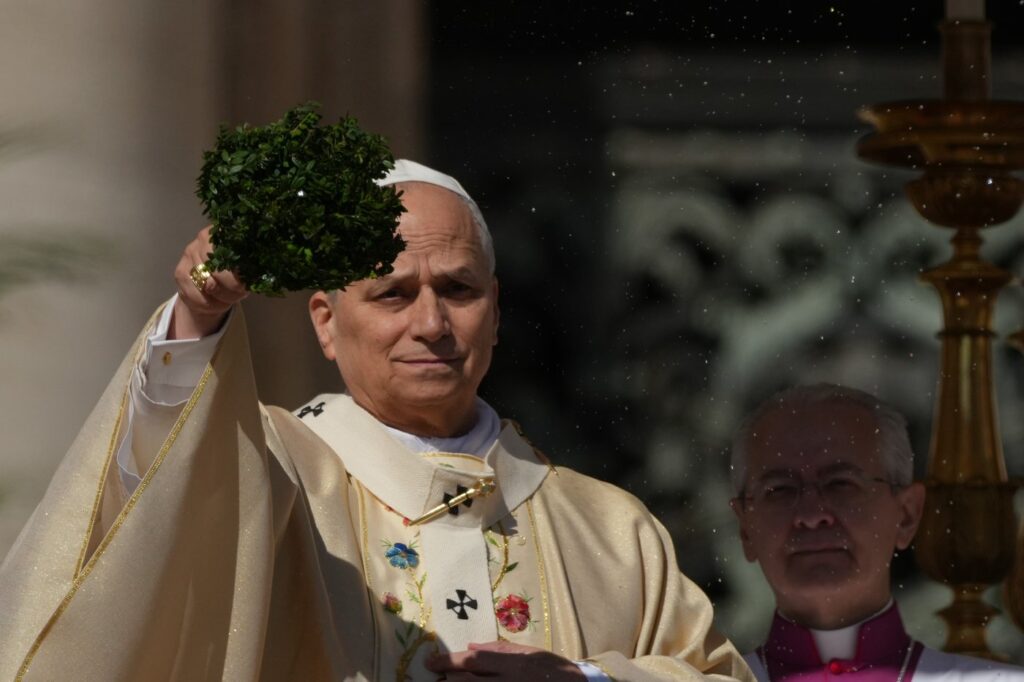
VATICAN CITY (AP) – Pope Leo XIV celebrated his first Easter Mass as pontiff, focusing on the theme of hope amidst ongoing global conflicts. In his Easter homily, delivered from an open-air altar in St. Peter’s Square, Pope Leo urged the faithful to sustain hope against the "violence of war that kills and destroys." He highlighted the pervasive nature of conflict, specifically referencing the U.S.-Israeli war on Iran and Russia's ongoing campaign in Ukraine, calling for a cessation of hostilities.
Pope Leo, the first U.S.-born pope, expressed deep concern over the state of the world, condemning those who initiate wars, exploit the vulnerable, and prioritize profits over human dignity. He emphasized the importance of remaining hopeful despite the pervasive death and suffering caused by injustices, selfishness, and oppression of the poor. According to the pope, the "cry of pain" from every corner of the world bears witness to the struggles faced by the weakest members of society. He also warned against the "idolatry of profit" that plunders the earth's resources.
In a message that resonated with his predecessor Pope Francis's teachings, Pope Leo XIV cautioned against the dangers of indifference in the face of persistent injustices and cruelty. He reminded the congregation that even in the darkest times, new life can emerge, eventually leading to fruitful outcomes. The pontiff's Easter message was underscored by the blooming white roses and spring flowers that adorned St. Peter's Square, symbolizing the hope he implored his followers to embrace.
Later in the day, Pope Leo XIV was scheduled to deliver the traditional "Urbi et Orbi" message, which translates to "to the city and the world." This address is often used by the pope to reach out to both the residents of Rome and the global Christian community, providing a moment of reflection on peace and reconciliation.
In a related context, Christians in the Holy Land observed a subdued Easter due to ongoing tensions and restrictions imposed by Israeli authorities. Traditional ceremonies at the Church of the Holy Sepulchre, believed to be the site of Jesus' crucifixion and resurrection, were significantly scaled back following an agreement with Israeli police. These measures were taken as a precaution amid ongoing missile attacks, affecting the size of public gatherings.
These restrictions further complicated the recent Muslim holy month of Ramadan and the Eid al-Fitr holiday, in addition to overlapping with the ongoing weeklong Jewish festival of Passover. Notably, the Jewish priestly blessing at the Western Wall, which typically draws tens of thousands of attendees, was limited to just 50 people, reflecting the broader impact of security measures on religious practices.
The growing tensions have caused strain in the relationships between Israeli authorities and Christian leaders. In a recent incident, Israeli police prevented two top religious leaders, including Latin Patriarch Pierbattista Pizzaballa, from celebrating Palm Sunday at the Church of the Holy Sepulchre, intensifying concerns about religious freedoms in the region. Furthermore, just days prior to Easter, Pope Leo XIV had expressed hope that ongoing conflicts could reach resolution before the holiday observance, showcasing his desire for peace in a tumultuous world.








