

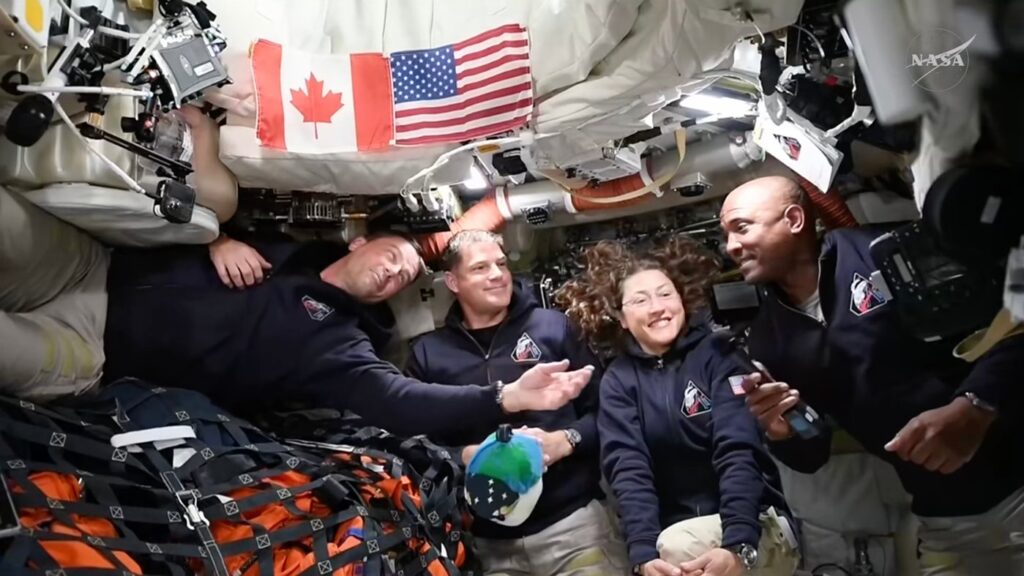
Jeremy Hansen is on the verge of making history as the first Canadian astronaut to orbit the moon as part of NASA's Artemis II mission. Just days before this monumental event, Hansen participated in a live question-and-answer session from aboard the Orion spacecraft alongside American astronauts Reid Wiseman and Christina Koch. The event, which took place on April 4, 2026, was aimed at engaging Canadian children by answering their space-related inquiries.
The virtual engagement was held about four days into the mission, which is set to last a total of 10 days. During the Q-and-A session, various intriguing questions were posed, including how food is prepared and consumed in space. Additionally, Hansen was asked to recommend a film that encapsulates the experience of being in space. He chose the classic "Apollo 13," released in 1995 and starring Tom Hanks, noting that although the film depicts a disaster, it captures the essence of a small group of humans surviving together in a confined space. “It’s one of my favourite space movies,” Hansen remarked.
Before the interaction, NASA officially confirmed on social media that the crew was “moonbound” and already more than halfway to their destination. They shared stunning images of the moon along with an internal view of the Orion capsule, further captivating the audience's imagination.
The Artemis II mission marks the first crewed expedition to the moon since the Apollo missions of the 1960s and 1970s. The mission has faced delays, primarily attributed to issues with hydrogen fuel leaks and helium flow problems. On this Sunday event, a young audience member curious about the effects of microgravity on human organs was informed by Hansen that he personally has not experienced significant changes, although he noticed a redistribution of blood within his body, leading to a puffiness in his face due to the absence of gravitational pull.
Christina Koch added that as astronauts adapt to microgravity, their organs also change function. For instance, the heart has to exert less effort to pump blood to the brain. However, she cautioned that prolonged exposure to microgravity can pose risks, including potential kidney disease.
Hansen was also asked whether the crew could see a crescent-shaped Earth, akin to how people on Earth might observe a crescent moon. “The reality is we do,” he confirmed, noting that they have seen partial and crescent shapes of Earth from their vantage point in space.
The four-member crew, which also includes Victor Glover, is scheduled to perform a lunar flyby around Day 6 of their mission. During this segment of the journey, they will zoom around the moon in their Orion capsule, which is about the size of a campervan. Upon reaching the moon, they are expected to spend several hours observing and photographing its surface, contributing valuable data that may assist scientists in comprehending the geological processes that have shaped both the moon and the solar system as a whole. The moon will appear about the size of a basketball when held at arm's length during their closest approach.
In discussing the personal sacrifices involved with such an ambitious mission, Hansen acknowledged the support and understanding from his family. He expressed appreciation for their encouragement and willingness to make sacrifices for him, highlighting the emotional challenges associated with being away from loved ones during such critical endeavors. “There’s a lot of sacrifice from the family,” he stated.
Moreover, responding to a question posed in French regarding the role of youth in future space exploration, Hansen emphasized the importance of the next generation's contributions. He encouraged young people to pursue their interests, learn extensively, share their dreams, and collaborate as a team to make meaningful advancements for humanity.
The crew, as part of the Artemis II mission, is anticipated to return to Earth, splashing down in the Pacific Ocean near San Diego on April 10, 2026. This mission is not only a crucial step in space exploration but is representative of international collaboration in the pursuit of scientific knowledge and discovery.








