

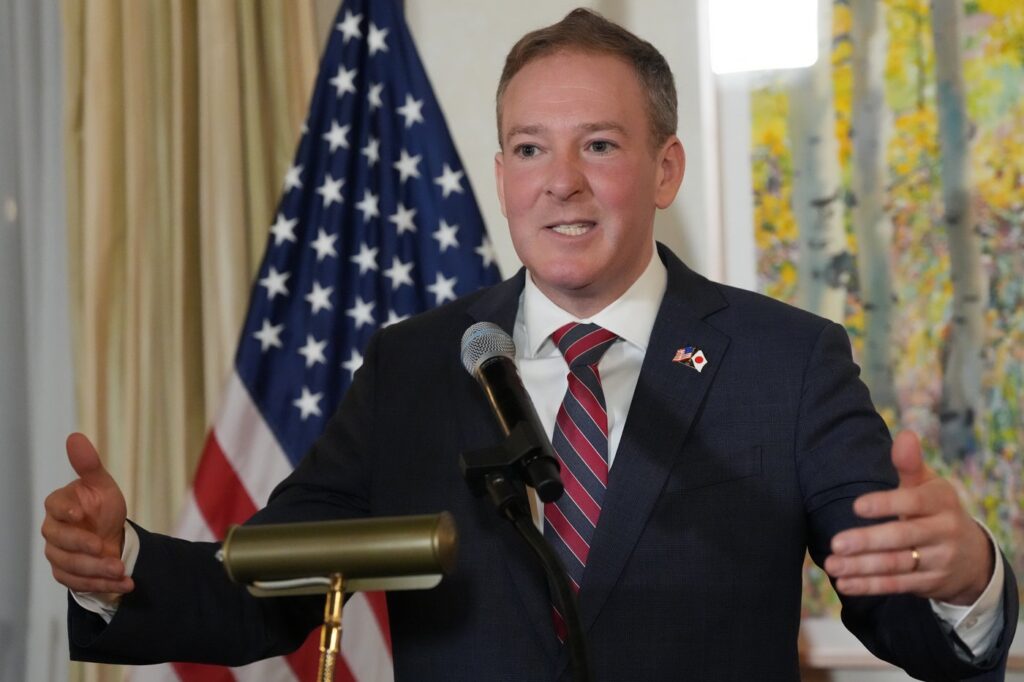
On Wednesday, the head of the Environmental Protection Agency (EPA), Lee Zeldin, defended his decision to repeal a key legal determination known as the "endangerment finding." This decision serves as the cornerstone for federal regulations aimed at mitigating climate change. Speaking at a conference hosted by the Heartland Institute, a conservative think tank that disputes mainstream climate science, Zeldin encouraged attendees to "celebrate vindication" for their long-standing skepticism regarding climate change.
During his keynote address, Zeldin, a former Republican congressman from New York, characterized the repeal of the 2009 endangerment finding as a correction of what he termed "decades of unthinking adherence" to perspectives presented by liberal politicians and environmental advocates about the perils of climate change. He heralded the occasion as "a day to celebrate," expressing his belief that the finding had been misused to promote an agenda that restricted industry and economic growth.
The EPA's revocation of the endangerment finding, which has underpinned regulations on greenhouse gas emissions from power plants and vehicles for 16 years, aligns with the Trump administration's broader effort to rollback environmental protections. The administration contends that the finding has unnecessarily hampered industry and economic progress, alleging that the previous Obama and Biden administrations manipulated scientific research to frame greenhouse gases as a public health risk.
Zeldin's presence at the Heartland conference is indicative of a significant departure from traditional environmental policies, showcasing the Trump administration's inclination to support industry interests over regulatory measures meant to protect the environment. He acknowledged the conference attendees as key supporters against the establishment of the endangerment finding back in 2009, emphasizing the group's role in shaping the current regulatory landscape.
Environmental groups and advocates criticized Zeldin's speech, accusing him of legitimizing disinformation at a critical time when climate change is increasingly associated with severe weather events such as intensified hurricanes, flooding, and wildfires. Joe Bonfiglio, an executive at the Environmental Defense Fund, denounced the Heartland Institute as a "disinformation factory" and expressed concern that Zeldin’s remarks exemplified a complete neglect of the EPA's commitment to safeguarding public health and the environment.
In response to the backlash, an EPA spokeswoman downplayed the criticism, claiming that "the era of the EPA as a vehicle for radical ideology is over." She asserted that Zeldin aims to engage with a diverse range of groups while focusing on fulfilling the agency's statutory obligations. According to the EPA, Zeldin's approach is grounded in credible science rather than alarmist narratives that aim to compel public adherence to regulatory frameworks.
The 2009 endangerment finding identified carbon dioxide and other greenhouse gases as threats to public health and welfare and is a foundational element for numerous climate regulations under the Clean Air Act directed at vehicles and power plants. The repeal of this finding not only undermines existing greenhouse gas emissions standards for cars and trucks but also opens avenues for dismantling a broader range of climate-related regulations affecting stationary sources like power plants and oil and gas operations. A coalition of nearly two dozen states, along with various public health and environmental organizations, has already filed legal challenges in response to the changes enacted by the EPA.








