

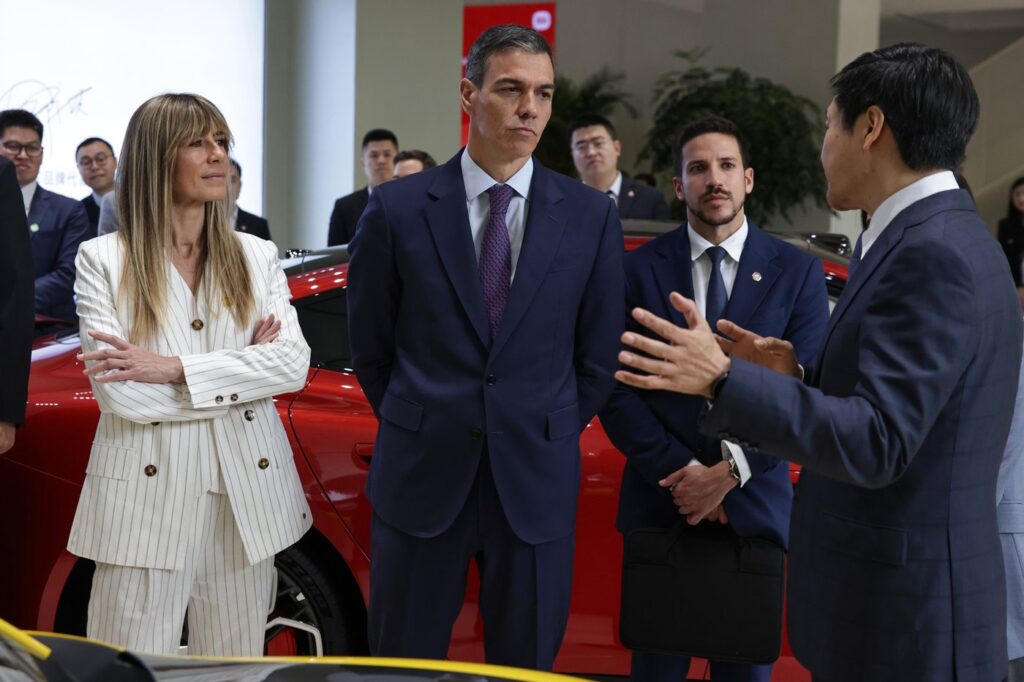
MADRID (AP) — Spanish Prime Minister Pedro Sánchez is making his fourth visit to China in as many years this week, reflecting Spain's intent to strengthen its political and commercial ties with the world's second-largest economy. This visit comes at a time of heightened geopolitical complexity, particularly with European leaders attempting to influence an end to the ongoing U.S.-Israeli conflict in Iran. Spain's relationship with the United States has also become strained, further underscored by Sánchez’s outspoken criticism of U.S. initiatives in the region.
During his trip, Sánchez addressed an audience at Beijing’s Tsinghua University on Monday, where he called for China to take on a more significant role in fostering a multipolar world. He emphasized the importance of adhering to international law while urging an end to various conflicts, including those in Lebanon, Iran, Gaza, the West Bank, and Ukraine. His subsequent meetings with Chinese President Xi Jinping are slated for the following day, underscoring the importance of this diplomatic engagement.
One primary objective of Sánchez's trip is to diversify Spain's political relationships with major global powers, including China. Spanish officials have expressed a desire to attract greater Chinese investment while also aiming to boost exports to the Asian nation. Despite trade negotiations being administered by the European Union, Sánchez's trip showcases Spain's efforts to capitalize on opportunities stemming from its domestic energy transition, particularly in acquiring essential raw materials, solar panels, and green technology from China as it moves away from fossil fuels.
Politically, Sánchez's visit takes on added significance as Spain has emerged as one of the most vocal critics of U.S. and Israeli military actions in the Middle East. The Sánchez administration has taken definitive stances, including recently closing Spanish airspace to U.S. aircraft involved in operations related to Iran and denying U.S. access to jointly operated military bases in southern Spain. Eric Sigmon, a Madrid-based political analyst and former U.S. national security adviser, highlighted that such frictions have elevated the importance of these annual meetings with China.
Sánchez is in China from April 13 to 15, where he is scheduled to engage in important discussions with Xi, Premier Li Qiang, and Zhao Leji, the senior lawmaker within the ruling Communist Party. Spain’s less adversarial stance toward China compared to other EU member states could benefit its diplomatic and economic pursuits. Over recent years, while investments from China to large EU economies like France and Germany have diminished, Chinese investments in Spain have actually increased since 2019.
As the fourth-largest economy in the eurozone, Spain recognizes the need to maintain strong relations with significant global powers. The Sánchez administration has articulated its intention to enhance bilateral ties, not only with China but also with India, while managing its alliance with the United States. Notably, King Felipe VI of Spain visited China in November, marking the first visit by a Spanish monarch in 18 years and signifying the nation's commitment to reinforcing ties with Beijing.
Sigmon remarked that the economic and commercial aspects of Spain’s relationship with China are critical, considering Spain’s need for foreign capital and investment. For China, having Spain as a relatively amicable partner within Western Europe is advantageous. However, the existing imbalance in the relationship suggests that Spain may find it challenging to negotiate significant concessions from Chinese authorities on technology transfers or other areas of interest.








