

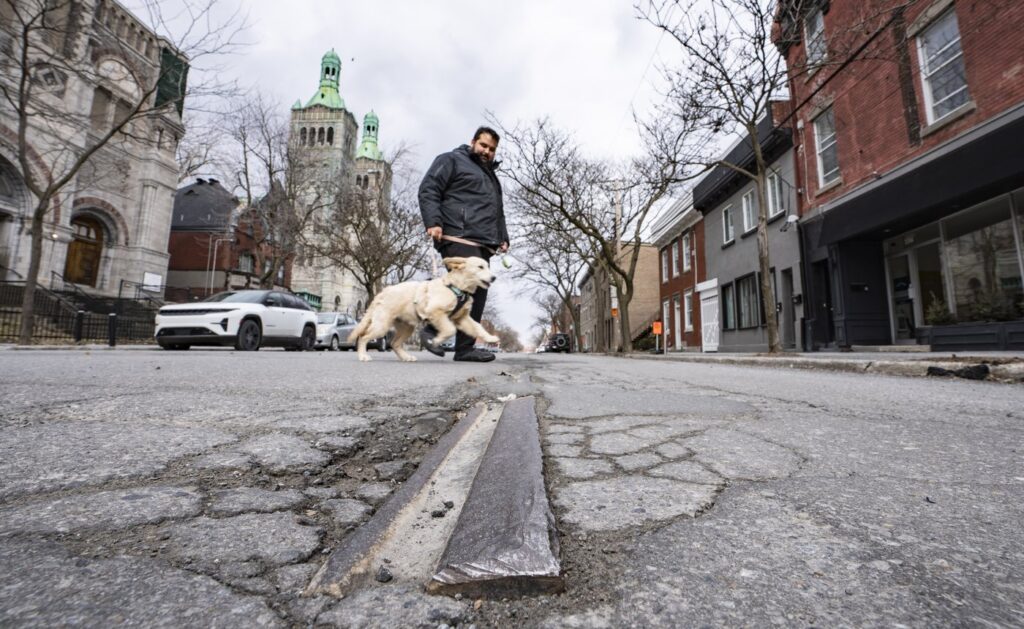
MONTREAL — The remnants of Montreal's once-thriving streetcar network are slowly emerging from beneath the asphalt as the spring thaw weakens the city's roads. The last operational streetcars disappeared from the city in 1959, but traces of their existence can still be found, such as a rusting metal rail peeking through a pothole near St-Laurent Boulevard. This forgotten network, which spanned hundreds of kilometers, used to transport millions of passengers annually.
The decision to pave over the old track instead of removing it stemmed from the high costs and time involved in the latter, according to Benoît Clairoux, a historian and communications advisor with Société de Transport de Montréal (STM). He reflects on the historical significance of these remnants, stating, “We might forget it today, but Montreal was a tramway city, like many other North American cities.” At its peak in the early 1930s, the network boasted 500 kilometers of track and nearly 1,000 operating vehicles.
The origins of Montreal's tramways date back to 1861, when horse-drawn trolleys made their debut. Electrification in 1892 allowed for a significant expansion, enabling a broader service across the city. Despite an increasing preference for buses during the 1930s, the Second World War briefly revitalized the streetcars due to restrictions on gasoline and tires, leading to a surge in ridership that peaked at nearly 400 million rides by 1947—a record that would not be broken until 2011.
According to Clairoux, various economic factors ultimately led to the tramways' demise. Streetcars required significant investment in infrastructure, such as rail tracks and overhead cables, which needed maintenance during the harsh winter months. Additionally, streetcars often disrupted traffic flow, much to the irritation of drivers, as they halted in traffic lanes, contrasting with buses that could pull aside to let cars pass. By the early 1950s, as the city established a new transit agency to take over the aging tramway system, the decision was made to retire the streetcars in favor of buses and eventually the Montreal Metro.
Despite recognizing the complications associated with streetcars, some residents advocate for their return. Pierre Barrieau, a transportation historian, argues that streetcars are faster, more comfortable, and generally favored by the public. He asserts that streetcars play an integral role in fostering dense urban development, stating, “Both buses and streetcars move people around, but we don’t transform cities around bus networks.”
In recent years, several cities across North America have begun to invest in tram lines, aiming to promote urban density near public transit hubs. However, this resurgence has not come without challenges. In a notable incident in Toronto, a man named Mac Bauer drew attention to the city's inadequacies by demonstrating that he could outrun the slow-moving streetcars, highlighting the pressing need for better transit infrastructure.
Barrieau acknowledges that streetcars are not a panacea; they thrive in scenarios where they have dedicated lanes and priority at intersections. He mentions that they are particularly effective for quick trips within neighborhoods rather than extended suburban journeys. Recently, the Autorité régionale de transport métropolitain has proposed a new tramway project, a 38-kilometer line with 31 stations, intended to enhance connectivity in the eastern areas of Montreal.
The agency is currently conducting necessary analyses and studies for project advancement, as stated in their communication. However, as for the remnants of the past, the buried tracks beneath Montreal's streets may remain hidden for the foreseeable future. Clairoux expresses uncertainty about the exact number of kilometers of old tracks still underneath the city, hinting that city officials may opt to remove them only during complete road renovations—a strategy reminiscent of the 1950s approach that initially led to their coverage.








