

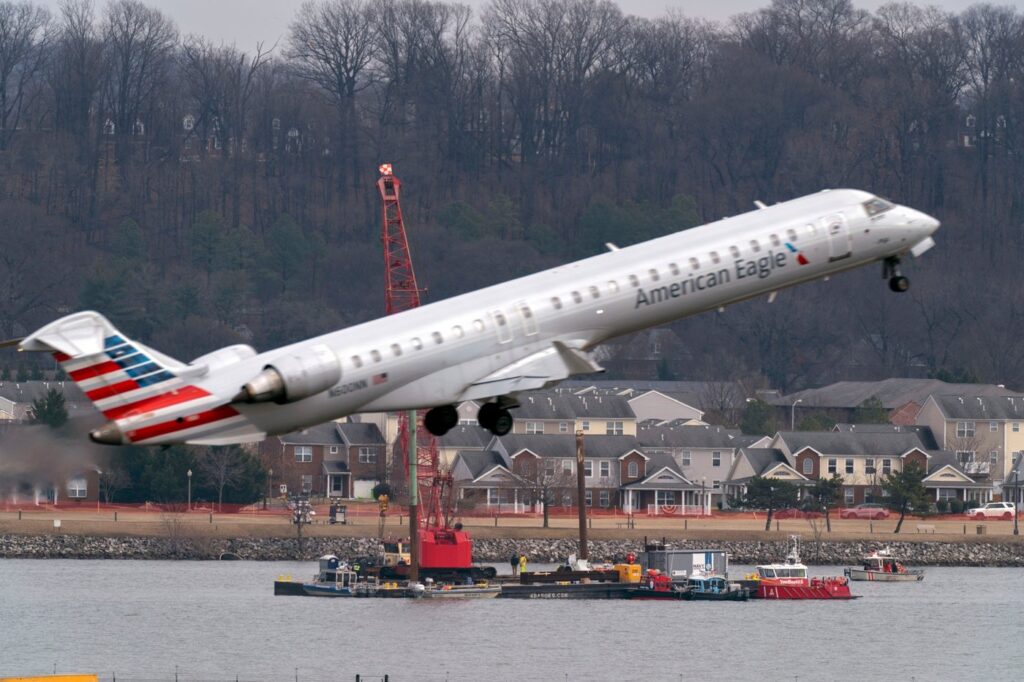
An aviation safety bill aimed at addressing the lessons learned from the devastating midair collision involving an American Airlines jet and an Army Black Hawk helicopter near Washington, D.C., is scheduled for a vote in the House of Representatives on Tuesday evening. The tragic incident, which occurred on January 29, 2025, resulted in the loss of all 67 individuals on board both aircraft. The families of the victims and several key senators believe the proposed legislation, known as the Alert Act, requires further strengthening to prevent similar tragedies in the future.
The Alert Act has garnered backing from prominent industry groups and is designed to fulfill recommendations made by the National Transportation Safety Board (NTSB). The revised legislation now mandates that all aircraft operating near busy airports be equipped with key locator systems, enabling pilots to gain more accurate awareness of the locations of other nearby aircraft. NTSB Chairwoman Jennifer Homendy has emphasized that such technology could have prevented the tragedy, adding that the board has been advocating for these systems since 2008.
The Alert Act was previously advanced unanimously by two key House committees and is currently set for a full House vote without the possibility of amendments. Although the bill has significant industry support, family members of the victims are urging lawmakers to establish strict timelines to ensure that the proposed reforms are effectively implemented. Sponsored by Republican Sam Graves and Democrat Rick Larens, the legislation must receive a two-thirds majority in the House to proceed to the Senate.
A separate piece of legislation, the ROTOR Act, which was crafted by the Senate, fell one vote short in the House earlier this year. Senators Ted Cruz and Maria Cantwell have voiced their concerns that the Alert Act still requires improvements to adequately address the underlying safety issues in aviation. The NTSB deemed the original version of the Alert Act as “watered down” and insufficient for safeguarding future air travel, although the amended version is thought to better confront the deficiencies identified during investigations.
In a hearing held by the NTSB in late January, members of the board expressed deep concern regarding longstanding warnings about dangers related to helicopter traffic that had been overlooked prior to the collision. The accident is noted as the deadliest plane crash on U.S. soil since 2001, with 28 members of the figure skating community among the victims. Following the incident, the NTSB found that a helicopter route in the approach path to Ronald Reagan Washington National Airport did not provide adequate separation between helicopters and landing aircraft, primarily due to infrequent reviews of the flight paths.
The revised legislation now requires planes to be installed with Automatic Dependent Surveillance-Broadcast In (ADS-B In) systems, which have the capability to receive data regarding the locations of other aircraft. Proponents of these systems argue that they could have alerted the pilots of the American Airlines jet sooner, potentially preventing the collision. While many aircraft are already equipped with complementary ADS-B Out systems that broadcast their own locations, there is a critical need for comprehensive implementation.
The NTSB has identified systemic weaknesses and repeated neglect of warnings as primary factors leading to the crash. Homendy stated that if both the airplane and the Black Hawk helicopter had been equipped with active ADS-B systems during the incident, the midair collision could have been averted. At the time, U.S. Army policy mandated that helicopters operate without this system turned on, to maintain operational security, even though the helicopter was on a training mission rather than a sensitive operation.








