

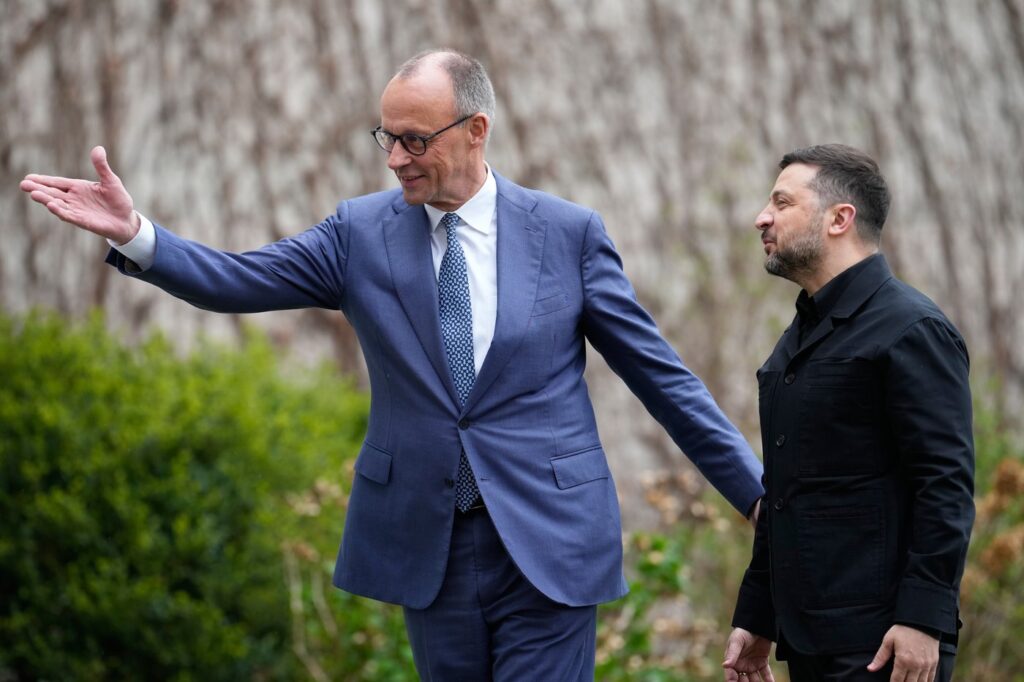
In Berlin, Ukrainian President Volodymyr Zelenskyy met on Tuesday with German Chancellor Friedrich Merz, emphasizing Germany's role as one of Ukraine's largest supporters in its ongoing battle against Russia's all-out invasion, which has persisted for five years. This meeting underscores the significance of international alliances as Ukraine seeks to bolster its defense capabilities against ongoing military aggression.
In parallel, German Defense Minister Boris Pistorius engaged in discussions with Mykhailo Fedorov, Ukraine's new defense minister who previously held the position of digital transformation chief. Fedorov has garnered praise for advancing military drone technology, reflecting Ukraine's innovative approaches to modern warfare. The collaboration between Ukraine and Germany highlights the importance of technological advancements in addressing contemporary military challenges.
However, U.S.-led initiatives to resolve the conflict in Ukraine have waned recently, as attention shifts to the ongoing war in Iran. Despite this, U.S. Deputy Ambassador to the United Nations, Tammy Bruce, reaffirmed Washington's commitment to pursuing a "negotiated and durable end" to the war in Ukraine, indicating that international focus on the issue remains vital.
Analysts and officials point out that Ukraine has achieved notable successes on the battlefield in recent months, managing to disrupt Russia's spring offensive, which began with improved weather conditions. As fields dry out and foliage offers increased cover, Ukraine's strategic maneuvers appear to be yielding results against a numerically superior Russian army.
Additionally, Ukraine's capabilities have been bolstered by the development of long-range drones and missiles that target oil facilities and manufacturing plants within Russia. According to Finland's President Alexander Stubb, Ukraine is currently in a stronger position than it has ever been during the conflict, claiming that last month, Ukraine deployed more drones and missiles against Russia than it received in return, reflecting a significant shift in military dynamics.
Despite these advancements, Moscow has also reported progress in its military operations, although independent verification of the claims from both sides is challenging. Currently, Russia occupies approximately 20% of Ukrainian territory, including the strategically significant Crimean Peninsula, which was annexed in 2014.
Amidst this backdrop, Ukraine faces significant financial challenges, being in urgent need of a promised 90-billion-euro ($106 billion) loan from the European Union. However, the disbursement of these funds has been delayed by Hungary's Viktor Orbán, although his recent exit as prime minister could potentially facilitate the release of this much-needed support for Ukraine.
Furthermore, Ukraine relies heavily on U.S. intelligence for operational targeting within Russia and necessitates advanced American-made air defense systems to protect its infrastructure from ongoing Russian missile strikes. Concerns loom that the prolonged Iran conflict might dilute U.S. support, which is critical for Ukraine, as President Zelenskyy has expressed apprehension regarding such scenarios.
Additionally, the Ukrainian military is grappling with personnel shortages, reportedly facing around 200,000 troop desertions and a draft avoidance by approximately 2 million individuals, according to Defense Minister Fedorov. This situation complicates Ukraine's capacity to maintain an effective defense against Russian advances.








