

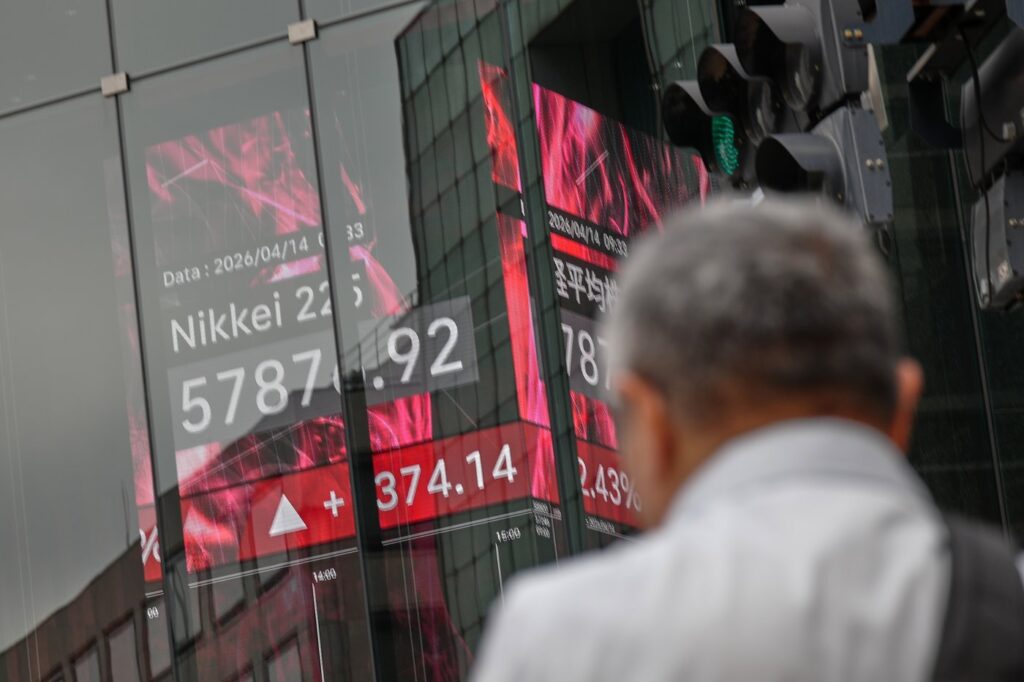
HONG KONG (AP) — Asian stock markets experienced a positive trading session on Tuesday, buoyed by gains from Wall Street. Investors reacted to rising expectations regarding potential further discussions between the U.S. and Iran concerning the ongoing Iran war. Oil prices declined as concerns over the conflict's escalation somewhat eased.
In Japan, the Nikkei 225 index surged 2.4%, reaching 57,877.39. South Korea also noted a significant increase with the Kospi gaining 2.7% to 5,967.75, having briefly surpassed the 6,000 mark during intraday trading. Meanwhile, Hong Kong's Hang Seng index rose by 0.7% to close at 25,832.85, and the Shanghai Composite index climbed 1% to 4,026.63. This came despite China reporting lower-than-expected export growth of 2.5% for March—its first report since the war's onset. However, analysts remain optimistic, suggesting that exports related to artificial intelligence and renewable energy will continue to provide support throughout the year.
In Australia, the S&P/ASX 200 experienced a gain of 0.5%, while Taiwan's Taiex saw an increase of 2.4%. Investors are showing hope for a potential de-escalation in the Iran war, which has now entered its seventh week. It has been reported that U.S. and Iranian officials are contemplating a second round of negotiations before an existing temporary ceasefire agreement is set to expire next week. Last Monday, the U.S. military initiated a blockade of Iranian ports, ramping up pressure on Tehran following unsuccessful ceasefire talks over the weekend.
U.S. President Donald Trump indicated on Monday that the United States is open to dialogue with Iran, revealing that the other side has reached out for communication, although he did not disclose specific details. As a result of these developments, oil prices have started to decline on Tuesday post earlier gains. Brent crude, the international benchmark, fell by 0.9% to $98.45 per barrel, having seen prices near $104 early on Monday due to lingering concerns about the Iran war and the halting progress of ceasefire negotiations.
Benchmark U.S. crude saw a more substantial drop of 2.6%, falling to $96.51 per barrel. This decline can be attributed to ongoing disruptions in maritime traffic, especially in the Strait of Hormuz, where a significant portion of global oil supplies are transported. The global energy crisis arising from these disruptions has contributed to rising fuel prices, leading to stronger inflationary pressures and posing risks to economic growth in various countries.
Across the Atlantic, Wall Street responded positively on Monday, with the S&P 500 gaining 1% to close at 6,886.24. The Dow Jones Industrial Average climbed 0.6% to 48,218.25, while the Nasdaq composite increased by 1.2% to 23,183.74. Interestingly, shares of Goldman Sachs, despite announcing better-than-expected quarterly profits, fell by 1.9% following the report.
Furthermore, commodities like gold and silver experienced an upswing on Tuesday. Gold prices rose by 0.7% to reach $4,802.3 per ounce, while silver prices surged by 3% to $77.91 per ounce. Notably, the value of the U.S. dollar declined, trading at 159.10 yen, down from 159.45 yen and the euro also increased, trading at $1.1778 compared to $1.1759 the previous day.
This ongoing intersection of global financial markets and geopolitical developments underscores the fragility and interconnectedness of today’s economy.








