

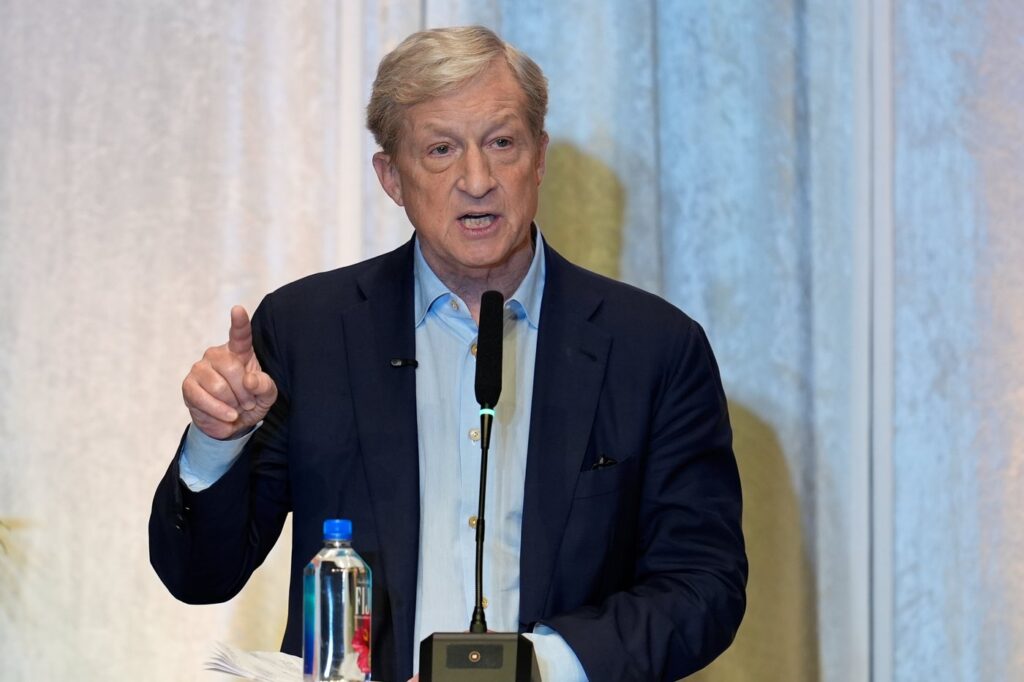
In the highly competitive race for California governor, billionaire Tom Steyer is making headlines with his extravagant spending on campaign advertisements. The former hedge fund manager and liberal activist is leveraging his substantial personal wealth to dominate television and mobile platforms with his messages, which promise to tackle household costs and criticize federal immigration policies.
According to advertising tracker AdImpact, Steyer has reportedly poured over $115 million into various ad formats, including broadcast TV, cable, and radio. This amount is nearly thirty times greater than that of his closest Democratic rival and could potentially surpass the 2010 record set by Republican Meg Whitman, who spent $178.5 million on her unsuccessful gubernatorial campaign. This situation marks a new high for campaign finance in California's political landscape.
Despite his massive ad spending, Steyer has not managed to significantly distinguish himself in the polls, raising questions about the effectiveness of his financial strategy. Veteran Democratic strategist Bill Carrick noted that if initial ad campaigns do not result in a demonstrable increase in poll numbers, subsequent efforts are unlikely to generate a different outcome. Carrick pointed out an unusual sense of stagnation in the current race, where no candidate appears to have seized control, unlike in previous gubernatorial contests.
Historical trends suggest that wealth does not guarantee electoral success. For instance, billionaire developer Rick Caruso invested more than $100 million in his bid for mayor of Los Angeles in 2022, only to be defeated by Karen Bass, who spent a fraction of Caruso's total. Similarly, Steyer's substantial financial contributions to his 2020 presidential campaign did not translate into viable support, leading to his early withdrawal after a disappointing finish in the South Carolina primary.
Steyer has never held an elected office, a circumstance that gives rise to skepticism about his intentions and capabilities among voters. In response to criticisms about his financial influence on political positions, a spokesperson for Steyer's campaign asserted that he is the only Democrat with the grassroots support, institutional backing, and resources necessary to advance to the general election.
The race has become further complicated by recent developments, including the sudden withdrawal of another leading Democrat, Eric Swalwell, amid sexual assault allegations. This change has altered the dynamics, creating an opportunity for candidates like Steyer and Katie Porter, with polling indicating a close contest among several contenders.
Polling data from late March and early April, conducted by the Public Policy Institute of California, revealed a tight cluster of candidates including Steyer, Porter, and Republican hopefuls Steve Hilton and Chad Bianco. California's primary system, which allows only the top two candidates to advance to the general election regardless of party affiliation, heightens concerns that Democrats could be eliminated from contention due to the large field of candidates.
In recent weeks, Steyer has gained traction, notably receiving an endorsement from the California Teachers Association, previously a backer of Swalwell. His advertisements address critical issues such as the need to “abolish” U.S. Immigration and Customs Enforcement and the pressing need for affordable housing, reinforcing his commitment to core Democratic values.
As mail-in ballots prepare to be sent out next month, the California gubernatorial race remains unpredictable, characterized by a lack of a clear frontrunner. Candidates are vying for attention and support in a contest that has yet to see any single individual emerge as a dominant force.








