

SEOUL, South Korea (AP) — North Korea launched multiple short-range ballistic missiles toward the sea on Sunday, as reported by its neighbors, shortly after the U.N. nuclear watchdog highlighted that North Korea is making "very serious" advancements in its nuclear weapons program.
The missiles were launched from the Sinpo area of North Korea and traveled approximately 140 kilometers (87 miles) in a direction toward the country's eastern waters, according to South Korea's Joint Chiefs of Staff. In response to these provocations, South Korea affirmed its readiness to counter any threats from the North and is actively exchanging intelligence with the U.S. and Japan.
During an emergency National Security Council meeting, senior South Korean officials expressed significant concerns regarding North Korea's ongoing missile tests and urged an immediate cessation of such activities. Notably, the missile launches occurred just hours prior to South Korean President Lee Jae Myung's departure for visits to India and Vietnam.
Both the U.S. and Japanese military forces detected these missile launches. The U.S. Indo-Pacific Command reiterated its commitment to defending the U.S. homeland as well as its allies in the region. Japan's Defense Ministry voiced a strong protest against Pyongyang, asserting that the missile launches pose a threat to regional and international peace and are in violation of U.N. Security Council resolutions barring any ballistic activities from North Korea.
Sinpo, the site of the missile launches, is a crucial eastern coastal city in North Korea that hosts a significant shipyard known for constructing submarines. South Korea's military is currently investigating whether the missiles were launched from a submarine, a land-based launcher, or both. Japan's Deputy Minister of Defense Masahisa Miyazaki mentioned that Japan is collaborating with the U.S. and South Korea to analyze the details of the launches.
If the missile launches originated from a submarine, it would represent North Korea's first submarine-launched ballistic missile test in four years. The acquisition of the capability to launch missiles from underwater would be a concerning development, as it complicates early detection measures for North Korea's adversaries. Last year, North Korea unveiled a nuclear-powered submarine, marking its first public acknowledgment of such a vessel’s construction.
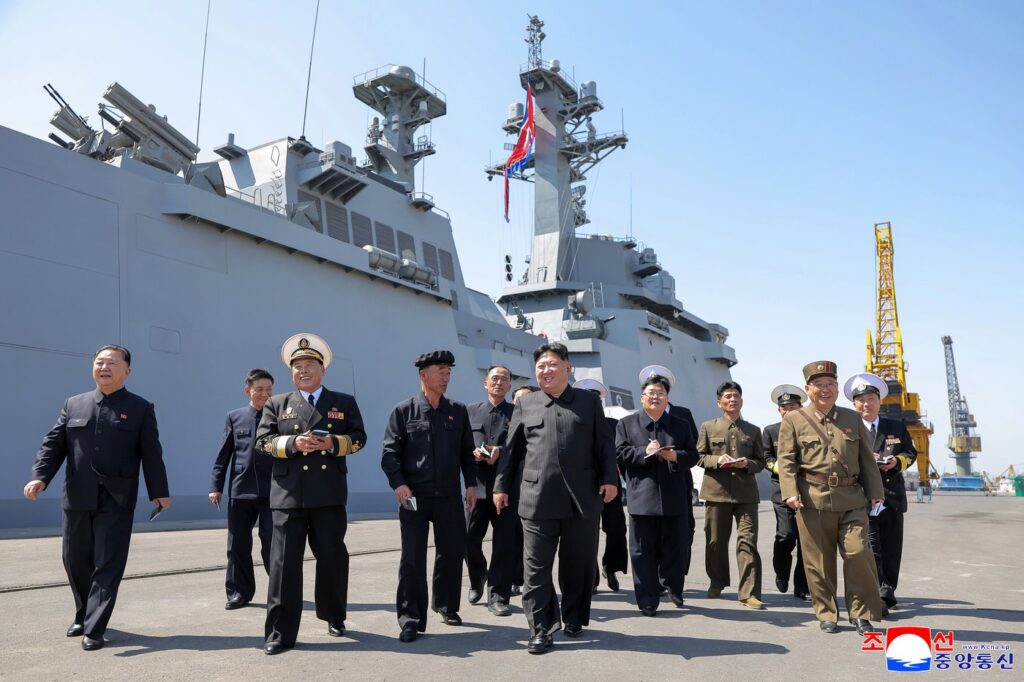
These recent missile launches are part of a series of weapons tests conducted by North Korea this year. Just last week, North Korea reported that leader Kim Jong Un oversaw missile tests conducted from a destroyer. The week before, North Korean officials announced three days of testing activities centered on ballistic missiles equipped with cluster-bomb warheads and explored various new weapon systems. Furthermore, last month, North Korea claimed to have tested an upgraded solid-fuel engine for missiles that could reach the U.S. mainland.
Since the collapse of high-stakes nuclear diplomacy between Kim Jong Un and former U.S. President Donald Trump in 2019, Kim has prioritized the enhancement of his nuclear and missile arsenals. Trump has expressed a desire to restore diplomatic relations with Kim, who has indicated a willingness for dialogue, albeit insisting that Washington should abandon its demands for North Korea's nuclear disarmament as a precondition for talks.
Trump is scheduled to travel to Beijing for a rescheduled summit with Xi Jinping in May, and analysts suggest that North Korea’s recent tests may be aimed at boosting its bargaining power in potential future negotiations with the U.S. in light of this diplomatic engagement.
On Wednesday, International Atomic Energy Agency Director General Rafael Grossi confirmed a "rapid increase" in activities at North Korea's nuclear manufacturing facilities, indicating a significant uptick in the country’s nuclear weapons production capabilities. Grossi's remarks resonated with the observations of various international analysts, who noted that North Korea appears to be expanding its primary Yongbyon nuclear complex and establishing new uranium enrichment sites in recent years. Last September, South Korea’s Unification Minister Chung Dong-young disclosed that North Korea is operating four uranium enrichment facilities, all of which are believed to be functioning on a daily basis.








