

SEOUL, South Korea (AP) — North Korea launched multiple short-range ballistic missiles toward the sea on Sunday, as reported by its neighbors. This escalation occurred just days after the United Nations' nuclear watchdog issued a warning regarding North Korea's "very serious" advancements in its nuclear weapons program.
The missiles, reportedly fired from the Sinpo area of North Korea, traveled approximately 140 kilometers (87 miles) towards the eastern waters, according to South Korea's Joint Chiefs of Staff. In response to the missile tests, South Korea asserted its readiness to counter any provocations from the North and emphasized its ongoing communication and coordination with the U.S. and Japan.
An emergency meeting of the National Security Council was convened, during which senior South Korean officials voiced their concerns over North Korea's continuous ballistic missile tests and urged the North to cease such activities immediately. These missile launches occurred shortly before South Korean President Lee Jae Myung embarked on an official visit to India and Vietnam.
Military authorities from the U.S. and Japan confirmed their detection of the missile launches. The U.S. Indo-Pacific Command reiterated its commitment to defend the U.S. homeland and its allies in the region. Meanwhile, Japan's Defense Ministry lodged a strong protest against Pyongyang, highlighting the launches as a threat to regional and international peace and a violation of U.N. Security Council resolutions prohibiting ballistic activities by North Korea.
Sinpo, the launch site, is a significant coastal city in North Korea known for its shipyard, which is primarily utilized for constructing submarines. South Korean military officials are currently analyzing whether the missiles were launched from a submarine, a land-based launcher, or both. Japan's Deputy Minister of Defense, Masahisa Miyazaki, confirmed that Japan is coordinating with the U.S. and South Korea to analyze the details of the launches.
If the launches were indeed submarine-based, it would mark North Korea's first submarine-launched ballistic missile test in four years. Such an advancement in North Korea's capabilities would be particularly concerning, as underwater missile launches are harder to detect, posing a greater challenge to regional security. In the previous year, North Korea showcased a nuclear-powered submarine under construction for the first time.
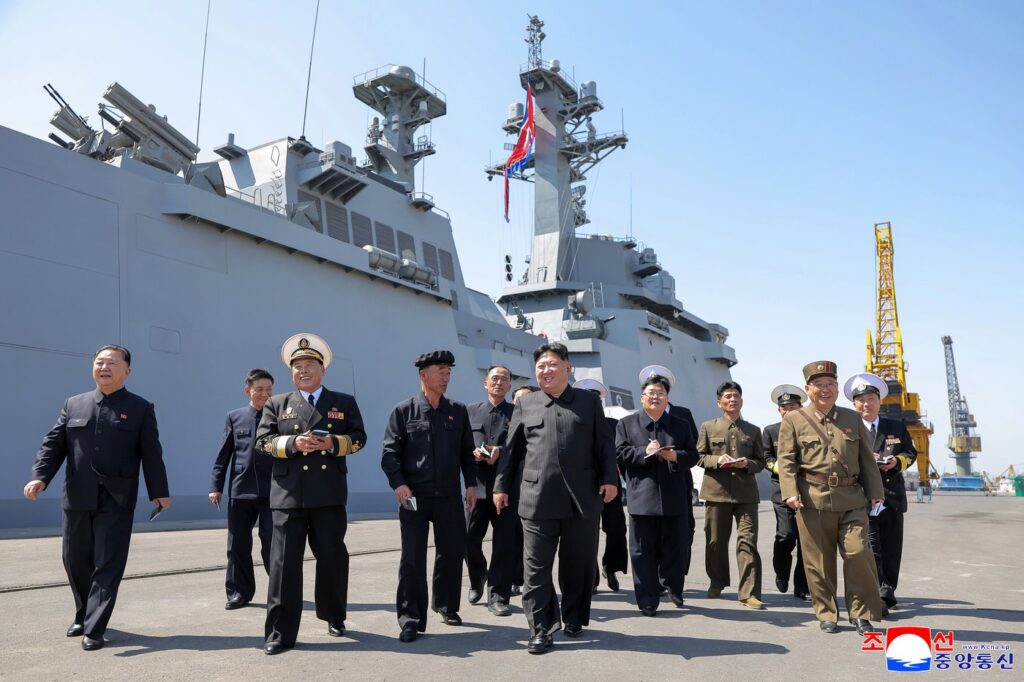
These recent missile launches are part of a broader series of weapon tests conducted by North Korea throughout the year. Just last week, it was reported that North Korean leader Kim Jong Un personally supervised missile tests from a destroyer. Furthermore, North Korea had previously conducted a three-day testing regimen examining ballistic missiles equipped with cluster-bomb warheads and other new weapon systems. In another instance, it announced the testing of an upgraded solid-fuel engine capable of reaching the U.S. mainland.
Since the collapse of high-stakes nuclear diplomacy with former U.S. President Donald Trump in 2019, Kim Jong Un has focused on expanding North Korea's nuclear arsenal and missile capabilities. Trump has expressed interest in re-establishing diplomatic discussions with Kim, who has recently indicated a willingness to negotiate but demands the U.S. drop its conditions for North Korea’s nuclear disarmament.
Additionally, IAEA Director General Rafael Grossi recently reported a "rapid increase" in activities at North Korea's nuclear manufacturing facilities, which points to a significant escalation in its nuclear weapons production capabilities. Observers note that North Korea has taken steps to expand its primary nuclear complex in Yongbyon and build additional uranium-enrichment sites in recent years. South Korea's Unification Minister, Chung Dong-young, previously noted that North Korea operates four uranium enrichment facilities that run continuously.








