

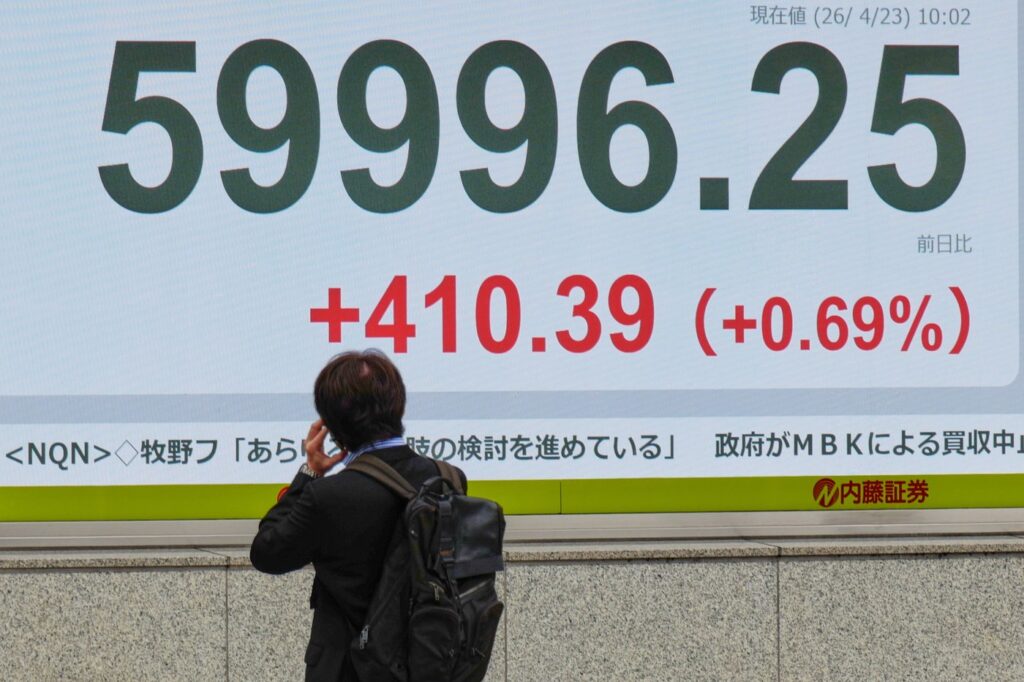
HONG KONG (AP) - Stocks in Asia experienced a retreat on Thursday after an initial surge that saw Japan's Nikkei 225 index surpass 60,000 for the first time. Concurrently, oil prices increased as investors reacted to the uncertain prospects for renewed talks aimed at ending the ongoing conflict in Iran.
U.S. futures also slipped following the previous day's record-setting performances on Wall Street, where strong corporate earnings contributed to a significant rally. The markets in Japan and South Korea had briefly reached new heights, propelled by an influx of investments into technology stocks. However, Japan's Nikkei 225 index ultimately fell 1.5% to close at 58,707.60 after peaking at 60,013.98.
In South Korea, the Kospi index dipped 0.1% to settle at 6,414.57, relinquishing earlier gains after briefly exceeding the 6,500 mark. The South Korean government reported a better-than-expected economic growth rate of 1.7% for the January-March quarter, primarily driven by robust exports of computer chips amidst the booming artificial intelligence sector.
Meanwhile, Hong Kong's Hang Seng index dropped by 1.1%, finishing at 25,865.88, while the Shanghai Composite index witnessed a decline of 0.8% to 4,073.71. Australia’s S&P/ASX 200 also fell by 0.8%, closing at 8,770.70. Additionally, Taiwan's Taiex experienced a sharp decline of 1.6%, and India's Sensex lost 0.6% of its value.
Investor sentiment has been increasingly weighed down by growing uncertainty surrounding the prospects for ending the Iran war, which has now entered its eighth week. This sentiment prevails even after U.S. President Donald Trump extended a ceasefire. The potential for renewed peace talks remains unclear. Tensions escalated when Iran recently fired on three ships in the Strait of Hormuz in retaliation to a U.S. blockade on Iranian ports.
With maritime traffic through the Strait of Hormuz—critical for global oil transport—effectively halted, the outlook for its reopening has dimmed substantially following the seizing of two out of three ships by Iran's Revolutionary Guard. This ongoing conflict has led to a significant surge in global energy prices, with Brent crude, the international benchmark, increasing by 1.5% to reach $103.39 per barrel, a stark rise from approximately $70 per barrel prior to the war's onset.
In parallel, benchmark U.S. crude prices rose by 1.8% to $94.66 per barrel. As the hope for a resolution between the U.S. and Iran wanes and peace talks appear stalled, analysts suggest that the oil market must adjust its expectations accordingly. Strategists from ING Bank noted that as hopes diminish, the reality of disruptions to supply is likely to impact pricing further, leaving the market to potentially become desensitized to recent headlines and noise influencing price fluctuations.
On Wall Street, records were achieved on Wednesday, supported by a series of impressive corporate earnings reports and the extended ceasefire related to the Iranian conflict. The S&P 500 rose by 1% to 7,137.90, surpassing its previous high established on Friday. The Dow Jones Industrial Average increased by 0.7% to reach 49,490.03, while the Nasdaq composite also set a new record, climbing 1.6% to 24,657.57.
Notable performances included a 13.7% jump in shares of GE Vernova after it posted stronger-than-expected quarterly profits, benefiting from high orders related to the AI boom. Other companies also saw gains, with Boeing's shares rising by 5.5% and Philip Morris International climbing 7% following their positive earnings reports.
As trading continued on Thursday, precious metal prices saw a downturn, with gold losing 0.6% to $4,722.70 per ounce, and silver decreasing by 2.3% to $76.17 per ounce. The U.S. dollar strengthened against the Japanese yen, rising to 159.53 from 159.48, while the euro was traded at $1.1696, a slight decline from $1.1705.








