

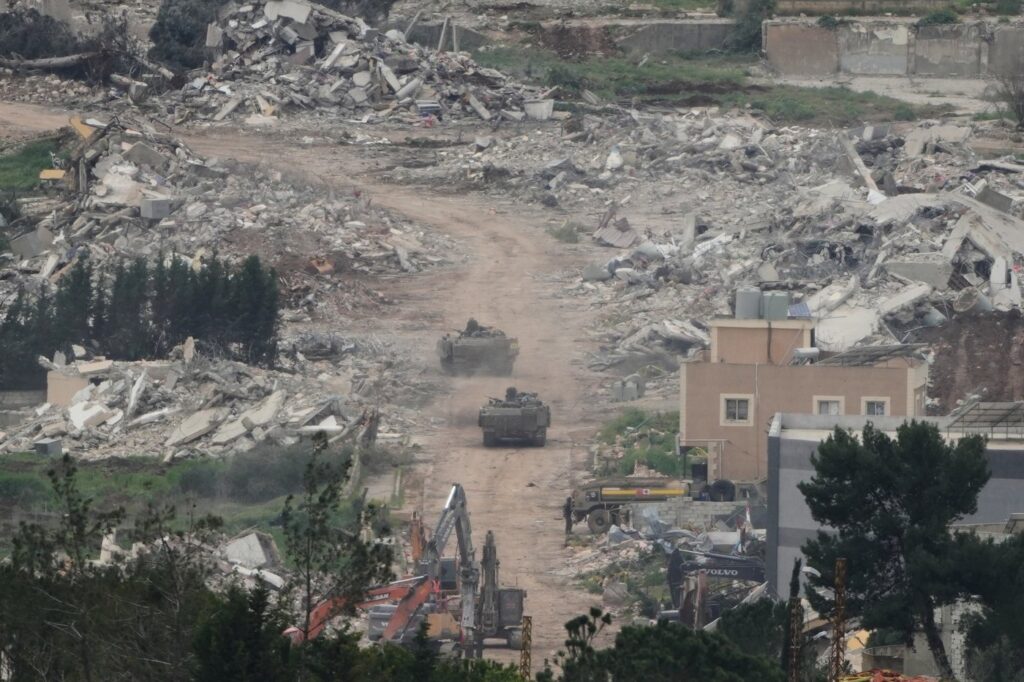
BEIRUT (AP) — In southern Lebanon, areas that have recently been occupied by the Israeli army following a ceasefire agreement with Hezbollah are witnessing extensive demolitions of homes. Israeli forces claim that these homes were utilized as outposts by the Iran-backed militant group, prompting concerns among local residents, Lebanese officials, and U.N. peacekeepers regarding the potential displacement of countless individuals if the fragile truce endures.
From a vantage point overlooking Beit Lif, approximately 4 km (2.5 mi) north of the Lebanon-Israel border, Associated Press journalists observed that the village, which previously housed a few thousand residents, has been nearly entirely laid waste. A local from a nearby village, Hassan Sweidan, remarked, “They were demolishing it gradually until they reached the main square, and now, as you can see, there are no more houses.”
Lebanese officials are expected to address this issue of widespread demolitions during discussions with Israeli representatives set for Thursday in Washington. These talks represent the first direct negotiations between the two nations in decades. However, due to security issues and restricted access, neither U.N. peacekeepers nor Lebanese officials have been able to perform detailed assessments of the affected villages, but numerous observers have reported systemic destruction of entire neighborhoods in various communities.
The ceasefire, which was established following an intense conflict that began on March 2, remains tenuous. Hezbollah's intervention included missile attacks on northern Israel, prompting a significant Israeli military response involving airstrikes and ground incursions into Lebanon. This conflict has resulted in approximately 2,300 fatalities in Lebanon, including many women and children, and has displaced hundreds of thousands from southern regions.
The ceasefire initiated on Friday has not completely halted hostilities, as both sides have executed military operations subsequent to the agreement. Hezbollah has cited Israeli demolitions as justification for its continued assaults, while Israeli officials have stated their intent to occupy parts of southern Lebanon, designating maps indicating an extensive "forward defense line" encapsulating various villages from which residents have been barred from returning.
Israeli Defense Minister Israel Katz asserted that areas now deemed secure had been “cleared of terrorists and weapons” and would continue undergoing structural devastation to eliminate what he referred to as terrorist infrastructure, emphasizing that demolitions were aimed at Hezbollah rather than civilian infrastructure.
Hassan Sweidan checked on his home in the village of Yater and found its structure intact amidst the widespread devastation in Beit Lif, which he could view from his higher ground. After the ceasefire commenced, Israeli forces returned with heavy machinery and began systematic demolitions. “We would come each day to see how much of the village was demolished,” he recounted.
U.S. peacekeeping forces in southern Lebanon, known as UNIFIL, confirmed ongoing observations of demolitions since the ceasefire took effect. Conversely, the Israeli military has maintained that their operations align with international law and are conducted only out of military necessity, excluding civilian property destruction unless required.
The demolitions come in the wake of previous conflicts, with many areas remaining in ruin following the 2024 Israel-Hezbollah war. Limited reconstruction has occurred since that time, and reports have emerged of Israeli bulldozers leveling neighborhoods, roads, and essential infrastructure in towns like Khiam, which was heavily impacted in past confrontations.
In response to these escalated tensions, Hezbollah announced drone and rocket attacks, framing them as a reprisal for Israeli actions against civilians and the devastation of their homes. As Lebanese leaders work to maintain the ceasefire, President Joseph Aoun emphasized the importance of halting demolitions and indicated that this topic would be part of the forthcoming negotiations in Washington, aimed toward not only extending the ceasefire but also establishing a broader framework for lasting peace between the two nations.
— Associated Press contributed to this report.








