

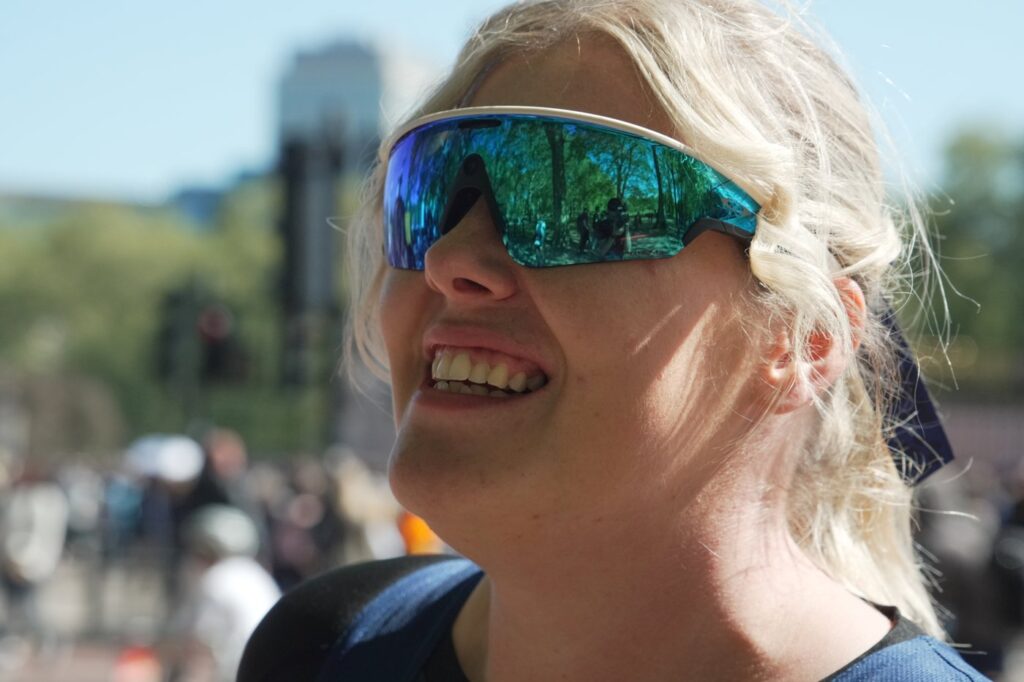
LONDON (AP) — Tilly Dowler is breaking barriers as she trains for the London Marathon, running past iconic landmarks like Buckingham Palace. Dowler, who suffers from Stargardt disease and has about 10% useful vision, only began her running journey last year. Starting with a couch to 5K program, she has steadily increased her distance and is now gearing up for the marathon with the support of her boyfriend who serves as her guide. To assist her with navigation and progress tracking, she is utilizing AI-powered Oakley Meta Vanguard smart glasses.
The glasses are designed to be AI-assisted, allowing Dowler to inquire about her surroundings while running. "I can ask for live cues, such as what landmarks are around me and how far I have run," she explained. This technology enables her to enjoy her music while also listening to her guide, enhancing her overall experience.
Dowler's mission extends beyond personal achievement; she aims to inspire individuals with sight loss and others facing difficulties in their lives, encouraging them to believe in themselves. She is part of a growing community of visually impaired runners who are leveraging AI-enabled smart glasses. These innovative devices meld conventional consumer technology with advanced features such as cameras, microphones, and open-ear speakers, allowing users to receive real-time feedback about their environment.
The most recognized smart glasses currently come from tech giant Meta, in partnership with Ray-Ban and Oakley. The popularity of these smart glasses is underscored by the sale of over 7 million pairs in the previous year. However, they have also raised significant privacy concerns, such as unauthorized filming of individuals and the potential misuse of video data by Meta for AI training.
Sha Khan is another individual who has embraced this technology following significant vision loss due to retinitis pigmentosa and Stargardt disease in 2021. He has integrated the glasses into his daily routines, relying heavily on them during training as well. "It's like literally a part of me now," Khan stated, adding that he wouldn't leave his home without his glasses. He also benefits from the assistance of his guide dog, Moby, for navigation when not running.
The hands-free capability of the glasses allows Khan to maintain focus with Moby without having to manage a smartphone. Using voice commands, he can interact with the glasses while running, capturing moments by saying commands like, "hey Meta, take a picture," when his guide runners identify landmarks. This functionality proves particularly beneficial, as Khan emphasizes that he doesn't need to fumble with a phone during his outdoor activities.
The smart glasses utilize a front-facing camera to gather visual input, which is then analyzed by artificial intelligence to provide auditory information through integrated speakers. Chris Lewis, a technology analyst and user of smart glasses while skiing, accentuated the added layer of awareness these devices bring. "The AI is taking the images coming in, analyzing it and giving you the information about what's in front of you," he explained. This real-time information is crucial for activities like running, where spatial awareness is key.
However, Lewis acknowledges potential challenges presented by events such as marathons, where large crowds could disrupt mobile networks, thereby affecting the reliability of the glasses in delivering timely information. Guide Dogs UK, an organization dedicated to assisting visually impaired individuals, highlights that such technology should complement rather than replace existing support systems. "These glasses can really support and enhance somebody's independence," explained Tommy Dean, a technology specialist at the charity, emphasizing the continued importance of guide dogs, mobility training, and human assistance, especially in complex environments.
Ben Hatton, an analyst at CCS Insight studying emerging technologies, reiterated the necessity for reliability. "If you’re going to allow visually impaired people to walk down the street or cross busy roads with the technology, then it has to be perfectly reliable every single time," he noted. Factors like accuracy, connectivity, and cost are pivotal in determining the broader adoption of this technology.
Despite such challenges, experts argue that advancements in artificial intelligence are playing an increasingly significant role in enhancing accessibility for individuals with sight impairment. "The fact that consumer technology can enhance the experience of someone with a sight problem adds to the potential to be more and more independent," Lewis remarked.
This year, the London Marathon is expected to see participation from over 59,000 runners, covering a 26.2-mile course through the capital, beginning in Greenwich and culminating near Buckingham Palace.








