

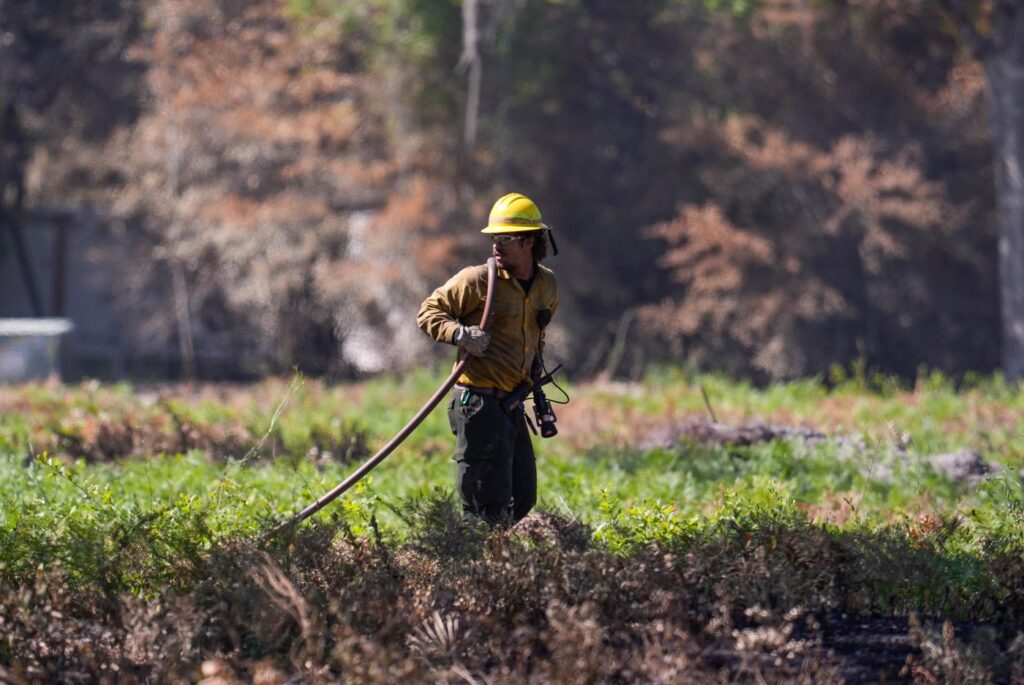
NAHUNTA, Ga. (AP) – A wildfire in Southeast Georgia is causing significant destruction, prompting local officials to issue more evacuation orders as the blaze continues to threaten a broader area. The fire, which has been active since it ignited on Monday in rural Brantley County, has already consumed over 8 square miles (20 square kilometers) of land and destroyed nearly 90 homes. This alarming situation has been exacerbated by strong winds, which have fanned the flames into the dry pine woods that have become highly susceptible to fire.
The Georgia Forestry Commission reported that as of Friday, the Brantley County fire is only 15% contained. Local authorities have been proactive in mandating evacuations in response to the fire's rapid spread, with orders being issued almost daily. Joey Cason, the county manager for Brantley County, emphasized the urgency of complying with evacuation notices in a Facebook video, noting the unpredictable nature of wildfire containment, which can quickly deteriorate.
Approximately 200 residents of Brantley County have been forced to evacuate their homes, grappling with concerns about the welfare of pets left behind and uncertainty regarding the future of their properties. Fortunately, no injuries or fatalities have been reported thus far. Firefighters are engaged in intensive efforts, utilizing bulldozers to create fire breaks and employing hoses and sprinklers to protect nearby structures from the encroaching flames.
Seth Hawkins, a spokesperson for the Georgia Forestry Commission, noted that local firefighters are actively on the ground, spraying down homes and surrounding areas to mitigate damage from the fire. Meanwhile, in a broader context, fire crews are also battling over 150 other wildfires across Georgia and Florida, contributing to hazardous air quality in several cities distant from the flames.
Scientists point to multiple factors that heighten the Eastern U.S.'s risk of severe wildfires, including the ongoing effects of climate change, a record drought, and an abundance of dead trees in Southern forests—a legacy of Hurricane Helene's impact in 2024. In addition, the Georgia Forestry Commission revealed that crews responded on Thursday to 31 new and smaller fires in the state, indicating the widespread nature of this crisis.
Rainfall is desperately needed in the region to effectively extinguish these large wildfires. The areas suffering from the two main fires in Georgia have only a 20% to 40% chance of receiving rain and potential thunderstorms over the weekend, but Hawkins cautioned that this precipitation might only slow down the fires rather than put them out entirely. Furthermore, lightning from any thunderstorms could ignite new fires, complicating firefighting efforts.
Officials assert that several inches of rain will be necessary to completely extinguish the wildfires plaguing Southeast Georgia. As the fire situation continues to evolve, local and state resources are being mobilized to safeguard communities and mitigate further damage from these destructive blazes.








