

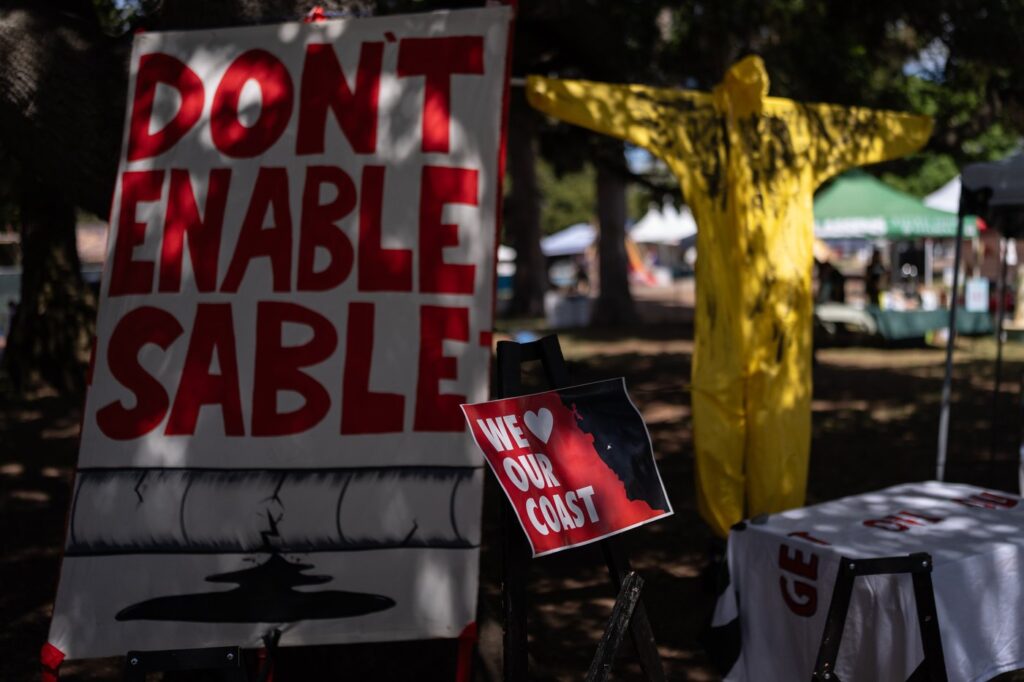
For the first time in over a decade, crude oil extracted from the depths of the Pacific Ocean is flowing through a pipeline that traverses California state park land. This development follows a controversial decision by the Trump administration to restart drilling operations off the coast of Santa Barbara, citing national security as a justification. State officials, however, have labeled this action as trespassing and are seeking a court order to halt the usage of the pipeline owned by Sable Offshore Corp., which runs for 4 miles through Gaviota State Park.
The pipeline system, owned by a Texas company, had remained inactive since a pipeline fracture in 2015 resulted in one of California's worst oil spills, affecting 150 miles of coastline from Santa Barbara to Los Angeles. The spill devastated a biodiverse habitat, harming endangered species like whales and sea turtles, and led to significant losses in the local fishing industry.
On March 13, Energy Secretary Chris Wright invoked a Cold War-era law to direct Sable to commence production, arguing that bolstering domestic oil supplies is crucial for stabilizing gas prices, particularly given the ongoing tensions related to the Iran war. Wright pointed out that over 60% of California's refined oil is imported from abroad, with a considerable portion passing through the geopolitically sensitive Strait of Hormuz.
This ongoing legal skirmish highlights the contentious tug-of-war between state powers and federal mandates, especially during wartime, as the Trump administration moves to relax regulations perceived as detrimental to its coastal drilling agenda. Prior to federal intervention, Sable had been unable to sell any oil due to legal challenges surrounding its operations, which include three offshore rigs and pipelines associated with the Las Flores Canyon Processing Facility.
Opposition to the project has been robust within Santa Barbara, particularly in light of the damaging 1969 oil spill that sparked the modern environmental movement in California. Local youth activist Ethan Maday criticized the federal government for undermining local democratic processes and the will of the community.
A state judge previously mandated that Sable halt operations until it can confirm compliance with state regulations. Additionally, the Santa Barbara District Attorney has pursued felony charges against Sable, alleging environmental violations during pipeline repairs. Sable has countered by claiming it obtained the necessary permits to operate.
According to the U.S. Energy Department, Sable's efforts could increase California's in-state oil production by roughly 15%, potentially replacing nearly 1.5 million barrels of imported crude oil each month. However, experts like Paasha Mahdavi from the University of California, Santa Barbara, argue that the crude being produced is heavy and expensive to refine, and its projected output of 50,000 barrels per day is minimal in the global context, unlikely to influence domestic gas prices.
California Attorney General Rob Bonta has initiated two lawsuits regarding the project, dismissing the federal government's claims as exaggerated and not reflective of the state's actual oil production capacity. Meanwhile, Sable's CEO Jim Flores announced that over 1 million barrels of oil had already been produced from the pipeline since its restart.
The Trump administration’s use of the Defense Production Act in this instance is unprecedented, as it intervenes in state regulatory matters. Legal experts have noted that while similar laws have been used during previous crises, this usage appears particularly aggressive against state legislation. State officials contend that permits allowing Sable to use state land expired in 2016, a claim disputed by Sable.
As the legal battle extends, the Santa Barbara County Superior Court Judge Donna Geck upheld an injunction from the previous year and ordered compliance with state regulations, even as Sable argues that federal directives take precedence. The U.S. Department of Justice has also requested modifications to a federal court decree established after the 2015 spill that mandates state authority over the operation's restart.
Despite ongoing litigation, Sable is pursuing legal action against state regulatory overreach and claims financial damages. The situation underscores growing tensions between state and federal authority, especially concerning environmental protection and energy security in a volatile geopolitical climate.








