

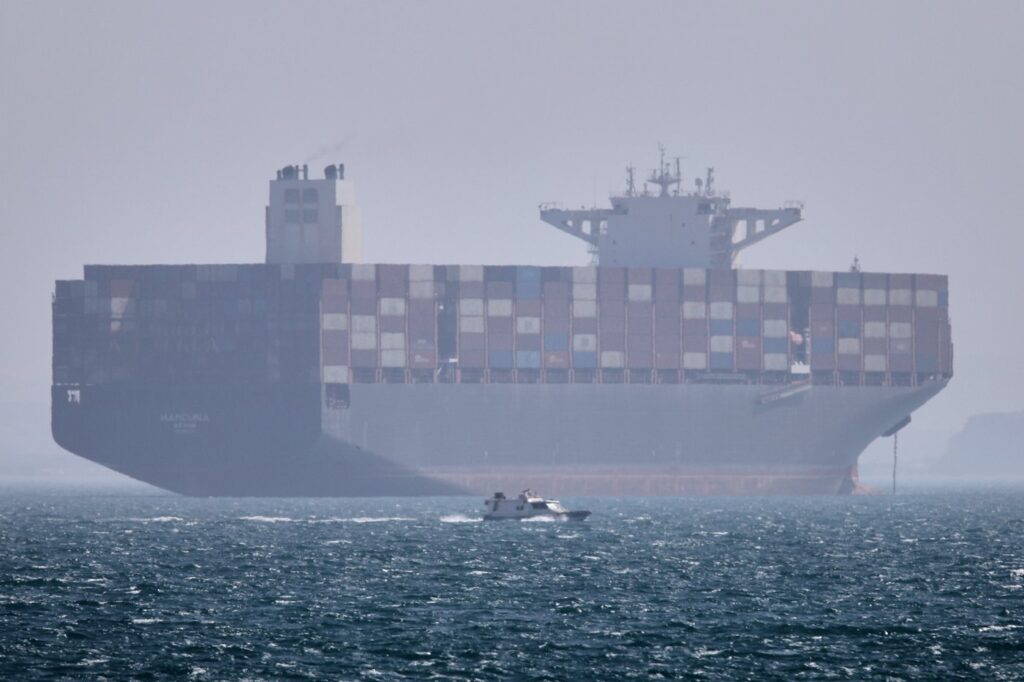
The ceasefire in the Iran war faced a critical challenge on Monday as the United States initiated efforts to open the Strait of Hormuz, aiming to allow hundreds of stranded commercial ships to depart. This maneuver came in the wake of warnings that the United Arab Emirates had been attacked for the first time since the ceasefire began in early April, alongside reports from a British military monitor indicating that two cargo vessels were in flames off the UAE coast.
Iran condemned the U.S. military-assisted initiative to guide ships through the strait, deeming it a breach of the delicate three-week-long ceasefire. Although the U.S. reported that two U.S.-flagged merchant ships successfully navigated the strait with their support, there were limited indications that other vessels felt confident to take part in “Project Freedom,” which President Donald Trump announced on Sunday. The situation has raised significant caution among shipping companies and market analysts due to the uncertainty surrounding the effort and the potential risks posed by Iranian hostilities.
The conflict has rendered hundreds of commercial ships and tens of thousands of sailors stranded in the strait, with weeks’ worth of essential goods, including oil, gas, and fertilizer, backed up. Iran’s control over this critical maritime route has been a strategic advantage in the ongoing war, affecting global economies and influencing the political landscape for Trump’s Republican party ahead of the U.S. midterm elections this year. As a result of the turmoil, oil prices surged on Monday amid persistent uncertainty surrounding the strait and the new U.S. initiative, which Trump framed as a humanitarian effort to assist nations “neutral and innocent” in the conflict.
While other nations in Europe and beyond have expressed concerns about the situation in the strait, Trump had urged them to participate in resolving the issue. Yet, there was no immediate indication of any international coalitions being formed in relation to the U.S. operation. The U.S. military’s plan included deploying guided-missile destroyers, over 100 aircraft, and approximately 15,000 service members, though details regarding their specific deployment remained vague.
In a stern warning, Trump stated that any interference with the U.S. efforts would be met with a forceful response. The U.S. military claimed to have sunk six small Iranian boats that were targeting civilian vessels and reported incidents of missile and drone attacks from Iran against ships under U.S. protection.
In response to the escalating tensions, Iran reaffirmed its stance by declaring that shipping must coordinate with Tehran for safe passage through the strait and warned that any foreign military force, particularly the U.S., attempting to enter the Strait of Hormuz would face military action. Iran's state-run IRNA news agency described Trump’s plan as a reflection of his “delirium.” The Iranian media further claimed that a U.S. vessel was struck southeast of the strait, alleging violations of maritime security norms, which the U.S. military denied.
Shipping security experts indicated that the threat level in the strait remains critical, despite a new advisory issued by the U.S.-led Joint Maritime Information Center regarding the American initiative. Jakob Larsen, chief safety and security officer at the Baltic and International Maritime Council, pointed out the lack of formal communication regarding the initiative and noted that without Iran's consent for safe passage, the threat to commercial shipping could not be adequately assessed or diminished. He also raised doubts about the sustainability of the American operation, citing a potential risk of renewed hostilities if the initiative proceeds.
The Joint Maritime Information Center recommended that vessels navigate through Omani waters as the U.S. establishes enhanced security measures, cautioning that traditional shipping routes are considered highly dangerous due to unassessed mines in the waterway. Mariners were advised to coordinate closely with Omani authorities, especially anticipating increased traffic volume in the area.








