

The Venice Biennale contemporary art exhibition opened on a notably contentious note, reflecting existing geopolitical tensions. The event is characterized as the most chaotic and contested in recent memory, especially due to the absence of Golden Lions awards after the jury resigned in protest of Israel's and Russia's participation, coinciding with significant protests occurring at their respective pavilions.
The jury's decision to resign was informed by the countries under investigation by the International Criminal Court for human rights abuses. However, some critics argue that the United States should also be included in this scrutiny. British artist Anish Kapoor highlighted the ongoing “politics of hate and war” prevalent in today's world.
Visitors to the exhibition venues at Giardini and Arsenale will actively participate in voting for the best national pavilion among 100 international entries and for the top entry in the main curated exhibition, “In Minor Keys.” The winners of these votes will be announced on closing day, November 22.
One of the exhibition's highlights is Koyo Kouoh’s 'In Minor Keys', which features a striking red feathered sculpture adorned with beaded embroidery, reflecting the cultural practices of New Orleans' Black Masking tradition, rooted in African heritage. Kouoh, the first African woman to curate the main exhibition, sought to showcase the talents of marginalized artists posthumously, as five co-curators continue her legacy after her passing a year prior.
British artist Lubaina Himid, a Turner Prize winner, examines the notion of belonging in her exhibition titled “Predicting History: Testing Translation” at the British Pavilion. She presents vividly colored paintings portraying couples who face the dilemmas encountered by newcomers attempting to establish their homes in an unfamiliar environment.
The Vatican's contribution focuses on offering spiritual solace amid global unrest through the “Mystic Gardens” of the Discalced Carmelite order near Venice's main train station. Visitors can traverse a serene landscape, listening to music by St. Hildegard of Bingen, a 12th-century mystic and composer, reinterpreted by contemporary artists like Brian Eno and Patti Smith. This experience aims to encourage self-reflection and understanding.
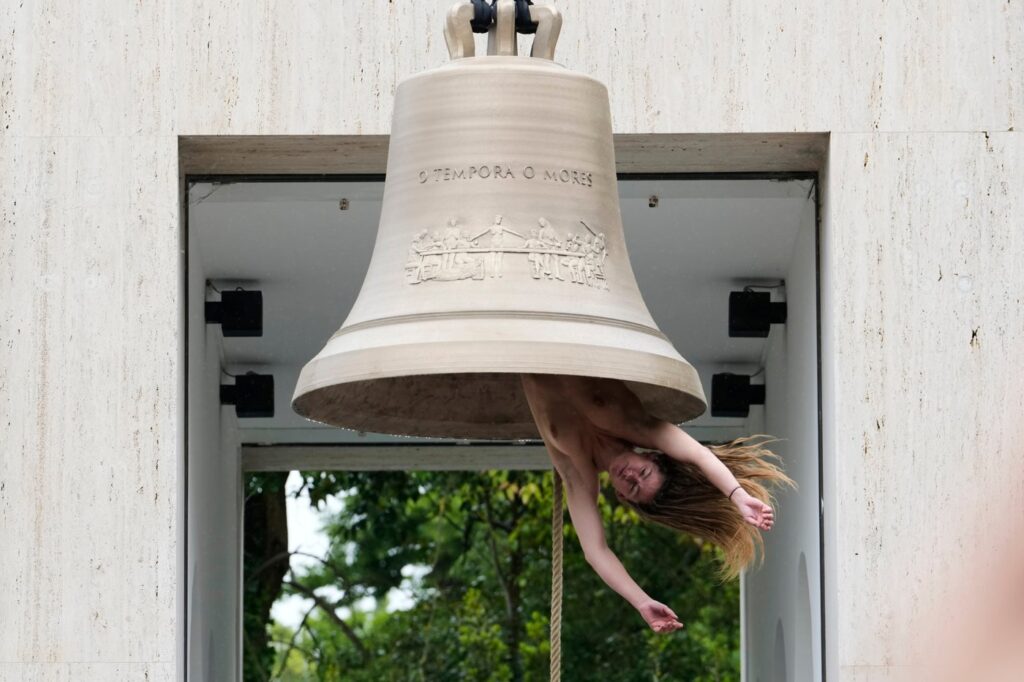
At the Austrian Pavilion, the provocative performance art by Florentina Holzinger features a naked woman functioning as a clapper hanging from a bell. Inside the pavilion, a nude figure rides a Jet Ski within a tank, symbolizing the commodification of Venice as a heavily touristic destination. Another installation, titled “Seaworld Venice,” utilizes water treated from nearby toilets to explore human existence and environmental degradation.
Romanian-born artist Belu-Simion Fainaru’s installation within the Israeli pavilion addresses themes of love and conflict through a conceptual artwork. Water drips through suspended tubes into a pool, pausing in cycles for 42 seconds—a representation of divine creative energy in Jewish mysticism. Locks tagged with the phrase “Love thy neighbor as thyself” and the optimist saying “This too shall pass” symbolize hope amidst the complexities of societal relations.
Finally, Estonian artist Merike Estna is engaged in a unique project throughout the Biennale at a gymnasium-turned-community center. She is creating a massive wall painting, which emphasizes the often-overlooked daily artistic endeavors associated with women's labor and contributes to a broader conversation about everyday feminism and environmental sustainability.








