

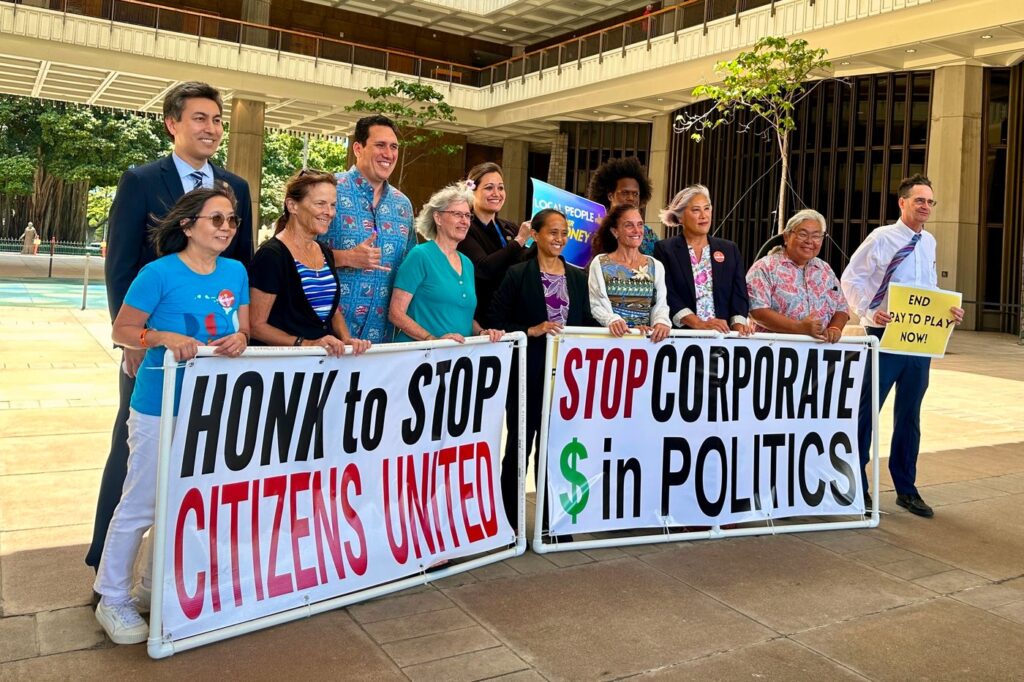
HONOLULU (AP) — Two states are exploring innovative methods to curb the impact of corporations and elusive “dark money” groups that have been able to spend limitless amounts on political endeavors since the landmark 2010 Supreme Court decision in Citizens United v. Federal Election Commission.
On Friday, Hawaii lawmakers forwarded a bill to the governor that would reclassify corporations in a manner that would prohibit any election spending. Meanwhile, a volunteer group in Montana is collecting signatures to bring a similar measure to voters in November.
Supporters of these initiatives argue that the public harbors a strong aversion to corporate influence and dark money in elections, thus underscoring the need for such legislative actions. Conversely, opponents contend that states cannot enact laws that seek to circumvent Supreme Court rulings with which they disagree.
At least 14 other states have introduced similar legislation besides Hawaii, but thus far, none have gained significant traction. Political spending dynamics have transformed dramatically since the Citizens United decision.
The case began when Citizens United, a conservative organization, sought to broadcast commercials promoting its anti-Hillary Clinton film during her 2008 presidential campaign. The Supreme Court ruling in 2010 effectively dismantled restrictions on corporate and union election donations, as long as explicit contributions to campaigns were avoided. This ruling has had ramifications for both Democratic and Republican candidates, with the watchdog organization OpenSecrets tracking over $4 billion in outside political expenditures during the 2024 federal elections—nearly twelve times the amount seen in 2008.
A substantial portion of this spending has emanated from dark money groups that are not obligated to reveal their donors. The Brennan Center for Justice estimated that dark money spending reached a record $1.9 billion in 2024, impacting various state-level races as well.
Justin Levitt, a professor at Loyola Law School specializing in campaign finance law, remarked that prohibiting corporate political spending might not dramatically alter the landscape of political finance, pointing out that affluent individuals, such as Elon Musk, spend significantly more.
One proposal voiced by advocates focuses on redefining corporate powers to disallow election expenditures while maintaining their ability to lobby legislators. Tom Moore, a former Federal Elections Commission lawyer and current senior fellow at the Center for American Progress, argues that this approach could effectively counter the impacts of Citizens United. Moore indicated that if even one state adopts this model, it could face legal challenges, paving the way for potential court reviews.
In Hawaii, Governor Josh Green, a Democrat, has not yet disclosed his intent regarding this bill, but he must indicate by June 30 whether he plans to veto it. State Senator Karl Rhoads, also a Democrat and the bill’s proponent, expressed optimism that Hawaii could make significant national waves through this legislation.
However, the state’s Attorney General, Anne Lopez, who is a Democrat, opposed the bill, suggesting implementing it could be challenging and financially burdensome in a courtroom setting.
Meanwhile, in Montana, volunteers are actively pursuing signatures to propose the corporate redefinition initiative, dubbed "The Montana Plan," for public voting in November. In April, Montana’s Supreme Court ruled that the initiative could proceed, despite Republican Attorney General Austin Knudsen's assertion that it violated the single-subject requirement for ballot initiatives.
Jeff Mangan, a former Montana state commissioner of political practices leading the ballot initiative, noted that the concept resonates well with citizens who experience its impacts firsthand.
Nevertheless, Bradley Smith, a former Republican member of the Federal Election Commission, expressed skepticism regarding the legality of Moore’s proposal, suggesting that supporters may be underestimating the ramifications of a Supreme Court ruling through semantic approaches. He indicated that lower courts are unlikely to uphold any law designed to bypass a Supreme Court ruling and may reject provisions linking government services to the behaviors of recipients. If enacted, Smith cautioned that corporations may opt to withdraw from states rather than restrict political contributions.
Levitt concluded that while the path forward remains unclear, the final determinations would ultimately rest in the hands of the judiciary. "If it gathers sufficient signatures, passes in Montana, and is upheld in the courts, the Supreme Court will likely want to weigh in," he remarked, underscoring the complex journey ahead for these legislative efforts.








