

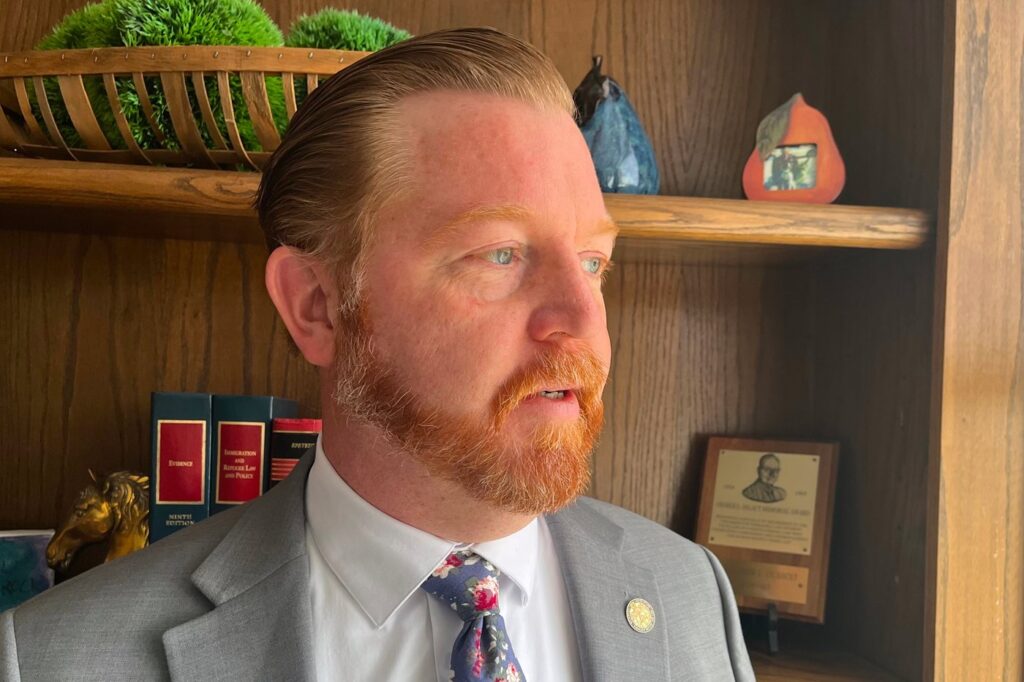
OMAHA, Neb. (AP) — The Nebraska 2nd Congressional District, often referred to as a "blue dot" amid the state's predominantly Republican landscape, is poised for significant attention as Democratic voters prepare to select their congressional nominee in an important primary election. This seat is especially coveted by the Democratic Party during the midterm elections, as it has historically favored Democratic presidential candidates, having voted for them three times out of the last five elections since 2008.
With U.S. Rep. Don Bacon retiring, the Omaha-area district has attracted a competitive field, featuring three prominent Democratic candidates: state Sen. John Cavanaugh, political activist Denise Powell, and district court clerk Crystal Rhoades. Notably, Republican Brinker Harding, an Omaha City Council member endorsed by former President Donald Trump, is running unopposed in the Republican primary.
Cavanaugh has found himself at the center of controversy, facing criticism from both Democratic and Republican factions. Opponents within his party argue that a victory for Cavanaugh could jeopardize the district's Democratic leanings. They posit that if he leaves his legislative seat to go to Congress, Nebraska's Republican governor would appoint a successor, likely a conservative, further empowering a Republican-led state legislature to enact controversial laws, including stricter abortion limitations and potential changes to the state's unique electoral vote-splitting system.
Critics argue that the electoral landscape for Democrats could be at risk if Cavanaugh wins the primary, suggesting that it would facilitate Republican efforts to alter existing electoral rules. Super PACs, including New Democrat Majority, have run ads warning voters of this potential loss, while EMILY's List has supported Powell, depicting Cavanaugh's run as a "gift to MAGA Republicans."
Republican groups have also targeted Cavanaugh with misleading claims about his alignment with Trump, suggesting he is publicly in agreement with the former president to undermine his candidacy. Cavanaugh himself asserts that such attacks are a sign that he poses the strongest threat to the Republican candidate in the general election.
The primary contest has grown increasingly contentious, with spending surpassing $2.6 million on advertising, predominantly by or in support of Cavanaugh and Powell. Cavanaugh has utilized roughly $375,000, while Powell has spent $345,000 with considerable backing from associated groups. Powell, who has notable political activism experience, believes her support from independents will help her gain traction among the electorate.
Rhoades has adopted a different approach, emphasizing direct voter engagement through door-to-door campaigning rather than relying heavily on advertisements. All candidates have rallied around common themes such as affordability and opposition to contentious Trump administration policies, though the race has become focused on concerns about Cavanaugh's candidacy and its implications for the Democratic presence in the district.
The winner of the Democratic primary will face a challenging general election. The district, which Trump won in 2016, has been held by Bacon for five terms, underscoring its competitive nature. Additionally, several other key races are set for the same day, including the Republican primary for the U.S. Senate where incumbent Pete Ricketts is seeking a full term and a crowded gubernatorial primary featuring incumbent Republican Gov. Jim Pillen.
As the elections approach, the stakes are undeniably high for both parties, particularly in a district that has proven pivotal in national elections every four years due to its ability to split electoral votes. The dynamics of this primary could drastically shape the electoral landscape in Nebraska and influence broader political narratives as the midterm season unfolds.








